
New York, July 13, 2026, 16:26 (EDT)
AI stocks ended Monday in the red, though losses varied across the sector. A group of three memory and storage plays tied to AI dropped 7.2%, nearly double the 3.7% loss for a set of four compute and foundry names. The split points to investors shortening their view on how long shortage-fueled gains can last, despite healthy order books and continued spend on infrastructure.
The comparison assigns equal weight to every company. It’s meant to track how the session moved internally, not as something to invest in.
| Monday exposure | Constituents and close-to-close move | Equal-weighted move |
|---|---|---|
| Memory and storage | SanDisk NASDAQ:SNDK fell 12.7%. Micron Technology NASDAQ:MU off 4.3%. Western Digital NASDAQ:WDC down 4.7%. | -7.2% |
| Core compute and foundry | Nvidia NASDAQ:NVDA lost 3.5%. Advanced Micro Devices NASDAQ:AMD dropped 4.2%. Broadcom NASDAQ:AVGO slipped 4.1%. Taiwan Semiconductor Manufacturing Co. NYSE:TSM dropped 2.9%. | -3.7% |
| Semiconductor benchmark | iShares Semiconductor ETF NASDAQ:SOXX | -4.9% |
High-bandwidth memory, or HBM, was the clear pressure point. SK Hynix NASDAQ:SKHY took 58% of HBM revenue in Q1. Micron and Samsung Electronics KRX:005930 each had 21%. SK Hynix shares in Seoul dropped 15.4%. Even after that, its U.S. ADRs still traded 25.6% above the Korean shares. Morningstar analyst Jing Jie Yu said “fresh capacity in 2027 and 2028 … will improve supply dynamics, thereby leading to price erosion.” Reuters
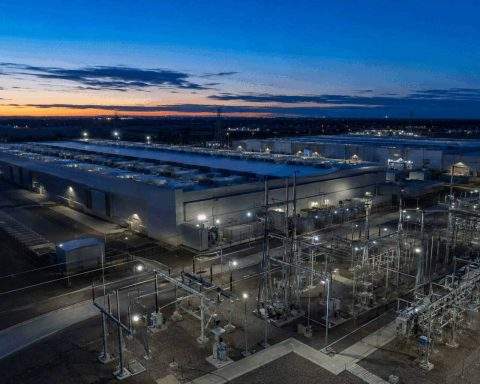
Fresh demand data pushed back on talk of an AI order slump. TSMC reported June revenue up 67.9% year-on-year to NT$442.68 billion and said second-quarter sales jumped 36%, hitting a record NT$1.27 trillion. Meta Platforms NASDAQ:META grew its Louisiana Hyperion data-center plan to 5 gigawatts, up from 2 gigawatts, and lifted projected spending to more than $50 billion. One gigawatt is one billion watts. Shares of Meta slipped 1.9%.
| Company | New operating signal | Monday reaction |
|---|---|---|
| TSMC | June revenue up 67.9% from last year, hit a new Q2 high | -2.9% |
| Meta Platforms | Hyperion now at 5 gigawatts, investment exceeds $50 billion | -1.9% |
| SK Hynix | HBM now 58% of revenue; U.S. listing still trades well over Korea | Seoul shares down 15.4% |
The breakup shows investors are thinking about how long profits will last. TSMC, as a foundry, makes chips for different companies and gets paid by many types of buyers. Memory and storage makers’ profits rise more when supplies are tight and parts get pricier. Traders on Monday sold shares in the firms that need scarcity to keep lifting earnings through 2027 and 2028.
Positioning set up the reversal, with funds tracking U.S. semiconductor stocks posting about $11 billion in outflows for the week ended June 24. That’s the biggest weekly outflow this century, after the group took in around $12 billion over the previous two weeks. Short interest, or the amount of stock borrowed and sold by bears, is at its highest in three years. The Philadelphia semiconductor index is still up 83% on the year, even after dropping more than 11% since its June peak. “We’ve never seen this kind of extreme earnings growth. But the question then becomes, how long can we expect this to continue,” said Steve Sosnick, strategist at Interactive Brokers. Reuters
The wider shock pushed up the cost to finance long-term AI projects. Crude oil finished up 9.4%. Markets priced in at least one more quarter-point U.S. rate hike by year-end. A basis point equals one-hundredth of a percentage point. Oracle NYSE:ORCL dropped 6.3%, and Intel NASDAQ:INTC fell 6.1%. Ross Mayfield, strategist at Baird, questioned “the deluge of corporate issuance to fund this AI capex.” Capital expenditure, or capex, covers spending on long-lived assets like chip plants and data centers. Reuters
The scarcity trade could bounce back fast if supply stays tight. SK Hynix CEO Kwak Noh-jung said, “We forecast that next year will be the worst year in the industry’s history from the supply perspective.” The other risk is that new plants start making chips in 2027 and 2028, just as higher power and borrowing costs slow customer rollouts, pushing memory prices down before more sales can make up for it. Reuters
First up this week, the U.S. consumer-price numbers land Tuesday at 08:30 EDT. Federal Reserve Chair Kevin Warsh is set to go before the Senate Banking Committee Wednesday. TSMC delivers full Q2 results on Thursday. If inflation runs hot or if TSMC signals caution, Monday’s repricing gets support. But if margins are strong and their demand outlook improves, investors look like they got ahead of the news.
Related articles: NASDAQ:META