Pfizer (NYSE:PFE) Shares Gain Pre-Earnings as 7% Dividend Undergoes Cash-Flow Scrutiny

Pfizer (NYSE:PFE) Shares Gain Pre-Earnings as 7% Dividend Undergoes Cash-Flow Scrutiny

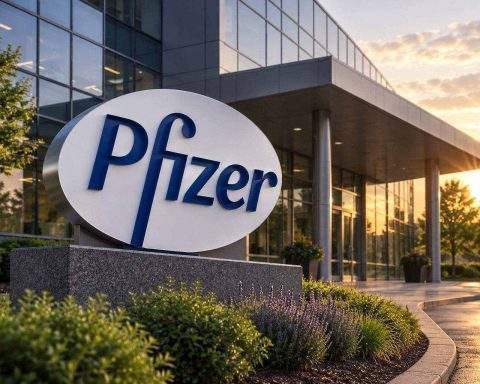
NEW YORK, July 28, 2026, 09:04 EDT — Pfizer stock advanced ahead of its earnings report, while investors watched closely to see if the company’s 7% dividend would withstand pressure on its cash flow.

  • Pfizer stock rose 0.8% to $24.87 ahead of Tuesday’s opening bell.
  • FactSet’s initial consensus estimates second-quarter earnings per share at $0.68, down from $0.78 a year ago.
  • The present dividend yields 6.9%, though first-quarter cash coverage was more limited.

Pfizer Inc. edged up in premarket trading in the United States, with its quarterly results set for August 4 just a week away. The gain was limited.

The Dow gained 0.51% on Monday, while Pfizer’s 0.53% climb was nearly equal. The S&P 500 edged up by only 0.02%. This indicates Pfizer has yet to achieve a rerating driven by company-specific factors.
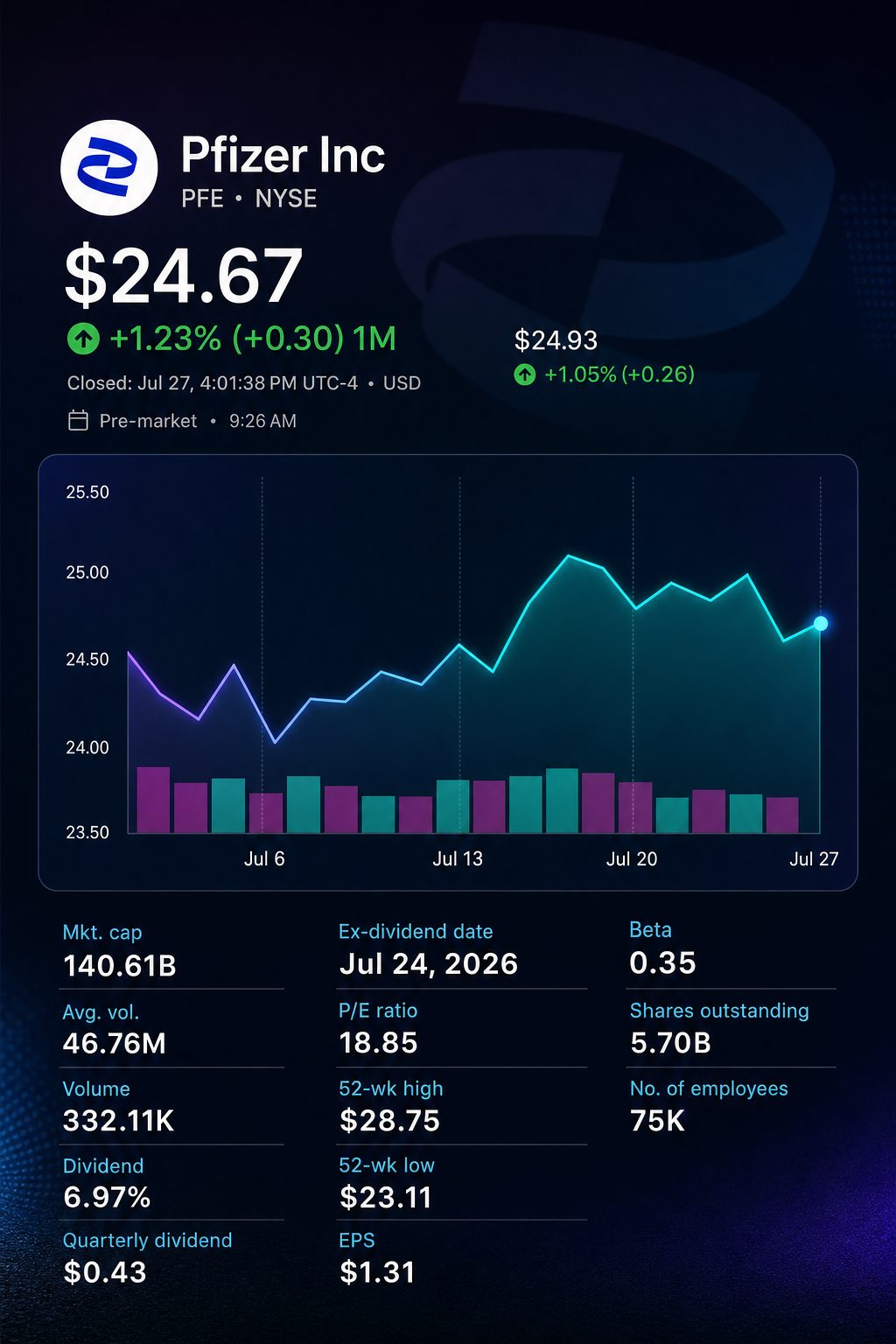
Stock chart for NYSE:PFE

For investors, cash flow is now the main benchmark rather than just surpassing earnings estimates. Pfizer is under pressure to maintain its dividend, pay down debt, and invest in new drugs.

The figures highlight that trial:

MeasureLatest figureComparison
Premarket share price$24.87, up 0.8%Monday close: $24.67
Q2 EPS, preliminary consensus$0.68$0.78 in Q2 2025; a decline of 12.8%
Full-year EPS, preliminary consensus$2.94 in 2026$2.84 in 2027; 3.4% lower
Dividend rate$1.72 annualizedImplied yield at 6.9%
Q1 cash generation$2.62 billion in operating cash flow$2.18 billion post-capex, compared with $2.45 billion paid as dividends

Based on preliminary 2026 consensus earnings, the implied payout ratio for the dividend stands at approximately 58.5%. Pfizer is trading at close to 8.5 times those projected earnings.

The price appears low. Funds are more limited.

Pfizer reported first-quarter operating cash flow of $2.62 billion. Capital expenditures totaled $436 million, resulting in a basic free-cash-flow figure of $2.18 billion. This amount covered approximately 89% of the company’s $2.45 billion cash dividend payout.

One quarter does not determine the overall outcome. Pfizer stated that shifts in operating cash flow were largely due to timing of payments and receipts. However, investors are likely to expect improved conversion in the upcoming quarters.

The earnings outlook remains narrow. Early FactSet projections indicate 2027 EPS is expected to decline 3.4% compared with 2026. The forecast for the second quarter is almost 13% less than the outcome from the same period a year earlier.

Pfizer posted a 5% increase in quarterly revenue, reaching $14.45 billion for the first quarter. Operational revenue expanded by 2%, and sales excluding COVID products advanced 7%. Newly introduced and acquired products saw operational growth of 22%.

Chief Financial Officer David Denton pointed to “solid commercial performance globally” as well as a continued “focus on operational efficiency.” Adjusted earnings per share were $0.75, marking an 18% decline compared with the previous year. Q4 Capital Management

Pfizer maintains its 2026 revenue outlook at $59.5 billion to $62.5 billion. The company’s adjusted earnings per share guidance is still $2.80 to $3.00. Pfizer says it does not plan to buy back shares in the current year.

As of March 29, gross borrowings stood at approximately $64.5 billion. Pfizer reported cash and short-term investments amounting to around $13.1 billion. The company has indicated that share repurchases might restart following additional reduction of its balance-sheet leverage.

The pipeline provides some backing. The FDA has given priority review status for broader use of Talzenna alongside Xtandi. A study involving 599 participants indicated a 52% drop in disease progression or mortality. The agency plans to make a decision in the fourth quarter.

Opinions on Wall Street are mixed. According to FactSet, analysts have an overall “Hold” consensus, with 18 hold recommendations and nine buy ratings. The mean price target stands at $28.33, representing an increase of roughly 14% compared to Tuesday’s premarket value. The Wall Street Journal

Risks persist. Pfizer projects around $5 billion in 2026 revenue from COVID-related products, alongside a $1.5 billion impact from patent expirations. Earnings recovery could be further postponed if regulatory hurdles arise or cash conversion falls short.

The August 4 test has two main challenges. Pfizer needs to uphold its 2026 guidance while also boosting its cash coverage. Simply surpassing revenue expectations might not be enough if projections for 2027 earnings continue to decline.

How is Pfizer’s stock positioned ahead of its earnings report?

Pfizer ended Monday’s trade at $24.67, up 0.53% on the day. That performance paralleled the Dow, which added 0.51%, and topped healthcare’s 0.22% advance. The Wall Street Journal Recent financial data valued Pfizer at roughly $141.4 billion. The shares have fluctuated between $23.11 and $28.745 over the past 52 weeks. At current levels, the stock changes hands at approximately 8.4 times projected 2026 earnings. The Wall Street Journal

What are the key expectations for Pfizer’s August 4 report?

Pfizer is set to report its second-quarter earnings that morning, before holding a call at 10:00 a.m. EDT. Pfizer According to FactSet, the consensus is for $14.40 billion in revenue and $0.68 in adjusted EPS. The projected revenue marks a decrease of roughly 2% from $14.65 billion. markets.businessinsider.com The profit estimate points to a decline of about 13% from $0.78 per share. Estimates from other sources are similar; Benzinga’s figure is currently $14.43 billion in revenue. The Wall Street Journal

Is Pfizer planning to increase its full-year outlook?

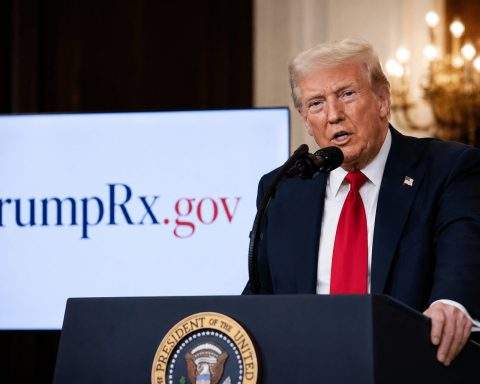
Pfizer’s revenue outlook remains at $59.5–$62.5 billion, with adjusted EPS guidance at $2.80–$3.00. FactSet’s consensus estimate for 2026 is currently around $61.78 billion in revenue and $2.94 in adjusted EPS, both above the midpoint but within the company’s forecasted range. For the first quarter, Pfizer posted $14.45 billion in revenue and $0.75 adjusted EPS. After those results, management reiterated guidance, opting not to increase it. The projections already factor in anticipated Most-Favored-Nation pricing, TrumpRx and existing tariffs. While an upward revision could still happen, it is not guaranteed. SEC

Is core growth sufficient to counteract losses from COVID and patent expirations?

First-quarter revenue rose 7% on an operational basis, excluding Comirnaty and Paxlovid. Operational revenue from newly launched and acquired products climbed 22%. Comirnaty sales dropped 59%, while global revenue from Paxlovid declined 63%. Pfizer’s forecast anticipates around $5 billion in COVID revenue for 2026. The outlook also factors in about $1.5 billion in headwinds due to loss of patent protection and exclusivity. As a result, underlying core growth is expected to account for the majority of gains. SEC

Which product’s sales are likely to draw the closest investor attention?

Eliquis logged $2.17 billion in first-quarter revenue, up 8% operationally. Padcev brought in $591 million, reflecting 39% operational growth. Vyndaqel posted $1.60 billion, with a more modest 4% operational increase. Combined worldwide sales of Nurtec and Vydura climbed 41% to $353 million. However, that figure reflected a one-off U.S. net-pricing benefit this quarter, putting its sustainability into question.

Have Pfizer’s latest oncology approvals significantly boosted its prospects?

Padcev’s expanded label in July included patients with earlier-stage bladder cancer, regardless of cisplatin status. Data backing the update showed the risk of recurrence, progression or death fell by nearly 50%, and the risk of death dropped by 35% compared to standard care. Pfizer Talzenna combined with Xtandi received FDA Priority Review after reducing the risk of progression or death by 52%. The regulator aims for a decision in the fourth quarter of 2026. The impact on near-term sales is still unclear. Pfizer

What was the impact of the sigvotatug vedotin trial’s failure?

The Phase 3 trial did not achieve its primary goal of improving overall survival. Sigvotatug did not demonstrate a statistically significant advantage over docetaxel in the overall study population. Pfizer There was a stronger trend seen in patients receiving the drug as a second-line treatment, but this finding was not definitive. Pfizer is still conducting a first-line combination trial involving pembrolizumab. Pfizer The failed result is a blow to one pipeline product and does not affect already marketed Padcev. Pfizer

What valuation should investors place on Pfizer’s obesity drug pipeline?

Berobenatide showed a 15.9% non-placebo-adjusted reduction in weight across 32 weeks of treatment. No weight loss plateau was seen during the exploratory extension stage. Pfizer Pfizer intends to conduct ten Phase 3 studies on berobenatide by 2026. The company’s wider development plan encompasses more than 20 trials targeting obesity. Headline results were not placebo-adjusted, limiting reliability in cross-trial comparisons. Pfizer

Is Pfizer’s dividend yield, close to 7%, sufficiently supported?

Pfizer will pay a $0.43 quarterly dividend, amounting to $1.72 per share on an annual basis. Pfizer With shares at $24.67, the annualized yield approaches 7.0%. markets.businessinsider.com The payout represents about 59% of the midpoint of Pfizer management’s adjusted earnings guidance. The announced distribution marks the 351st straight quarterly dividend from Pfizer. Pfizer As of March, Pfizer reported $13.08 billion in cash and short-term investments against total debt of $64.46 billion. The Wall Street Journal Dividend payments are not assured.

Is there additional risk involved with the upcoming CFO change?

Pfizer’s Dave Denton is set to depart the company on August 15 to take a job in the consumer-goods sector. Cecile Guegan will assume the role of interim CFO beginning August 16. Pfizer Guegan has spent over 20 years at Pfizer and played a key role in the integration of Seagen. Pfizer Denton is expected to lead his last results call on August 4, where investors are expected to focus on guidance, leverage and capital allocation. Pfizer

Iwona Majkowska is a financial markets journalist at TS2.tech, specializing in stocks, artificial intelligence and technology. A graduate of the Warsaw School of Economics, she previously worked in equity research and financial analysis before focusing on market reporting. Her daily coverage helps investors follow major developments across U.S. and global markets. Follow Iwona Majkowska on Google News.

Google Preferred Source

TS2 TECH • AI MODEL PORTFOLIO

Top Stock Picks Today

Five earnings-confirmed ideas for a mixed U.S. session with elevated AI-valuation risk and a Federal Reserve decision ahead.

Today’s market stance Defensive • staged buys
Portfolio type Earnings-confirmed
Initial deployment 40% of planned capital
Model horizon 6–18 months
#1 • HIGHEST RISK-REWARD 24% target weight

United Parcel Service

NYSE: UPS
BUY • STAGED
Model score 93 / 100
★★★★★

The low-margin Amazon volume reset is largely complete. A quarterly beat, higher 2026 targets and network cost leverage create today’s clearest turnaround setup without relying on crowded AI exposure.

Q2 revenue$22.83B
Adjusted EPS$1.76
2026 revenue guideAbout $91.2B
Action today

Open 40% of the target position. Add after the July 29 Fed decision or on a controlled pullback.

Next catalyst

U.S. Domestic margin recovery and delivery of the 2026 cost-savings plan.

Main risk: Fuel costs, consumer weakness and restructuring execution.
#2 • PRICING POWER 22% target weight

Sherwin-Williams

NYSE: SHW
BUY ON PULLBACK
Model score 91 / 100
★★★★★

A clean sales and earnings beat, raised guidance and resilient price/mix show that Sherwin-Williams is gaining share despite uneven construction and housing demand.

Q2 sales$6.79B • +7.5%
Adjusted EPS$3.70
2026 adjusted EPS$11.80–$12.20
Action today

Do not chase the result-day gap. Build in two tranches after a pullback or a two-to-three-day base.

Next catalyst

Delivery against raised guidance and further price/mix gains.

Main risk: Housing weakness, raw-material inflation and a post-earnings reversal.
#3 • DEFENSIVE GROWTH 20% target weight

Unilever

LON: ULVR • NYSE: UL
BUY ON WEAKNESS
Model score 90 / 100
★★★★★

Unilever delivered its strongest quarterly volume growth in more than a decade and lifted its outlook. The shares add defensive global growth and reduce dependence on U.S. mega-cap technology.

Q2 underlying sales+5.8%
Q2 volume growth+5.5%
2026 sales guide+4% to +6%
Action today

Start no more than one-third after the result-day rally. Add only as the price consolidates.

Next catalyst

Evidence that volume-led growth converts into durable margin expansion.

Main risk: Currency moves, commodity inflation and portfolio-change execution.
#4 • CASH-FLOW DEFENSIVE 18% target weight

Coca-Cola

NYSE: KO
ACCUMULATE
Model score 88 / 100
★★★★☆

Broad volume growth, resilient brands and upgraded earnings guidance make Coca-Cola a high-quality stabilizer. The lower rank reflects a strong year-to-date run and a less attractive entry after today’s jump.

Q2 net revenue+7%
Unit case volume+5%
2026 comparable EPS+9% to +10%
Action today

Do not chase the breakout. Use a one-third starter or wait for a 2%–3% retracement.

Next catalyst

Sustained volume growth and execution against the upgraded 2026 outlook.

Main risk: Valuation, input-cost inflation and foreign-exchange pressure.
#5 • SELECTIVE AI EXPOSURE 16% target weight

Cadence Design Systems

NASDAQ: CDNS
STARTER ONLY
Model score 86 / 100
★★★★☆

Cadence offers direct exposure to chip-design software rather than chip manufacturing. Revenue growth, record backlog and raised guidance are strong, but valuation and sector volatility justify the smallest weight.

Q2 revenue$1.584B • +24%
Non-GAAP EPS$2.11
Backlog / 2026 growth$8.1B / about 19%
Action today

Open at most 25% of the target position. Add only after AI and semiconductor volatility stabilizes.

Next catalyst

Backlog conversion, AI-design adoption and progress toward the higher cash-flow target.

Main risk: AI valuation compression, China/export controls and chip-sector volatility.
Target portfolio structure
Consumer defensives 38%
Logistics 24%
Coatings & materials 22%
AI design software 16%
Capital deployment plan
40%
Initial positions

Deploy only the first tranche today.

30%
After the Fed

Add after the July 29 decision if the market confirms direction.

30%
Pullback reserve

Keep cash for 2%–5% retracements or failed earnings gaps.

These percentages describe planned capital deployment, not target portfolio weights.

Event-risk watch WAIT BEFORE BUYING
VisaNYSE: V

Reports after the close on July 28.

Microsoft + MetaNASDAQ: MSFT • META

Both report after the close on July 29.

Amazon + AppleNASDAQ: AMZN • AAPL

Both report after the close on July 30.

High-beta AI chipsNVDA • MU • INTC • ASML

Wait for valuation pressure and semiconductor volatility to stabilize.

Portfolio heat 5.8 / 10

Moderate risk. Favor fresh earnings revisions, defensive demand and staged entries.

Market risk check

AI-valuation concerns are pressuring technology shares, while the July 29 Fed decision can reset rates and risk appetite. Avoid full-size entries and do not chase result-day gaps.

TS2 AI MODEL PORTFOLIO 100% target allocation

Data points reviewed from company releases and current market reporting. Target weights are model allocations, not instructions to invest all capital today. Editorial content only; not personalized investment advice. Model scores are comparative signals, not guaranteed-return forecasts.

Amazon (NASDAQ:AMZN) shares decline as almost all operating cash flow goes to capex
Previous Story

Amazon Earnings Outlook: AWS Margins Under Pressure Amid $200 Billion Capex Plan

Verizon (NYSE:VZ) shares gain further, yet subscriber goals hinge on stronger second-half performance
Next Story

Verizon (NYSE:VZ) shares gain further, yet subscriber goals hinge on stronger second-half performance