Oil Slides on Strait of Hormuz Optimism; Energy Shares Show Defiance

Oil Slides on Strait of Hormuz Optimism; Energy Shares Show Defiance

NEW YORK, July 28, 2026, 09:59 EDT — U.S. cash markets have started trading.

Oil’s two-day decline has narrowed roughly 60% of the distance between Friday’s Brent finish and the scenario for full reopening presented by Goldman Sachs . However, major energy stocks have seen only minor changes. This gap stands out as the most obvious message from investors.

Brent crude hovered close to $86.65 on Tuesday, slipping 1.9%. West Texas Intermediate dropped 1.5% to reach $81.36. Both oil benchmarks looked set for a third straight day of losses.
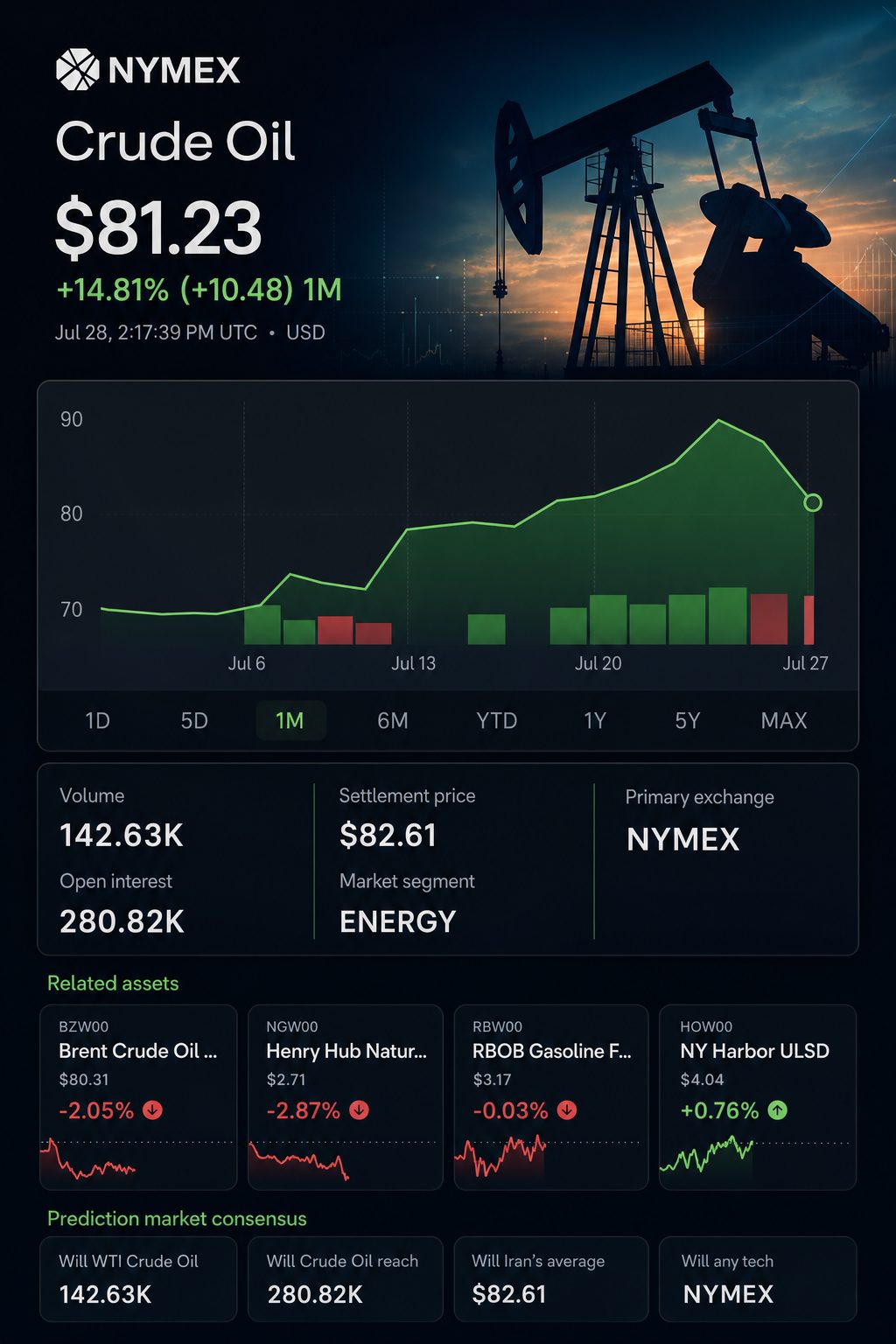
Stock chart for NYMEX:CLW00

Shares of Exxon Mobil Corp. increased 0.4% at the start of trading. Chevron Corp. advanced 0.8%. The Energy Select Sector SPDR Fund was up 0.3%.

The increases came after crude experienced only minor declines on Monday. The initial comparison takes into account both Monday’s performance and early prices on Tuesday.

AssetMonday shiftEarly TuesdayNet change since Friday
Brent crude-9.0%-1.9%-10.5%
WTI crude-7.5%-1.5%-8.9%
Exxon Mobil-1.4%+0.4%-1.0%
Chevron-2.3%+0.8%-1.5%

Crude prices, as a result, dropped between six and ten times further than the two leading companies. Equity investors seem to anticipate that earnings will stay protected. The market is not factoring in a complete cash-flow adjustment.

Brent settled at $96.78 on Friday. Goldman projects the price will fall to $80 by the end of the year, assuming full reopening of Hormuz takes place in the fourth quarter. On Tuesday, prices had reflected about 60% of that projected drop. This figure represents a price comparison, rather than any estimate of likelihood.

Physical supply has lagged behind in its recovery. Persian Gulf oil exports stayed at 41% of levels seen before the war. Red Sea deliveries dropped by over 3 million barrels per day last week.

Giovanni Staunovo at UBS Group AG noted that the market “hopes the situation improves.” Oman is in talks with Iran about establishing a Hormuz management system. The plan would feature voluntary transit fees and involvement from Gulf states. Reuters

Significant supply risk persists. Saudi Aramco closed its Jazan refinery, which processes 400,000 barrels per day, following an assault. Ship movement through the Strait of Hormuz stayed limited, though activity near Bab el-Mandeb saw a slight uptick.

Energy stocks remained resilient, offsetting declines in the technology sector. The SPDR S&P 500 ETF Trust dropped 0.3%. The Invesco QQQ Trust retreated 1.6%, and Nvidia Corp. slipped 1.3%.

Integrated producers benefit from downstream insulation. TotalEnergies SE posted a 362% increase in refining and chemicals profit, with that segment generating $1.8 billion in the second quarter. Chief Executive Patrick Pouyanne stated that sporadic access to Hormuz may represent “the new normal.” Reuters

Risks: If the ceasefire fails, oil’s war premium may quickly return. Additional Red Sea interruptions risk driving prices higher than $100. On the other hand, a sustained reopening of Hormuz would weigh on upstream profits and favour Goldman’s $80 Brent outlook.

Investors are advised to monitor tanker movements and refinery shutdowns, rather than focusing solely on diplomatic rhetoric. Energy stocks currently reflect a lull that has yet to be matched by a rebound in physical flows. Markets have yet to factor in a return to regular supply levels.

What ceasefire is currently influencing market activity?

The key market concern is the tenuous lull in fighting between the U.S. and Iran. Washington suspended its bombing campaign, which lasted 13 nights, over the weekend. Iran says it will refrain from attacks as long as the U.S. halt continues. There has been no formal agreement announced, and Tehran rejects Washington’s assertion that active negotiations are underway. Market attention remains on this pause, which does not yet amount to peace. Reuters

What is the change in oil prices following the ceasefire headlines?

Brent slipped 2.3% to $86.32 as of 12:54 GMT on Tuesday, while WTI was down 2.0% at $80.93, both marking one-week lows. On Monday, losses were sharper: Brent declined 8.7% and WTI dropped 7.5%. Brent is still trading roughly 23% above its July 2 low of $70.14. The market is factoring in short-term relief, but has yet to price in a full return of regional supply. Reuters

Why is the Strait of Hormuz considered more significant than the wording on a ceasefire?

Prior to the conflict, the Strait of Hormuz accounted for around one-fifth of global oil and LNG shipments. Kpler data shows only six vessels carrying commodities transited the strait on Monday. Vessel movement remains sharply limited along this major energy passage. Oman has suggested a regional joint management plan that includes optional user fees. As of Monday evening, Iran had yet to formally respond to the offer. Geopolitical risk premiums for crude remain significant until flows return to normal. Reuters

What factors could drive crude lower this week?

A practical Hormuz deal and ongoing ship movement are crucial. Oman’s proposal prevents Iran from having exclusive control and turns payments into an option. Bab el-Mandeb saw 28 ships pass on Monday, down from the July high of 46. A wider rebound in shipping would reduce the leftover supply premium. Goldman Sachs forecasts Brent around $80 by year-end if Hormuz reopens entirely. That outlook factors in reopening during the fourth quarter. Reuters

What factors could end the pause and push oil prices up again?

Trump stated that U.S. airstrikes may restart if talks do not succeed. Iranian officials have also vowed to retaliate under the same circumstances. Saudi Arabia’s Jazan refinery, with a capacity of 400,000 barrels per day, was shut on July 27 following an attack. The Houthis said they targeted the East-West Pipeline heading toward Yanbu. On July 23, Brent rose to $102—only five days ago. Triple-digit oil prices are, therefore, a current reality rather than a hypothetical risk. Reuters

What is causing uneven gains among U.S. stock indexes?

The Dow opened higher by 0.54% to reach 52,492.88 on Tuesday. The S&P 500 slipped, losing 0.24%, and Nasdaq decreased 0.43%. The session’s start was shaped by concerns over AI chips and elevated technology spending. A chip selloff sent global equity markets to a one-month low. Easing oil prices offered some support, but broader market risks remained. Reuters

What industries stand to gain the most if the pause remains in effect?

Airlines, travel operators, and transport firms often benefit from declining fuel costs. On Monday, the plunge in oil sent Occidental shares down 4.1% and Exxon shares lower by 1.4%. Reuters By Tuesday’s opening session, trading was mixed. Delta shares were little changed, United slipped 0.6%, and both oil majors climbed back 0.4%. While initial market moves benefited companies reliant on fuel, factors like earnings and investor positioning soon muddied the picture.

Does the ceasefire mean investors ought to exit defense stocks?

The tape currently signals no. Lockheed shares climbed 1.7% and RTX rose 1.0% in early trade Tuesday. The companies reported order backlogs totaling $230.4 billion for Lockheed and $289 billion for RTX. Lockheed’s order book expanded 38.3%, RTX’s increased 22% versus the prior year. Ongoing demand from Ukraine and Pentagon restocking both serve as distinct, significant revenue sources. Even a tentative pause does not eliminate those contracted orders. Reuters

What impact does the ceasefire have on gold and interest-rate forecasts?

Spot gold was down 1.2% at $4,026.21 as of 12:00 GMT Tuesday. The dollar held close to a four-week peak, pressuring bullion prices. Markets were factoring in a 36% probability of a 25-basis-point rate increase from the Fed on Wednesday, and saw about an 80% likelihood of a September rate hike. While falling oil may help cool inflation, energy prices are still high. As a result, gold’s performance reflects movements in rates and currencies, in addition to optimism over a possible ceasefire. Reuters

What key factors should investors monitor in the coming week?

Monitor Iran’s official reply to Oman’s Hormuz initiative. Keep tracking daily ship movements in Hormuz and Bab el-Mandeb. Reuters The Fed’s Wednesday, July 29, policy move may overshadow short-term ceasefire sentiment. Trump’s July 28 talks with Netanyahu could shift the level of military risk. Sustainable relief relies on real improvements in shipping and a stretch of strike-free days. Headlines alone will not suffice. Reuters

Leokadia Głogulska is a financial and technology journalist at TS2.tech, covering stocks, artificial intelligence, space technology and global market developments. She graduated from Wrocław University of Economics and Business and previously worked in financial analysis before moving into business journalism. Her reporting focuses on helping readers understand the market trends, companies and technologies shaping the global economy.

Google Preferred Source

TS2 Tech on Google

Follow the stories that move markets

Make TS2 Tech a preferred source or open our publication directly in Google News.

TS2 TECH • DAILY MODEL PORTFOLIO

Stocks to Buy Today

Five stocks stand out, supported by recent earnings or more attractive entry points. Today's selection highlights companies raising their outlooks and reporting firm orders, rather than focusing on heavily traded chipmakers.

Today’s market stance Selective • earnings-led
#1 • HIGHEST CONVICTION 24% weight

Xylem

NYSE: XYL
STRONG BUY
Model score 92 / 100
★★★★★

A 12-cent earnings beat and raised 2026 profit outlook highlight the results, while quarterly revenue matched expectations. The water treatment segment offers AI infrastructure exposure without increasing semiconductor holdings.

Why today

Earnings per share surpassed expectations; the company raised its guidance, citing increased water demand from data centers.

Next catalyst

Order conversions are being monitored to confirm that the new margin level is sustainable.

Main risk: Annual revenue guidance moved to about $9.2bn, and project timing can shift.
#2 • BEST CONTRARIAN 22% weight

Alphabet

NASDAQ: GOOGL
BUY ON WEAKNESS
Model score 89 / 100
★★★★½

Google Cloud's revenue surged 82%, with its operating margin hitting 35.6%. However, shares declined as capital expenditures increased. The reset offers a better entry point, but exposure remains limited since quarterly free cash flow moved into negative territory.

Why today

Cloud segment outperformed expectations; company reset guidance following earnings; search operations continue to drive strong cash flow.

Next catalyst

Cloud backlog is being converted more efficiently, leading to improved alignment between expenditures and cash flow.

Main risk: 2026 capex is now $195bn to $205bn, while depreciation is rising.
#3 • DEFENSIVE GROWTH 20% weight

Unilever

LON: ULVR • NYSE: UL
BUY ON PULLBACKS
Model score 87 / 100
★★★★☆

Underlying sales increased by 5.8%, driven by a 5.5% rise in volume—the company's strongest volume growth in over ten years. Guidance has been raised, but after today's significant share price jump, a gradual approach to buying may be more prudent.

Why today

Strong volumes drive results; outlook raised; steady cash flow in low-beta environment

Next catalyst

Second-half pricing trends and updates on the Foods transaction.

Main risk: Commodity inflation, currency moves and a large one-day gap.
#4 • EARNINGS MOMENTUM 18% weight

Sherwin-Williams

NYSE: SHW
ACCUMULATE
Model score 84 / 100
★★★★☆

Sales and adjusted earnings surpassed expectations, prompting management to raise its full-year guidance. The company is benefiting from higher prices and increased market share, but the stock's rapid three-day rally suggests investors may want to hold off on buying at the open.

Why today

The company beat expectations, raised its outlook, demonstrated strong pricing power, and continued to gain market share.

Next catalyst

The company is targeting adjusted EPS between $11.80 and $12.20.

Main risk: Weak housing demand, raw-material inflation and a richer entry.
#5 • TACTICAL UPSIDE 16% weight

PayPal

NASDAQ: PYPL
TACTICAL BUY
Model score 81 / 100
★★★★☆

Adjusted earnings surpassed expectations, prompting an increase in full-year profit guidance. The reported $60.50 per share approach offers added flexibility, though its smaller weighting signals lower margins and uncertainty regarding a potential deal.

Why today

Earnings surpass forecasts; guidance raised; strategic options under review.

Next catalyst

Focus is on the $400 million cost program, margin trends, and any official response to the deal.

Main risk: Operating margin fell to 17.4%, and no sale is assured.
Portfolio structure
Water & infrastructure 24%
Technology & cloud 22%
Consumer staples 20%
Coatings & materials 18%
Payments 16%
Build positions in two or three tranches.

Avoid buying a stock that's trading more than 5% above its previous close. Revisit the list after Wednesday's Fed decision and this week's mega-cap earnings.

Strong companies, weaker entries today
Coca-Cola NYSE: KO
WAIT FOR PULLBACK

Strong quarter with improved guidance, but a nearly 6% rally limits short-term upside.

Visa NYSE: V
WAIT FOR RESULTS

Visa is set to report earnings after the close. The portfolio won’t be taking on new event risk ahead of the results.

Nvidia NASDAQ: NVDA
WATCH

While long-term demand is solid, questions persist around chip momentum and AI financing.

Portfolio heat 6.4 / 10

Moderate. Recent earnings provide solid support, though event risk is still elevated.

Market risk check

The Nasdaq faces continued pressure as chip stocks endure a steep correction. With the Federal Reserve set to announce its decision on Wednesday, investors should brace for increased intraday volatility.

TS2 DAILY MODEL PORTFOLIO 100% allocated

This is an editorial model portfolio and does not constitute personalized investment advice. The scores reflect how today's five holdings compare to the current opportunity set, rather than predicting future returns.

Boeing (NYSE:BA) Shares Climb as Cash Flow Outlook Counters Increased Loss
Previous Story

Boeing (NYSE:BA) Shares Climb as Cash Flow Outlook Counters Increased Loss

UPS stock falls with 2026 forecast upgrade signaling lower margin
Next Story

UPS stock falls with 2026 forecast upgrade signaling lower margin