JetBlue (NASDAQ:JBLU) Shares Rise as 2028 Profit Goal Hinges on Lower Fuel Costs
28 July 2026
2 mins read

JetBlue (NASDAQ:JBLU) Shares Rise as 2028 Profit Goal Hinges on Lower Fuel Costs

NEW YORK, July 28, 2026, 15:05 EDT.

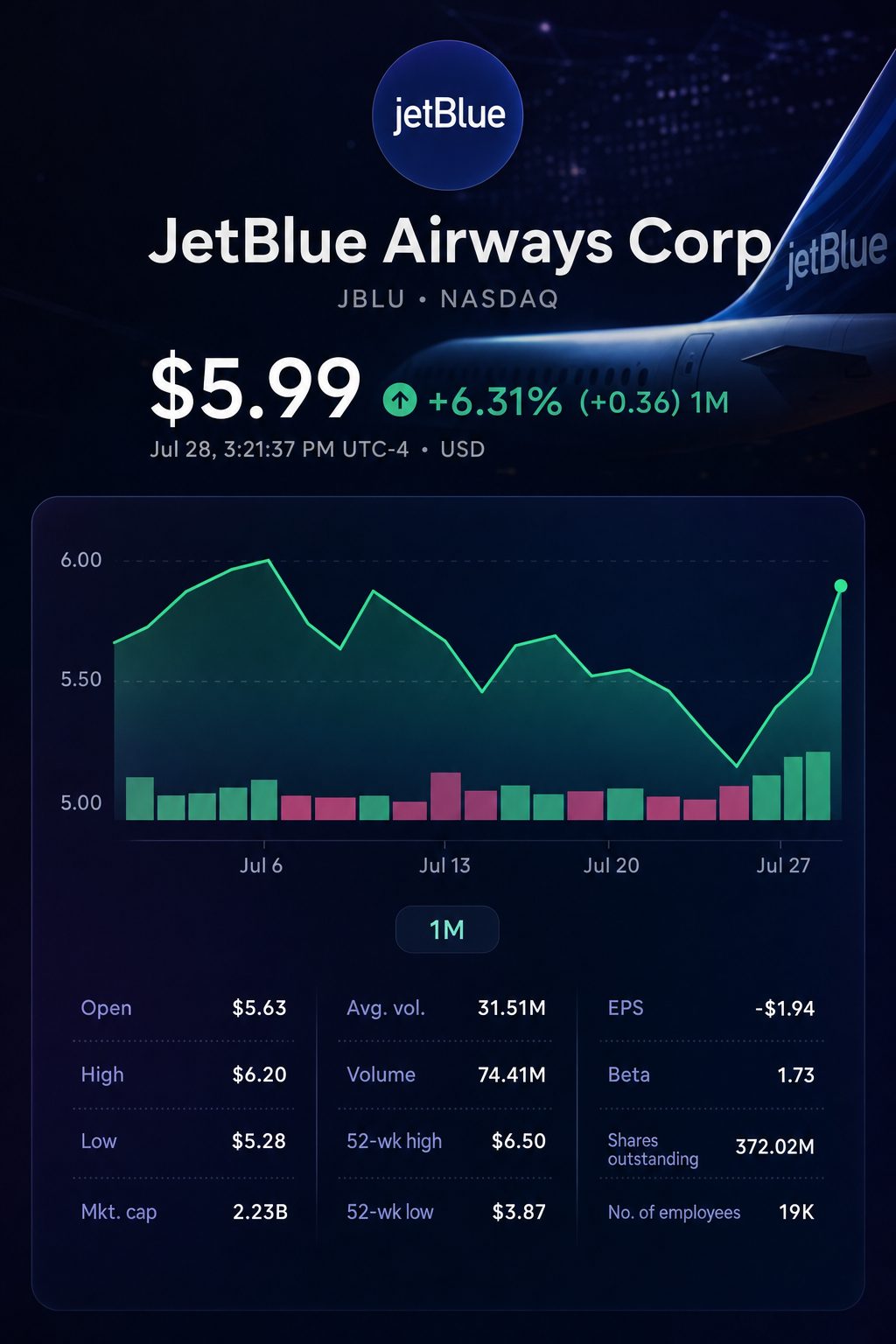
  • JetBlue stock gained 9.4%, reaching $5.94 during afternoon trading on the Nasdaq.
  • Unit revenue in the second quarter increased by 10.9%, while fuel costs surged 80.7%.
  • An initial sensitivity analysis estimates JetBlue’s fuel price gap at approximately $1.06 per share pretax.

Shares in JetBlue Airways Corporation climbed 9.4% to $5.94 on Tuesday after the airline surpassed quarterly forecasts, reinstated its yearly outlook, and established a profit goal for 2028.

The increase signals stronger pricing power. JetBlue offset close to 50% of increased fuel expenses, exceeding its earlier forecast of 30%-40%. The airline’s average ticket price increased by 8.6%, and revenue per available seat mile grew 10.9%.

That solid position does not eliminate exposure to commodity fluctuations. JetBlue’s projection of at least $1 in earnings per share for 2028 is based on $3 jet fuel. The airline’s 2026 forecast sets the price at $3.49 per gallon.

An initial sensitivity analysis highlights the significance of the gap. JetBlue used 408 million gallons of fuel in the first half; projecting that rate for the full year, a 49-cent per-gallon difference equates to about $400 million pretax. That represents approximately $1.06 for each second-quarter weighted share. The calculation does not factor in changes to capacity, tax rates or fuel efficiency.

The target of $5.94 represents roughly 5.9 times expected 2028 earnings. That estimate depends on steady demand and a decrease in fuel prices.

MeasureLatest result or targetComparison
Share price$5.94Jumped 9.4% during session
Adjusted EPS-$0.66LSEG expectation: -$0.71
Operating revenue$2.697 billionRose 14.5% from a year ago
RASMGained 10.9%Updated outlook: 9%-12%
Fuel cost per gallon$4.23$2.40 in the same period last year
2026 operating margin-5% to -2%Annual guidance reinstated
2028 EPS targetAt least $1.00Based on $3 fuel assumption

Raymond James analyst Savanthi Syth described the 2028 objective as “ambitious.” According to her calculations, achieving it would need over $1.3 billion in pretax gains starting in 2026. She noted that just around $400 million would result from reduced fuel expenses. Reuters

JetBlue reported a significantly larger loss this quarter, with a $247 million deficit compared to a $74 million loss in the prior year. The airline’s adjusted loss came in five cents less than analysts’ forecasts.

Revenue growth extended across all segments. Premium RASM climbed roughly 13%, main-cabin RASM was up 11%, and loyalty revenue also advanced 13%. The number of new premium-card accounts surged by almost 40%.

JetBlue is increasing its focus on fare segmentation, updating its structure to distinguish onboard services from options like flexibility and refunds. The company stated these adjustments will get travelers ready for the introduction of its BlueFirst domestic first-class cabin.
Stock chart for NASDAQ:JBLU

BlueFirst is scheduled to launch sales in the fall. According to management, the product may boost RASM by around five points once stabilized. JetBlue identifies it as the key remaining JetForward earnings contributor.

JetBlue projects third-quarter RASM will grow 12.5%-16.5%. Capacity is anticipated to be up 3%-6%, with ex-fuel unit costs expected to climb 2.5%-4.5%. The company continues to predict an operating loss for the full year.

Chief Financial Officer Ursula Hurley stated that pricing would “provide an offset” in the event fuel costs remain high. Whether that holds true will be seen in the third-quarter outlook. Reuters

Risks are still significant. As of June 30, cash and securities stood at $2.17 billion, while debt reached $8.48 billion. JetBlue projects interest expense of roughly $590 million in 2026. Softer demand or higher-than-anticipated fuel costs would weigh on its recovery.

At present, investors prioritized managing revenue over immediate profit. The challenge ahead is to maintain unit-revenue growth in the double digits, even as cost inflation is not offset.
TS2 TECH • EXTENDED COVERAGE

Further analysis

What caused JetBlue stock to surge following its July 28 earnings release?

Tuesday’s most recently confirmed price stood at $5.93, representing a 9.2% increase from July 27. Trading volume surpassed 71 million shares, more than doubling the 50-day moving average. The stock jump came after the company exceeded earnings forecasts, reinstated its outlook, and posted stronger prices. Management also set a 2028 EPS goal of at least $1.00. JetBlue is still operating at a loss. Achieving that target is still contingent on successful execution ahead. MarketWatch

Were Wall Street’s expectations exceeded in the second-quarter results?

JetBlue posted an adjusted net loss of $0.66 per diluted share for the quarter, outperforming the $0.71 loss analysts predicted, based on LSEG data referenced by Reuters. Total revenue came in at $2.697 billion, just over the consensus estimate of $2.68 billion. The company’s GAAP net loss deepened to $247 million, compared to $74 million previously. Operating margin declined to negative 5.2%, down from positive 0.3%. The earnings result surpassed expectations, yet the underlying quarterly loss grew significantly. Reuters

Will JetBlue’s revenue growth carry on into the third quarter?

RASM climbed 10.9%, with average fares up 8.6% from a year ago. Passenger numbers rose 5.1%, and load factor stood at 82.7%. Premium RASM advanced roughly 13%, and Main Cabin RASM rose 11%. JetBlue is forecasting third-quarter RASM growth between 12.5% and 16.5%. Capacity is projected to increase by 3% to 6%, expected to drive additional unit-revenue growth. The outlook appears positive. Demand and fuel costs continue to be highly volatile. JetBlue Investor Relations

How does the reinstated 2026 forecast affect projected profitability?

JetBlue expects full-year RASM to rise between 10% and 12.5% according to updated guidance. Capacity expansion is still limited and remains in the 1.5% to 3.5% range for 2026. CASM, excluding fuel, is forecast to increase by just 2% to 4% in 2026. Nevertheless, adjusted operating margin is still forecast at negative 2% to 5%. Interest expenses are predicted to be around $590 million, with capital expenditures projected at $850 million. Management anticipates operating margin in the second half to improve by about 3.5 percentage points. While the outlook is more positive, profitability has yet to be restored. JetBlue Investor Relations

What level of risk does JetBlue face if fuel prices surge again?

JetBlue’s quarterly fuel costs surged 80.7% to $911 million versus a year earlier. The airline paid $4.23 per gallon, marking a 76% rise from before. As of June 30, JetBlue had no active fuel hedges. A 10% fuel price rise would increase annual costs by about $309 million. The company’s full-year forecast anticipates an average $3.49 per gallon in 2026. JetBlue managed to recover almost half of the fuel cost increase via pricing and demand. Fuel remains the primary volatility driver. JetBlue Investor Relations

Does JetBlue have a balance sheet capable of supporting a turnaround?

As of June 30, 2026, JetBlue held $2.2 billion in available liquidity. The company maintained a $600 million undrawn revolving credit facility with Citibank. Debt and finance-lease obligations stood at approximately $8.48 billion, after deducting issuance costs. JetBlue reported a working-capital deficit close to $1.4 billion. Around 67% of its owned property, equipment, and intangible assets were pledged or otherwise committed. Management stated existing liquidity would be sufficient to meet obligations for at least twelve months. The balance sheet remains under significant pressure. SEC

Do Pratt & Whitney engine issues remain significant?

On June 30, four planes stayed grounded due to a shortage of Pratt & Whitney engines. JetBlue projects that a mid-single-digit number of aircraft will remain out of service for the rest of 2026. Management reports that PW1500G engine repairs typically take about 200 days, while PW1100G repairs now take around 300 days. Updated support deals provide eligible purchase credits up to $105 million, which will expire in December 2027 and involve the release of some claims. While the impact is seen as manageable, both expenses and operational challenges persist. SEC

Is there evidence of financial benefits from JetForward and BlueFirst?

JetForward delivered $470 million in cumulative incremental EBIT as of June 2026. Management maintains its goal of $850 million to $950 million in annual gains by the end of 2027. The benefits are forecast to total about $1.2 billion per year in 2028. Sales of BlueFirst are expected to begin this fall, the latest update showed. Loyalty revenue climbed 13%, with premium-card sign-ups rising almost 40%. These improvements are already evident. The majority of the projected financial impact is still ahead. JetBlue Investor Relations

Is JBLU undervalued based on its updated 2028 earnings forecast?

JetBlue projects earning at least $1.00 per share in 2028. With shares at $5.93, this values the airline at about 5.9 times the earnings target. The outlook is based on ongoing demand and fuel costs of $3.00 per gallon, which is under the $3.49 forecast for 2026. Raymond James described the goal as ambitious, pointing to the need for more than $1.3 billion in pretax improvements. As trailing EPS is now negative $1.93, the current price-to-earnings ratio is not practical. Shares only appear undervalued if JetBlue reaches its turnaround objectives. JetBlue Investor Relations

Marcin Frąckiewicz is the founder and CEO of TS2 Space, a satellite communications company serving customers around the world. A graduate of the Warsaw School of Economics (SGH), he has more than two decades of experience in telecommunications, satellite services and technology ventures. He writes about satellite communications, space technology, artificial intelligence and the stock market, with a particular focus on technology companies, semiconductors, emerging industries and the trends shaping global innovation. Follow Marcin Frąckiewicz on Google News, Facebook. or Linkedin.

AI PORTFOLIO

Top Stock Picks

Today’s highest-ranked model selections.

#1 BUY IN STAGES

AerCap

NYSE: AER 95 / 100
#2 BUY ON WEAKNESS

Xylem

NYSE: XYL 93 / 100
#3 ACCUMULATE

General Dynamics

NYSE: GD 91 / 100
#4 BUY WITH LIMITS

Visa

NYSE: V 88 / 100
#5 TACTICAL BUY

IDEX

NYSE: IEX 85 / 100
View full portfolio
Editorial model selection. Not personalised advice.
Chip Selloff Softened for SMH on Heavyweight Exposure, but ETF Still Trails by 19 Points YTD
Previous Story

Chip Selloff Softened for SMH on Heavyweight Exposure, but ETF Still Trails by 19 Points YTD

SoFi Technologies (NASDAQ:SOFI) Shares Dip Ahead of Q2 Amid 38% EBITDA Margin Challenge
Next Story

SoFi Technologies (NASDAQ:SOFI) Shares Dip Ahead of Q2 Amid 38% EBITDA Margin Challenge