DETROIT, July 29, 2026, 05:57 EDT
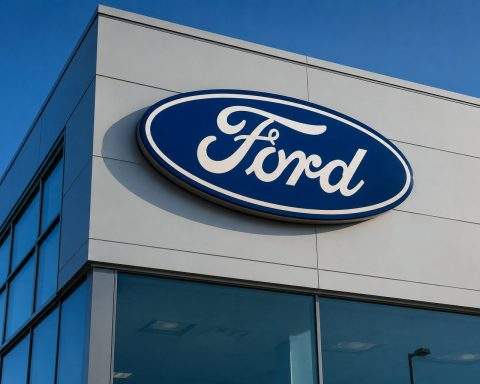
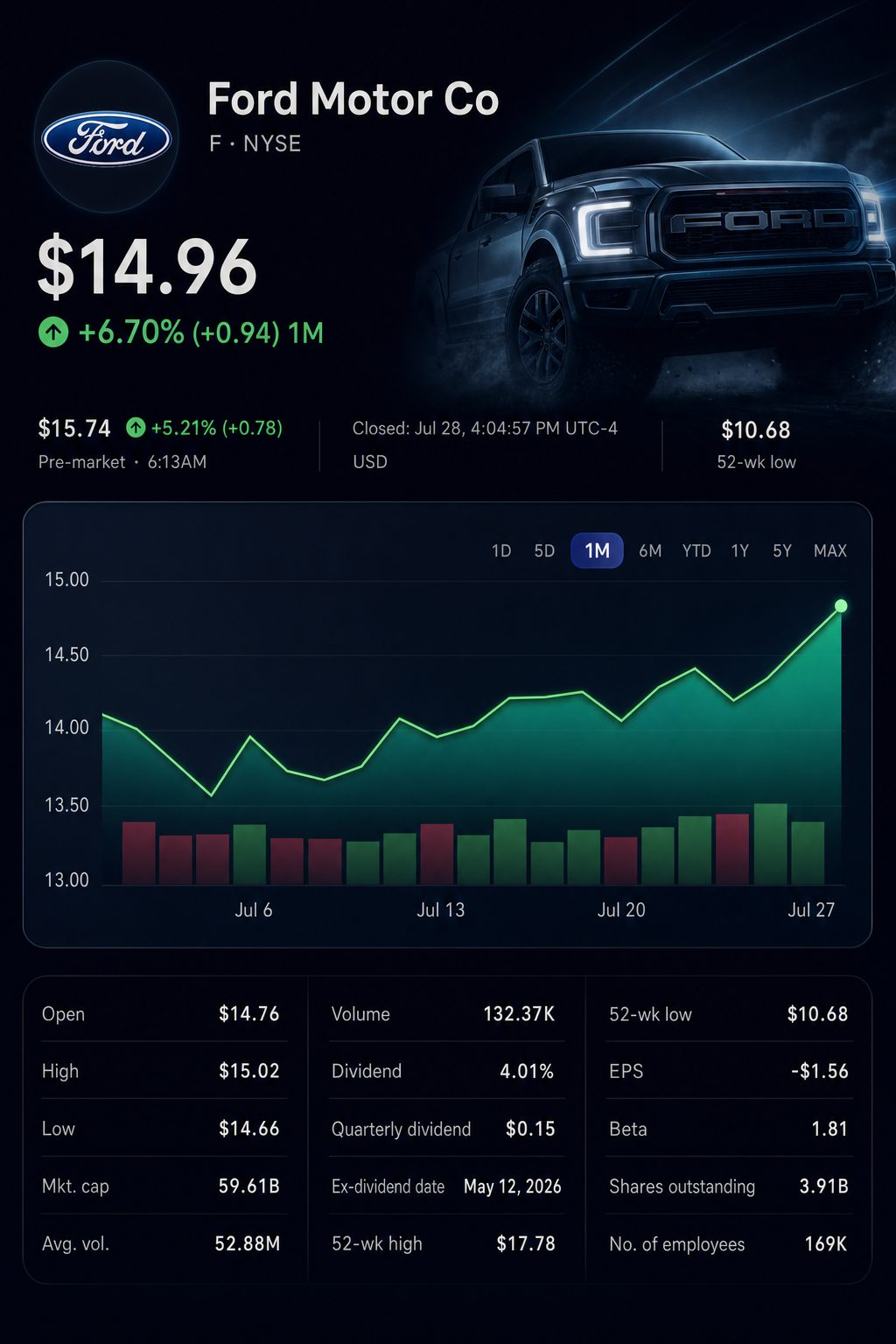
- Early premarket indications showed Ford Motor Company NYSE:F up 4.75% at $15.67. U.S. cash markets were not yet open.
- Ford increased its adjusted operating profit midpoint by $1 billion to reach $10.5 billion.
- Basic midpoint calculations allocate $750 million of the rise to Ford Blue and Ford Pro.
Ford stock rose ahead of Wednesday’s opening bell as the automaker boosted its yearly profit guidance. Shares last finished Tuesday at $14.96, gaining 1.91%.
Earnings quality outweighed the impact of the loss. Wholesale volume declined 12%, but adjusted operating profit increased 19%. The quarter was supported by strong pricing, higher trim levels, and disciplined cost management.
Ford posted adjusted earnings of 42 cents per share, exceeding Wall Street’s projection of 35 cents. The company recorded a net loss of $1.3 billion following special charges.
The biggest item was a $3.6 billion expense, primarily non-cash, related to Ford’s exit from the BlueOval SK battery partnership.
Ford updated its 2026 adjusted EBIT outlook, now expecting $10 billion to $11 billion. EBIT refers to earnings before interest and taxes. Previously, Ford’s forecast ranged from $8.5 billion to $10.5 billion.
The midpoint climbed 10.5% to $10.5 billion. Guidance for adjusted free cash flow was raised to a range of $6 billion to $7 billion.
Ford 2026 adjusted EBIT outlook, midpoint comparison
| Business | Previous midpoint | Updated midpoint | Difference |
|---|---|---|---|
| Ford Blue | $4.75 billion | $5.25 billion | +$0.50 billion |
| Ford Pro | $7.00 billion | $7.25 billion | +$0.25 billion |
| Ford Model e | -$4.25 billion | -$4.00 billion | +$0.25 billion |
| Total company | $9.50 billion | $10.50 billion | +$1.00 billion |
Ford’s stated ranges are used to determine midpoints. The segment division is estimated and does not represent official company figures.
On that basis, Blue and Pro account for 75% of the midpoint increase, while the rest comes from Model e’s smaller anticipated loss.
Ford Blue demonstrated the strongest operating leverage, as EBIT increased by $474 million with revenue growth of just $300 million. The division’s margin improved to 4.4%, up from 2.6%.
CEO Jim Farley stated that trucks, off-road vehicles and hybrids are “commanding real pricing power.” Nearly a quarter of Ford’s U.S. sales came from off-road variations. Ford Shareholder Services
Ford Pro continued as the top industrial profit driver, generating $1.72 billion in earnings despite a $600 million decline in profit. Production of high-margin trucks was restricted due to aluminum shortages associated with supplier Novelis.
Model e delivered a less uniform performance. Its loss reduced by $410 million to reach $919 million. However, revenue dropped by 56%, and its EBIT margin further deteriorated to negative 89.6%.
Ford continues to forecast approximately $4 billion in losses for its Model e unit this year, representing nearly 38% of the company’s projected EBIT at the midpoint. In addition, Ford intends to invest around $1 billion more in its new electric vehicle platform and Ford Energy.
General Motors Company NYSE:GM provides the nearest benchmark. Last week, GM increased its 2026 adjusted EBIT forecast to a range of $14 billion-$16 billion. In the second quarter, adjusted EBIT totaled $3.9 billion, driven by strong pricing for trucks and SUVs.
Ford rose roughly 1.0% in the week that ended July 24, followed by a further 4.1% increase over Monday and Tuesday. Early premarket signals are provisional and may change by the time markets open.
In the week ahead, investors are set to monitor July sales figures and F-Series production. Ford has forecast around $1 billion in additional EBIT from Novelis compared with the prior year, with much of it anticipated in the latter half. Restoring supply is now seen as a key challenge for execution.
Risks: Ford expects U.S. industry pricing to increase by roughly 0.5%. U.S. sales for the first half dropped 9.6%, while Model e continues to post significant losses. Reduced truck demand, higher tariffs or slower aluminum recovery could result in earnings landing closer to the lower bound.
Related articles: NYSE:F