Arm Holdings (NASDAQ:ARM) Shares Surge with Rapid Growth in AI Core Shipments

Arm Holdings (NASDAQ:ARM) Shares Surge with Rapid Growth in AI Core Shipments

NEW YORK, July 30, 2026, 10:07 EDT Arm Holdings shares surged after the company reported a fourfold increase in the pace of shipments for its AI cores.

  • Shares of Arm climbed roughly 7.1% to $240.96 during early Nasdaq trade.
  • Adjusted earnings were 45 cents in the first quarter, with revenue totaling $1.289 billion.
  • Arm delivered another 500 million Neoverse cores in just nine months.

Shares of Arm Holdings plc climbed 7.1% to $240.96 as of 9:52 EDT on Thursday. The stock started the session at $259.79 before giving up part of its advance. It had fallen close to 7% in after-hours trading on Wednesday following its release.
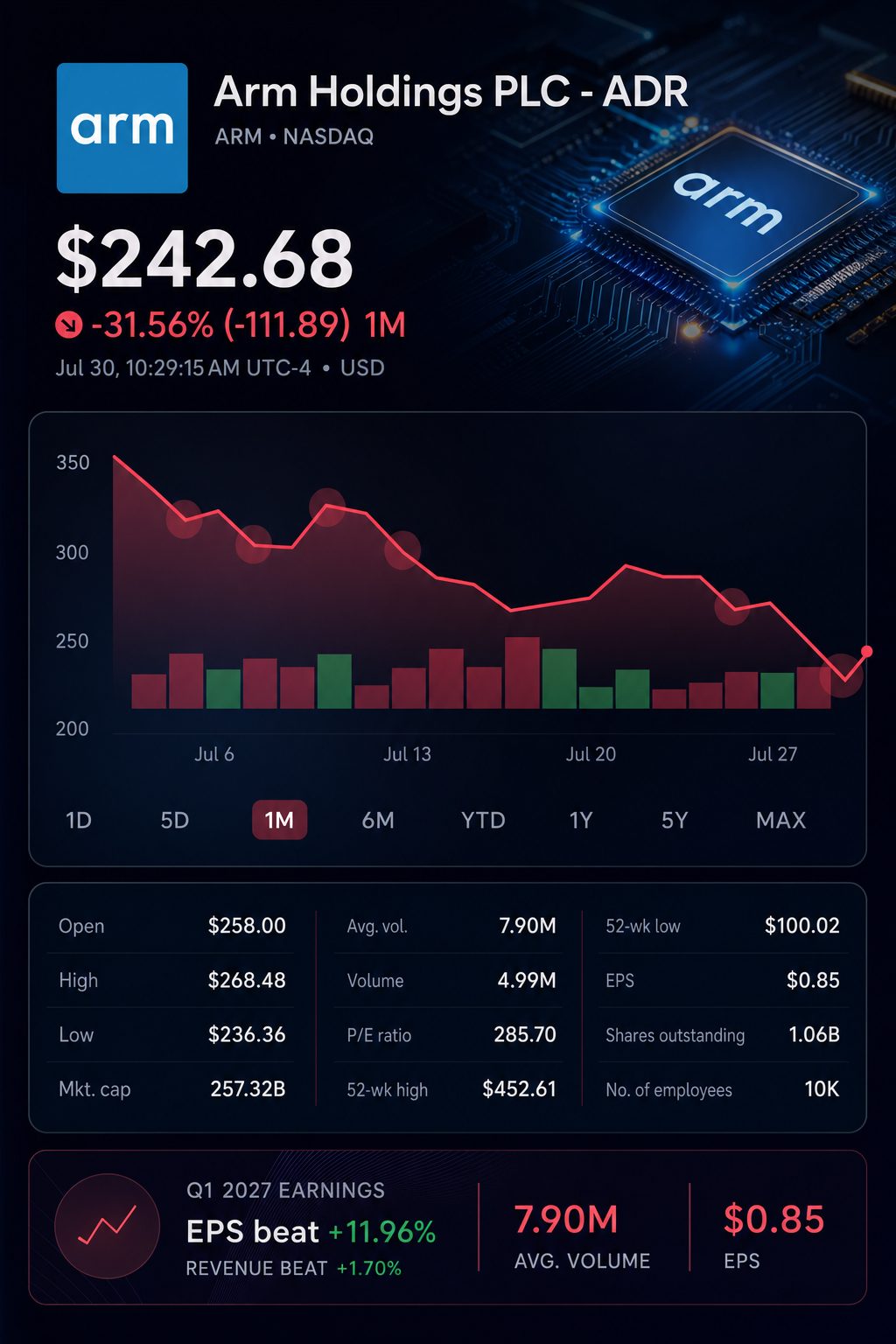
Stock chart for NASDAQ:ARM

The signal that resonated more with investors was the pace of server shipments rather than the slight earnings outperformance. Arm delivered its most recent 500 million Neoverse cores in just nine months, compared to six years to reach the first billion.

The company’s numbers indicate the annualized shipment rate has quadrupled. Royalty income from data centers more than doubled over the quarter. This growth trend points to a shift in Arm’s revenue dependence away from smartphones.

Neoverse shipment phaseCores shippedTime requiredAnnualized paceRelative pace
First billion1.00 billion72 months167 million yearly1.0x
Most recent500 million9 months667 million yearly4.0x

Arm’s disclosures provide the basis for annualized rates, which have been rounded for clarity.

The change is significant as smartphones continue to be the short-term vulnerability. Accelerated server uptake can balance out lower handset shipments and increase the value derived per chip. This also heightens the importance of successful rollout for Arm’s new AGI processor.

Revenue for the quarter to June 30 was $1.289 billion, up 22%. Adjusted earnings rose 29% to 45 cents per share. Both results exceeded the most recent Wall Street consensus estimates.

First-quarter metricArm resultStreet consensusDifferenceBeat
Revenue$1.289 billion$1.260 billion$29 million2.3%
Adjusted EPS$0.45$0.40$0.0512.5%

Reuters provided the consensus figures; all percentages represent calculated values.

Profit quality showed more mixed results. The adjusted operating margin increased by 2.1 percentage points to reach 41.2%. According to standard accounting principles, the margin declined by 3.7 points to 7.1%. Research expenditure climbed 29% to $838 million.

First-quarter metricFiscal 2027Fiscal 2026Change
Total revenue$1,289 million$1,053 million22%
Royalty revenue$715 million$585 million22%
Licensing revenue$574 million$468 million23%
Adjusted operating margin41.2%39.1%+2.1 points
Standard operating margin7.1%10.8%−3.7 points
Adjusted free cash flow$665 million$150 million343%

Second-quarter forecasts topped consensus as well, but the margins were modest. The revenue midpoint was 3.0% higher than the average analyst forecast. For adjusted earnings, the midpoint was 9.3% above the consensus estimate.

Second-quarter metricArm guidanceMidpointStreet consensusMidpoint premium
Revenue$1.33 billion-$1.43 billion$1.38 billion$1.34 billion3.0%
Adjusted EPS$0.43-$0.51$0.47$0.439.3%

Company midpoints and reported consensus are used to calculate premiums.

Chief Executive Rene Haas stated that as AI inference grows, central processors handle additional tasks. “The more inference workloads you run, that creates work that only CPUs can do,” he told Reuters. Inference refers to the process during which a trained AI system provides responses to questions. Reuters

Arm introduced its AGI CPU in March, marking a shift from design licensing to producing complete chips. Orders have surpassed $2 billion for fiscal years 2027 and 2028. Early shipments have been delivered to multiple clients. Arm has locked in capacity relating to its earlier identified $1 billion opportunity.

Oracle Corporation has committed to purchase the new processor, according to Haas. Analysts at Jefferies Financial Group estimate fiscal 2031 sales will reach $18 billion. Arm’s forecast for the same period stands at $15 billion. Both are projections, not actual revenue.

Smartphones continue to be the immediate area of weakness. Arm forecasts a sequential dip in handset royalties for the coming quarter. Finance chief Jason Child pointed to memory shortages as a contributing factor. This caution contributed to the after-hours selloff on Wednesday.

Cash generation remained robust, supported by beneficial collection timing. Adjusted free cash flow increased to $665 million, up from $150 million. Arm pointed to favorable receivable collections and timing around tax payments as contributing factors.

Risks are still elevated. Based on its stated $252.5 billion market capitalization, Arm trades at nearly 49 times annualized sales from the first quarter, according to an initial calculation. This basic metric does not account for seasonality and should not be treated as an outlook. Ongoing smartphone weakness, supply chain challenges and the difference between standard and adjusted earnings may continue to bring significant volatility.

Thursday’s recovery indicates investors prioritized Arm’s progress in server acceleration. The fourfold increase in shipments overshadowed only moderate forecast beats and weaker handset demand. Maintaining this momentum is now crucial.

TS2 TECH • EXTENDED COVERAGE

Further analysis

What is the current trading price of ARM shares, and how does their performance stack up against leading indexes?

ARM traded at $244.03 as of 9:50 a.m. ET on July 30, marking an 8.5% increase from Wednesday’s $224.89 close. The QQQ advanced 2.7% and the SOXX semiconductor ETF climbed 7.4%. ARM led the Nasdaq-100 tracker, while its gains only slightly surpassed other semiconductor stocks. Prices remain subject to significant fluctuation before the session ends.

Did Arm’s most recent quarterly earnings surpass analyst forecasts on Wall Street?

Revenue for the fiscal first quarter jumped 22%, hitting a record $1.29 billion. Analysts on Wall Street had forecast around $1.26 billion ahead of the release. Adjusted earnings were $0.45 per share, topping the consensus estimate of about $0.40. GAAP diluted EPS increased to $0.25, up from $0.12 in the same quarter last year. Royalty revenue reported a 22% rise, while licensing revenue grew 23% year over year. SEC

What caused ARM shares to decline at first even though earnings surpassed expectations?

Shares dropped close to 7% in after-hours trading immediately after the announcement. Management forecast smartphone royalties to rise by about 10% to 15%. Reuters reported a decline in royalties, though the baseline period was not given. The apparent discrepancy could stem from comparing sequential results to year-over-year figures. Investors at first prioritized concerns over weaker handset demand, despite solid gains in the data-center segment. Thursday’s share rebound indicated market sentiment remained in flux. Reuters

What are Arm’s projections for the September quarter?

Arm forecasts fiscal second-quarter revenue of $1.38 billion, with a possible variation of $50 million. The midpoint surpasses Wall Street’s estimate of about $1.34 billion. The company projects adjusted EPS of $0.47, with a margin of four cents either way. Analysts were looking for around $0.43 to $0.44 per share. Non-GAAP operating expenses are anticipated to be roughly $780 million in the quarter. SEC

What is the significance of Arm’s latest AGI CPU prospect?

Orders for Arm’s AGI CPU have now topped $2 billion, covering fiscal 2027 and fiscal 2028. This is up from the $1 billion production opportunity the company previously indicated for those periods. Oracle is named as a purchaser, however, the size of its contract has not been made public. Arm continues to project around $15 billion in production-silicon sales for fiscal 2031. Jefferies projects $18 billion, but that remains an external estimate. Demand is now visible, but the timing of recognized revenue and actual profit margins is still unclear. SEC

Is the expansion of data centers reaching a scale that could significantly impact Arm’s business?

Data-center royalty revenue more than doubled in the most recent quarter. Neoverse shipments have exceeded 1.5 billion cores over around six years. Of those, 500 million cores shipped in just nine months, while the first billion took about six years. This rapid pace supports Arm’s push in cloud and AI infrastructure markets. The company did not provide a specific dollar figure for data-center royalty revenue. SEC

Do Arm’s margins and cash flow match the pace of its revenue gains?

Non-GAAP operating margin increased to 41.2% from 39.1% in the same period last year. GAAP operating margin declined to 7.1% from 10.8%. The difference was partly due to $343 million in share-based compensation. Operating cash flow totaled $902 million for the quarter. Non-GAAP free cash flow stood at $665 million, supported by the timing of collections. Management noted tax-payment timing also played a role, making straightforward annualization unreliable. SEC

Is ARM trading at a high valuation at its current price?

Arm’s valuation stood near $256 billion at $244.03 per share. With trailing EPS just under $0.98, shares traded at roughly 249 times earnings. Forward P/E ratios differ, reflecting varied earnings projections; recent figures have ranged from about 100 to 121. GuruFocus listed the semiconductor industry median at around 26. The disparity gives little margin for mistakes. StockAnalysis

How do analysts view prospects for ARM shares?

Google Finance showed a three-month consensus target of $291.52 from 25 analysts, with some predictions made before earnings. This indicated an approximate 19% increase over the current price of $244.03. Analysts’ ratings were split between 18 buys, six holds, and one sell. New targets released on July 30 spanned from $212 by Morgan Stanley to $360 by Barclays. The complete public range extended from $150 to $500, highlighting significant variation among forecasts. Price targets do not represent assured outcomes. Google

Which figures are important for investors to monitor next?

The midpoint for revenue in the September quarter suggests year-over-year growth of about 22%. Growth in smartphone royalties is projected to range from 10% to 15%. Royalties from data-centers are required to compensate for slower gains from handsets. Investors will monitor over $2 billion in AGI demand conversions. Annual contract value increased by 13% to $1.73 billion, lagging behind revenue growth. Falling short on several metrics could put pressure on Arm’s premium valuation. SEC

Iwona Majkowska is a financial markets journalist at TS2.tech, specializing in stocks, artificial intelligence and technology. A graduate of the Warsaw School of Economics, she previously worked in equity research and financial analysis before focusing on market reporting. Her daily coverage helps investors follow major developments across U.S. and global markets. Follow Iwona Majkowska on Google News.

AI PORTFOLIO

Top Stock Picks

Today’s highest-ranked model selections.

#1 BUY ON PULLBACK

Microsoft

NASDAQ: MSFT 94 / 100
#2 BUY

L3Harris Technologies

NYSE: LHX 90 / 100
#3 BUY

Xylem

NYSE: XYL 89 / 100
#4 BUY IN TRANCHES

Lam Research

NASDAQ: LRCX 87 / 100
#5 BUY ON WEAKNESS

GE HealthCare

NASDAQ: GEHC 84 / 100
View full portfolio
Editorial model selection. Not personalised advice.
Bloom Energy Shares Gain Following Strong Q2 with Single Customer Representing 73% of Revenue
Previous Story

Bloom Energy (NYSE:BE) surges 26% as single client drives 73% of Q2 sales

Lam Research (NASDAQ:LRCX) shares recover after company projects $8.1 billion, beating forecasts
Next Story

Lam Research (NASDAQ:LRCX) stock jumps as AI outlook points to 45% incremental margin