30 July 2026
2 mins read

Dow Jones advances 615 points, rally driven by just two stocks

NEW YORK, July 30, 2026, 16:08 EDT

  • Initial closing numbers show the Dow gaining 614.91 points, or 1.19%, at 52,209.05.
  • Microsoft and Goldman Sachs together contributed about 626 points to the Dow’s gains.
  • Sixteen stocks on the Dow declined. S&P 500 losers led winners by a two-to-one margin in late trade.

The Dow Jones Industrial Average closed with strong gains on Thursday, though the headline figure masked weakness beneath the surface.
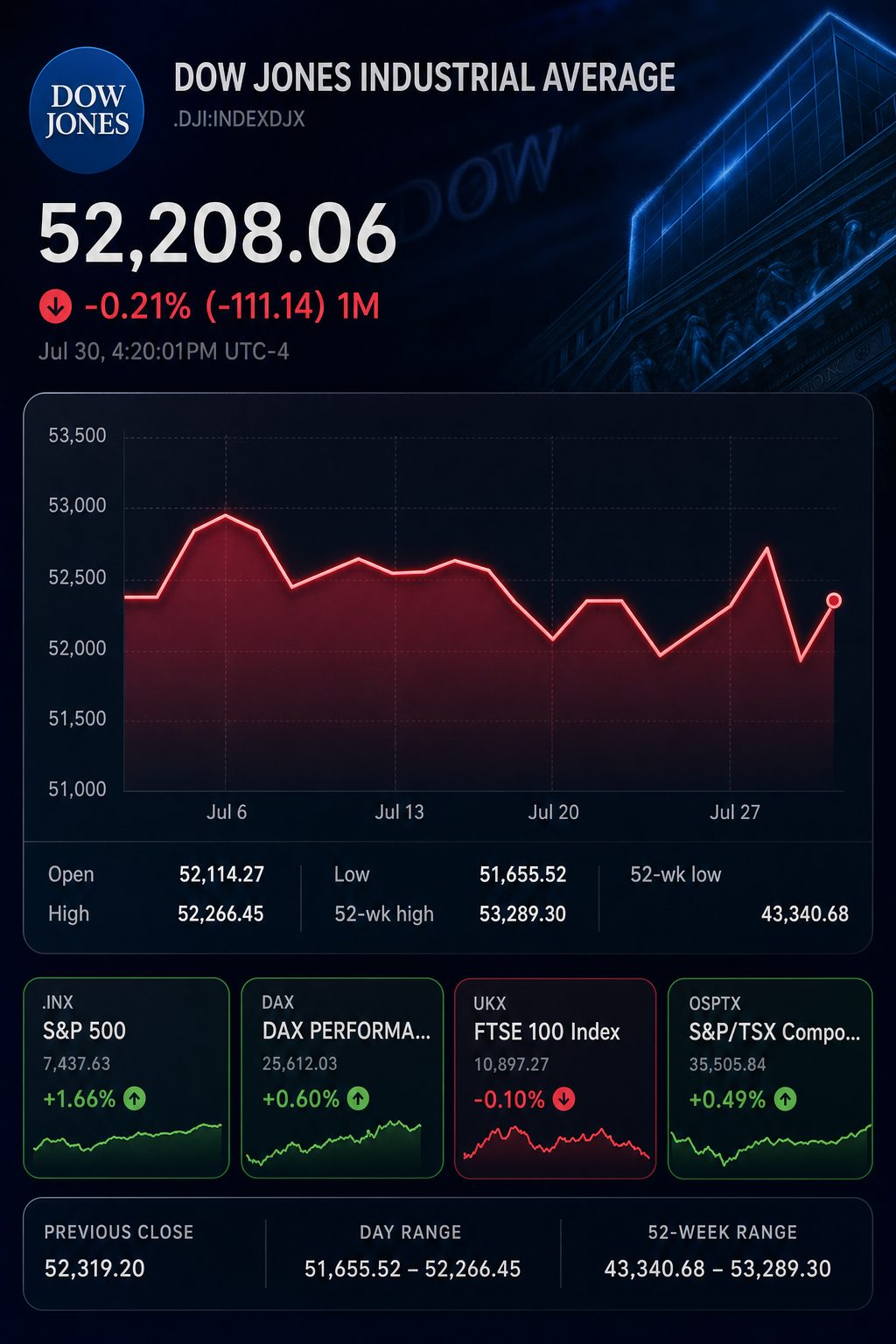
Stock chart for INDEXDJX:.DJI

As of 3:57 p.m., Microsoft rose by $60.18 while Goldman Sachs advanced $45.20. Every $1 change in a component moves the Dow by approximately 5.94 points, suggesting the two stocks contributed about 626 points combined.

The recovery was notably more pronounced beyond the price-weighted Dow.

IndexPreliminary closeThursday moveWednesday loss recovered
Dow Jones52,209.05up 614.91, rising 1.19%53%
S&P 5007,438.05up 121.90, advancing 1.67%108%
Nasdaq Composite25,125.51up 682.57, gaining 2.79%157%

The Dow advanced Thursday following a loss of 1,153.18 points in the previous session. On Wednesday, the S&P declined by 112.63 points and the Nasdaq fell 433.97 points. Recovery percentages are based on these declines.

The Dow recouped just 50% of its earlier loss. The S&P reversed its decline from Wednesday. The Nasdaq bounced back by more than one-and-a-half times its previous fall.

Recent component figures reveal that the Dow’s advance was supported by a slim margin.

Dow componentStock-price moveEstimated Dow impactShare of Dow rise
Microsoft+$60.18+357 points58%
Goldman Sachs+$45.20+268 points44%
Together+$105.38+626 points102%

The numbers provided are initial estimates. They match a 3:57 p.m. component snapshot against an index reading taken after the market closed. These numbers reveal concentration and do not represent an official contribution calculation.

The Dow’s unique structure leads to the discrepancy. It assigns weight to components based on their share price instead of total market cap, allowing stocks with higher prices to exert greater influence on the index. In the most recent update, 14 components were up, while 16 moved lower.

Microsoft led the session after it projected 45% constant-currency growth for Azure, topping analysts’ expected 40.92%. The company also anticipates fiscal first-quarter capital expenditures of $50 billion.

Jake Behan, who leads capital markets at Direxion, presented the investor challenge simply. Microsoft had to “shift the conversation from how much it is spending on AI to what it is earning,” he said. Reuters

The outcome was different for Meta Platforms , whose shares declined around 9% following a 91% decrease in free cash flow for the second quarter. The divergence indicates that investors are prioritizing cash conversion over simply increased AI expenditure.

The macro environment offered diminished support.

SignalLatest readingComparison
Federal-funds target3.50%-3.75%No change; 9-3 split
Second-quarter real GDP+1.5% annualisedPrevious quarter: +2.1%
June headline PCE inflation+3.7% year-on-yearMay: +4.1%
30-year Treasury yield5.2071% late; 5.2444% peakPeak since mid-2007

Three members of the Federal Reserve favored raising rates by 25 basis points. Futures tied to Fed funds showed a 64% probability of a rate hike in September.

Bonds failed to deliver a clear risk-on confirmation, with the 30-year yield hitting its highest level in 19 years while equities advanced. Sanjiv Tumkur, head of equity research at Rathbones, noted there was “scope for bumps along the way.” Reuters

Risks: Elevated long-term yields may weigh on equity valuations. The Dow’s narrow leadership increases the risk of a reversal. A decline in Microsoft or Goldman could erase most of Thursday’s gains.

The Dow declined by 0.4% last week. The S&P slipped 0.6%, and the Nasdaq was down 2.1%. In the coming week, multiple indicators of wage and labour-market health are expected.

DateScheduled US catalyst
July 31Employment Cost Index for Q2, 08:30 EDT
August 4JOLTS data for June, 10:00 EDT
August 6Q2 productivity preliminary release, 08:30 EDT
August 7July jobs report, 08:30 EDT

A lasting Dow recovery now requires wider support. Thursday finished on a firm note, but the underlying support was lacking.

TS2 TECH • EXTENDED COVERAGE

Further analysis

What was the Dow Jones closing value on July 30, and why are there discrepancies among data feeds?

Late-session data placed the Dow around 52,210–52,226, marking a rise of approximately 1.2%. Google Finance recorded 52,209.57 at 4:01 p.m. Eastern. Investing.com listed 52,215.72, and Barron’s noted a 632-point gain. The modest discrepancies likely result from closing-auction updates and feed adjustments still pending. Even the lowest figure managed to recoup roughly 53% of Wednesday’s 1,153-point decline. Google

What drove the Dow’s strong rebound on Thursday?

Microsoft led the way, climbing almost 17% after posting results and outlook that surpassed expectations. The company projected higher sales and cloud revenue than analysts forecast, while its capital expenditures were lower than anticipated, alleviating concerns over AI-related costs. The chip index surged nearly 8%, with Micron up 18%, Sandisk up 24%, and AMD climbing 14%. Amazon advanced roughly 4%, but Meta dropped nearly 9%. Reuters

What portion of the Dow’s increase was due to Microsoft’s performance?

Since the Dow uses price-weighting, Microsoft’s share price change had an outsized impact. In a late session reading, Microsoft rose by around $66. With each $1 change translating to approximately 5.94 points on the Dow, this equates to a contribution of almost 392 points—representing roughly 63% of the Dow’s overall advance. This figure could adjust somewhat based on final closing data. Investing.com

Did the rally show sufficient breadth to indicate more robust market momentum?

The market’s gains lacked breadth. According to Barron’s, just nine of the 30 Dow stocks ended higher. Over 70% of S&P 500 constituents fell, and the equal-weighted index declined by 0.8%. Reuters reported that S&P 500 decliners outnumbered advancers by two to one. This narrow leadership leaves the rebound more vulnerable than the headline figures show. Barron’s

How do Treasury yields and the Federal Reserve impact the Dow?

The Federal Reserve kept its target range steady at 3.50%–3.75% in a 9–3 decision, with three policymakers instead calling for a 25-basis-point hike. The yield on the 30-year Treasury climbed to 5.2444%, marking its highest point in 19 years, while the 10-year yield ended close to 4.67%, exerting ongoing pressure on stock valuations. Market participants priced in about a 60% probability of a rate hike in September. Rates continue to be the most significant macroeconomic obstacle. Federal Reserve

Did economic numbers released on Thursday help fuel the stock-market recovery?

Gross domestic product expanded at a 1.5% annualized rate in the second quarter, following 2.1% growth in the prior quarter. Private domestic final sales advanced by 3.9%, outperforming overall GDP. Personal consumption expenditures inflation in June eased to 3.7% year-on-year, with core inflation measured at 3.3%. Monthly headline prices slipped 0.1%, while real consumer outlays increased 0.4%. Data lend support to corporate results but provide little argument for swift rate cuts. Bureau of Economic Analysis

What messages are Apple and Amazon delivering post-market close?

Amazon shares finished up 3.9% and advanced a further 5.1% in after-hours trading, reaching $247.60. Apple ended the session 1.4% lower, but edged up 0.3% after the close. These preliminary moves point to a positive yet mixed signal for the Dow. Both companies’ earnings calls were set for 5 p.m. Eastern. Updated guidance could alter these initial after-hours movements, leaving the signal tentative for now. Google

Which Dow milestones are important now, and what is projected for the near term?

Immediate support is found in the 51,550 to 51,660 range, corresponding to this week’s lowest levels. The initial resistance is seen at Thursday’s intraday high of 52,266. The following resistance area spans 52,747 to 52,902, aligning with Tuesday’s close and high. The all-time high region stays near 53,056–53,289. The Dow is currently trading about 1.6% beneath its record close. Thursday’s rebound maintains a modest upward bias as long as 51,550 remains intact. Should support break, 51,000 turns vulnerable; moves above 52,902 would open the path to record highs. Google

Khadija Saeed is a financial markets reporter at TS2.tech, specializing in stocks, technology and emerging industries. She studied economics and finance at the London School of Economics and previously worked in market research before moving into financial journalism. Her coverage focuses on the companies, innovations and economic trends influencing global investors. Follow Khadija Saeed on Google News.

AI PORTFOLIO

Top Stock Picks

Today’s highest-ranked model selections.

#1 BUY ON PULLBACK

Microsoft

NASDAQ: MSFT 94 / 100
#2 BUY

L3Harris Technologies

NYSE: LHX 90 / 100
#3 BUY

Xylem

NYSE: XYL 89 / 100
#4 BUY IN TRANCHES

Lam Research

NASDAQ: LRCX 87 / 100
#5 BUY ON WEAKNESS

GE HealthCare

NASDAQ: GEHC 84 / 100
View full portfolio
Editorial model selection. Not personalised advice.
S&P 500 climbs 1.45% as narrow AI-driven surge highlights weak market breadth
Previous Story

S&P 500 climbs 1.45% as narrow AI-driven surge highlights weak market breadth

Ford (NYSE:F) Sheds Earnings Boost Amid China Alert, Underscoring EV Challenge
Next Story

Ford (NYSE:F) Sheds Earnings Boost Amid China Alert, Underscoring EV Challenge