Browse Category

Starlink News 29 May 2025 - 7 June 2025

Starlink Satellite Internet FAQ

Starlink Satellite Internet FAQ

Starlink is SpaceX’s satellite-based broadband internet service, and by 2025 the constellation has launched over 7,500 satellites with about 6,750 active in orbit. The satellites orbit in low Earth orbit at roughly 550 km altitude, delivering typical download speeds of 50–200+ Mbps and latency around 20–40 ms. SpaceX began launching Starlink in 2019, and by early 2025 it served more than 5 million customers in 125+ countries. The residential Starlink kit costs about $599 in many regions, with US promotions as low as $349, and monthly service typically $90–$120, with occasional $0 hardware deals tied to multi-month commitments. There are
7 June 2025
Battle for the Final Frontier: Starlink vs OneWeb vs Kuiper vs Telesat Lightspeed

Battle for the Final Frontier: Starlink vs OneWeb vs Kuiper vs Telesat Lightspeed

Starlink has launched over 8,000 satellites since 2019, serves 125 countries, and by April 2025 reached the 250th dedicated Starlink launch, establishing SpaceX’s network as the largest in orbit. OneWeb, founded in 2014, began Gen1 launches in 2019 with 618 of 648 satellites deployed by March 2023, filed for Chapter 11 in 2020, was rescued by a UK/India $1 billion bailout, and merged with Eutelsat in September 2023. Project Kuiper, unveiled in 2019, has FCC approval for 3,236 satellites, started production with 27 satellites launched in April 2025 on an Atlas V, uses three shells at 590–630 km with inclinations
3 June 2025
Why Starlink Keeps Hitting Red Tape Around the World

Why Starlink Keeps Hitting Red Tape Around the World

In May 2023 the U.S. FCC sided with Starlink over proposed uses of the 12.2–12.7 GHz band, preserving it for satellite services and preventing two-way 5G interference. In August 2022 the FCC denied Starlink’s $885 million Rural Digital Opportunity Fund subsidy due to performance concerns and high equipment costs, including a roughly $600 dish. By late 2024 Starlink had deployed about 7,000 satellites and controlled nearly two-thirds of all active satellites in orbit, signaling its regulatory and market prominence. France’s Conseil d’État annulled Arcep’s Starlink frequency license in April 2022 for lack of a required public consultation, leading to a
3 June 2025
No Signal? No Problem – Starlink’s Direct-to-Cell Satellites Are Eliminating Dead Zones

No Signal? No Problem – Starlink’s Direct-to-Cell Satellites Are Eliminating Dead Zones

August 2022: SpaceX and T-Mobile announced a partnership to provide direct-to-cell connectivity via Starlink satellites, with texting expected in 2023–24 and voice/data thereafter. January 2024: SpaceX achieved the first SMS directly via satellite, enabling a two-way text conversation between ordinary smartphones relayed entirely through space after the first batch of D2C-equipped satellites launched. Gen2 Starlink satellites carry the Direct-to-Cell payload, and the smaller V2 Mini satellites launched on Falcon 9 in 2023–24 were equipped to support these tests. By late 2024, more than 400 Starlink satellites had Direct-to-Cell capability, enabling voice calls, video calls, and IoT tests such as Cat-1
Starlink’s Sky Grab: How SpaceX Is Quietly Rewiring the Global Internet Game

Starlink’s Sky Grab: How SpaceX Is Quietly Rewiring the Global Internet Game

Starlink launched its first batch of 60 satellites in 2019, and by late 2024 the constellation numbered nearly 7,000 satellites in low-Earth orbit. In 2022 Starlink introduced laser inter-satellite links, enabling data to hop between satellites and extending coverage to oceans, polar regions, and remote locales. By mid-2023 Starlink declared global coverage aside from regulatory holdouts, with service reaching Arctic areas and mid-ocean shipping lanes. By early 2024 Starlink was legally available in about 70 countries. Starlink’s user base grew from 1 million by end-2022 to over 4.6 million by end-2024, with more than 5 million users expected by early
3 June 2025
The Shocking Truth About Internet Access in Burkina Faso – From White Zones to Starlink Dreams

The Shocking Truth About Internet Access in Burkina Faso – From White Zones to Starlink Dreams

As of 2023, internet penetration in Burkina Faso is about 20%, with roughly 4.7 million active internet users in a 23 million population. By late 2023 there were about 17 million mobile internet subscriptions, offering ~77% potential coverage though many subscribers are not active. Fixed broadband remains extremely limited, with about 85,000 active fixed internet subscriptions in Q3 2023, up 140% from 2022. There is a pronounced urban–rural gap: 3G reaches about 64% of the country and 4G/LTE about 46%, 85% have basic mobile signal, 15% have no signal, 1,700 white zones were identified in 2022, of which only 183
2 June 2025
Starlink Global Availability and Impact Report

Starlink Global Availability and Impact Report

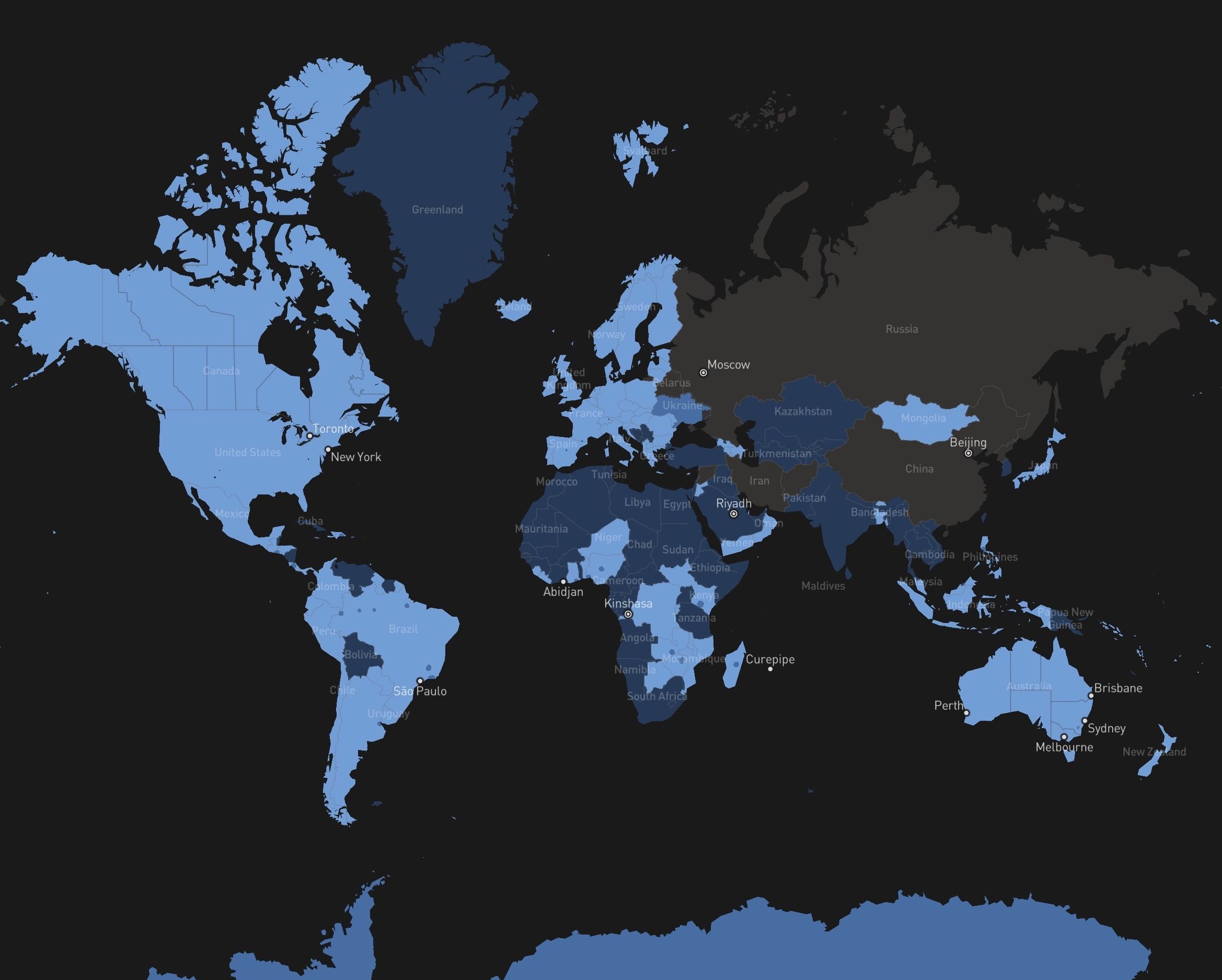
Starlink is available in over 100 countries as of mid-2025, spanning North America, Europe, Asia, Africa, Oceania, and parts of South America. As of late 2024, Starlink had surpassed 4 million subscribers. Starlink offers five service types: Residential, Roam, Business (Priority), Maritime, and Aviation. Typical speeds range from about 50 Mbps to 150+ Mbps, with most users above 100 Mbps under good conditions, and latency around 20–50 ms. Monthly pricing ranges from about $90–$120 in well-connected markets, with discounts to roughly $30–$50 in developing regions. The United States was the first to receive Starlink, with public beta in mid-2020 and
2 June 2025
Starlink and the Satellite Internet Market (2025) – Comprehensive Report

Starlink and the Satellite Internet Market (2025) – Comprehensive Report

Starlink uses a direct-to-consumer model with a Starlink kit (dish antenna + WiFi router) and monthly service, priced around $100–$120 per month, with the kit originally costing about $599 (some markets as low as $350). Speeds reach roughly 50–200 Mbps down and 10–20 Mbps up, with latency around 20–40 ms, far lower than geostationary satellites. Starlink Roam for RVs, Maritime for ships (initially about $5,000 per month with dual terminals for ocean coverage), and Aviation with dedicated aero antennas (about $150,000 hardware and $12,500–25,000 monthly for unlimited in-flight Wi‑Fi) illustrate its multi-sector strategy. In 2023 Starlink began beta mobile-phone connectivity
1 June 2025
Internet Access in Andorra: From Mountain Signals to Starlink Skies

Internet Access in Andorra: From Mountain Signals to Starlink Skies

By 2012 Andorra completed nationwide Fiber-to-the-Home rollout, wiring 100% of homes with fiber and establishing internet as a universal service delivering at least 100 Mbps. Copper ADSL networks were fully decommissioned by 2016. Andorra Telecom is the sole ISP and 100% government‑owned, delivering fixed broadband, mobile services, landlines, and TV across the country. Andorra’s mobile network provides 4G LTE coverage over about 98% of the territory, with 5G launched in December 2021 in Non-Standalone mode and a goal of 99% population coverage by end-2022 and a full Standalone core by 2025. Residential fiber plans include Fiber 300 (300 Mbps symmetric)
30 May 2025
Inside Ethiopia’s Internet Boom: Fiber Optics, 5G Dreams, and Starlink Skies

Inside Ethiopia’s Internet Boom: Fiber Optics, 5G Dreams, and Starlink Skies

As of early 2025, about 28.6 million Ethiopians were internet users, roughly 21.3% of the population. Ethio Telecom owned about 23,000 km of fiber-optic cable across Ethiopia as of 2023, forming the national backbone and linking to neighboring undersea cables via Djibouti. In late 2024, Ethio Telecom signed a Horizon Fiber corridor deal with Djibouti Telecom and Sudatel to create a multi-terabit cross-border link between Ethiopia, Djibouti, and Sudan. Ethio Telecom launched commercial 5G in Addis Ababa in October 2022, with 145 sites active in the capital by September 2023 and expansion to additional cities planned. Safaricom Ethiopia launched commercial
29 May 2025
Inside OneWeb’s Global Internet Play: How This Satellite Network Is Quietly Disrupting Starlink’s Orbit

Inside OneWeb’s Global Internet Play: How This Satellite Network Is Quietly Disrupting Starlink’s Orbit

OneWeb’s first-generation constellation comprises 648 LEO satellites at about 1,200 km altitude, each ~150 kg, using Ku-band for user links and Ka-band for gateways, with 16 spot beams and no inter-satellite laser links, delivering up to 7.2 Gbps per satellite. By late 2021, OneWeb achieved partial service in high-latitude regions, focusing on the Arctic, Northern Europe, Greenland, and Alaska. On March 25, 2023, the first-generation constellation reached 614 operational satellites, exceeding the minimum ~588 satellites required for global coverage, with 648 planned total. In September 2023, OneWeb merged with France’s Eutelsat to form Eutelsat OneWeb, making Eutelsat the 100% owner
29 May 2025
Sky-Fi Revolution: How Starlink Is Reshaping Global Internet Access

Sky-Fi Revolution: How Starlink Is Reshaping Global Internet Access

Starlink is a SpaceX satellite internet constellation that began launching in 2019 to deliver broadband virtually anywhere on Earth. As of late 2024, SpaceX had launched over 7,000 Starlink satellites, with FCC authorization for about 12,000 and potential expansion beyond 30,000 in the future. Starlink satellites orbit at approximately 550 km altitude in multiple orbital shells, enabling lower latency than geostationary satellites. SpaceX reached 1 million Starlink subscribers by the end of 2022 and 4 million by September 2024. Each Starlink satellite is equipped with phased-array antennas, and some models include inter-satellite laser links for in-space data routing. The network
29 May 2025
1 3 4 5

Stock Market Today

Semiconductor stocks surge as AI capex stays high; Nvidia and AMD lead into next week

7 February 2026
New York, February 7, 2026, 12:35 (EST) — Market closed. U.S. semiconductor stocks finished Friday sharply higher, lifting the Philadelphia Semiconductor Index (.SOX) 5.7% to 8,048.6. Nvidia (NVDA.O) climbed 7.87% to $185.41, while Advanced Micro Devices (AMD.O) rose 8.28% to $208.44 and Broadcom (AVGO.O) gained 7.22% to $332.92; Intel (INTC.O) added 4.87% to $50.59. (Investing.com) The move matters now because investors have been re-sorting the AI trade in a hurry, rotating away from software companies hit by fears that new tools could squeeze pricing power. The S&P 500 software and services index dropped 4.6% on Thursday and was on track
Oil stocks jump on Iran risk lift for crude — what to watch before Monday

Oil stocks jump on Iran risk lift for crude — what to watch before Monday

7 February 2026
U.S. oil stocks surged Friday as crude prices rose on renewed Middle East tensions. Exxon Mobil gained 2.0%, ConocoPhillips 2.5%, and Occidental Petroleum 2.7%. Refiners rallied after a national union deal eased strike risk, though BP’s Whiting plant faces a local dispute. Brent settled at $68.05 a barrel, up 0.74%.
Silver price rebound masks fresh stress after CME lifts margins again

Silver price rebound masks fresh stress after CME lifts margins again

7 February 2026
Spot silver surged 8.6% to $77.33 an ounce Friday after dropping below $65, but still lost over 8.7% for the week. CME Group raised margin requirements for COMEX silver futures to 18% from 15%, effective after Feb. 6. China’s UBS SDIC Silver Futures Fund hit its 10% down limit for a fifth session. Traders await key U.S. jobs and inflation data next week.
Go toTop