
NEW YORK, July 13, 2026, 14:09 (EDT)
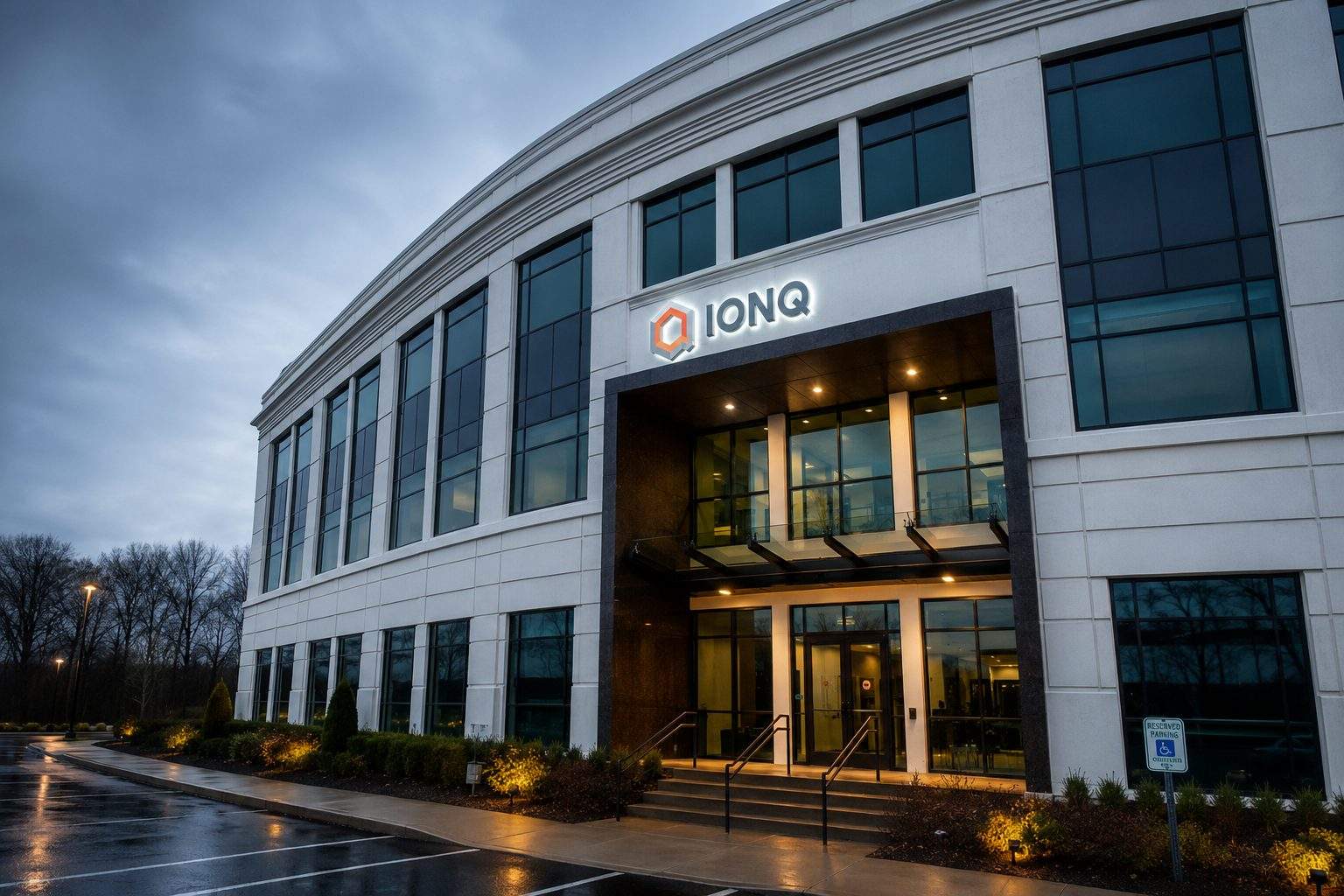
IonQ Inc. NYSE:IONQ fell 9.4% to $38.82 in Monday afternoon trading, leading a synchronized retreat in D-Wave Quantum NYSE:QBTS, Rigetti Computing NASDAQ:RGTI and Quantum Computing Inc. NASDAQ:QUBT. The four stocks erased an estimated $2.51 billion of market value by 1:53 p.m. EDT, with no fresh company-specific catalyst apparent.
What matters now is the mismatch inside the selloff. Investors are treating quantum shares as one high-beta basket — stocks that typically move more than the wider market — although the companies have very different sales bases and cash cushions. Their combined market capitalization remained $28.24 billion against just $75.7 million of first-quarter revenue; multiplying that quarter by four, a rough run rate rather than a forecast, produces a 93-times sales multiple. IonQ supplied about 86% of the revenue but represented 51% of the group’s market value.
The trigger came from outside the sector. Renewed U.S.-Iran tension in the Gulf lifted crude futures about 5% earlier, while the Invesco QQQ Trust NASDAQ:QQQ, a proxy for large technology shares, was down 1.8%. “Money is leaving this part of the market today,” said Robert Pavlik, senior portfolio manager at Dakota Wealth. Tuesday’s U.S. consumer-price report and Fed Chair Kevin Warsh’s congressional testimony add another rate test for companies whose profits are expected far in the future. Reuters
The damage was broad, but IonQ accounted for roughly 60% of the group’s lost value:
| Company | Price ($) | Day move | Market cap ($bn) | Est. value lost ($bn) |
|---|---|---|---|---|
| IonQ | 38.82 | -9.4% | 14.41 | 1.50 |
| D-Wave | 18.73 | -6.8% | 6.86 | 0.50 |
| Rigetti | 15.41 | -6.8% | 5.16 | 0.38 |
| Quantum Computing | 8.05 | -7.0% | 1.80 | 0.14 |
| Combined | — | — | 28.24 | 2.51 |
The balance-sheet comparison is less uniform:
| Company | Q1 revenue ($m) | Cash and investments ($bn) | Cash-adjusted annualized Q1 sales |
|---|---|---|---|
| IonQ | 64.7 | 3.10 | 43.7x |
| D-Wave | 2.9 | 0.59 | 549.0x |
| Rigetti | 4.4 | 0.57 | 261.0x |
| Quantum Computing | 3.7 | 1.40 | 27.2x |
| Combined | 75.7 | 5.66 | 74.6x |
The last column subtracts reported cash and investments from market value, then divides by four times Q1 revenue. It is a simple comparison, not enterprise value or a revenue forecast.
IonQ looks expensive but less extreme than two peers on this measure: 43.7 times after cash, compared with 261 times for Rigetti and 549 times for D-Wave. QUBT falls to 27.2 times because cash and investments equal about 78% of its market value, though the company said most of its first-quarter revenue increase came from businesses acquired in February and March.
IonQ’s roughly 100-times trailing price-to-earnings ratio is also a weak anchor. Its $804.6 million first-quarter net income included a $1.06 billion noncash gain from marking warrant liabilities to market — revaluing them as the stock price changes — while operations lost $271.5 million. The multiple therefore reflects a large accounting swing, not ordinary operating profit.
The operating case is stronger than the earnings multiple suggests, but still early. IonQ reported $470 million of remaining performance obligations — contracted revenue not yet recognized — and forecast $260 million to $270 million of 2026 sales. Its security-and-space push includes Clavis XG Multiplex, which carries quantum and conventional data traffic over the same metropolitan fiber, and a commercial service for three-day, millimeter-scale ground-motion monitoring. IonQ President Jordan Shapiro said Clavis lets customers send “multiple types of data across the same fiber.” TradingView
D-Wave offers a different commercial signal: $33.4 million of first-quarter bookings — customer orders expected to become revenue — against $2.9 million of recognized sales. The bookings included a $20 million system order whose revenue is due in later quarters. CEO Alan Baratz called the quarter evidence of “strong execution, expanding commercial adoption.” Rigetti, meanwhile, has put its 108-qubit Cepheus system into general availability, but its $4.4 million quarterly revenue remains small beside a $5.16 billion market value. Business Wire
But the path can break both ways. A cooler inflation reading or easing Gulf tension could trigger a fast rebound in sentiment-driven shares; the downside is that interest rates remain high while technical milestones slip. IonQ targets an operational 256-qubit system in the fourth quarter of 2026, and a delay could push customer installations and revenue recognition further out.
The next hard test is not Monday’s tape. It is whether IonQ can convert contracted work and new products into revenue fast enough to narrow a valuation gap that remains large even after the selloff.
Related articles: NASDAQ:RGTI