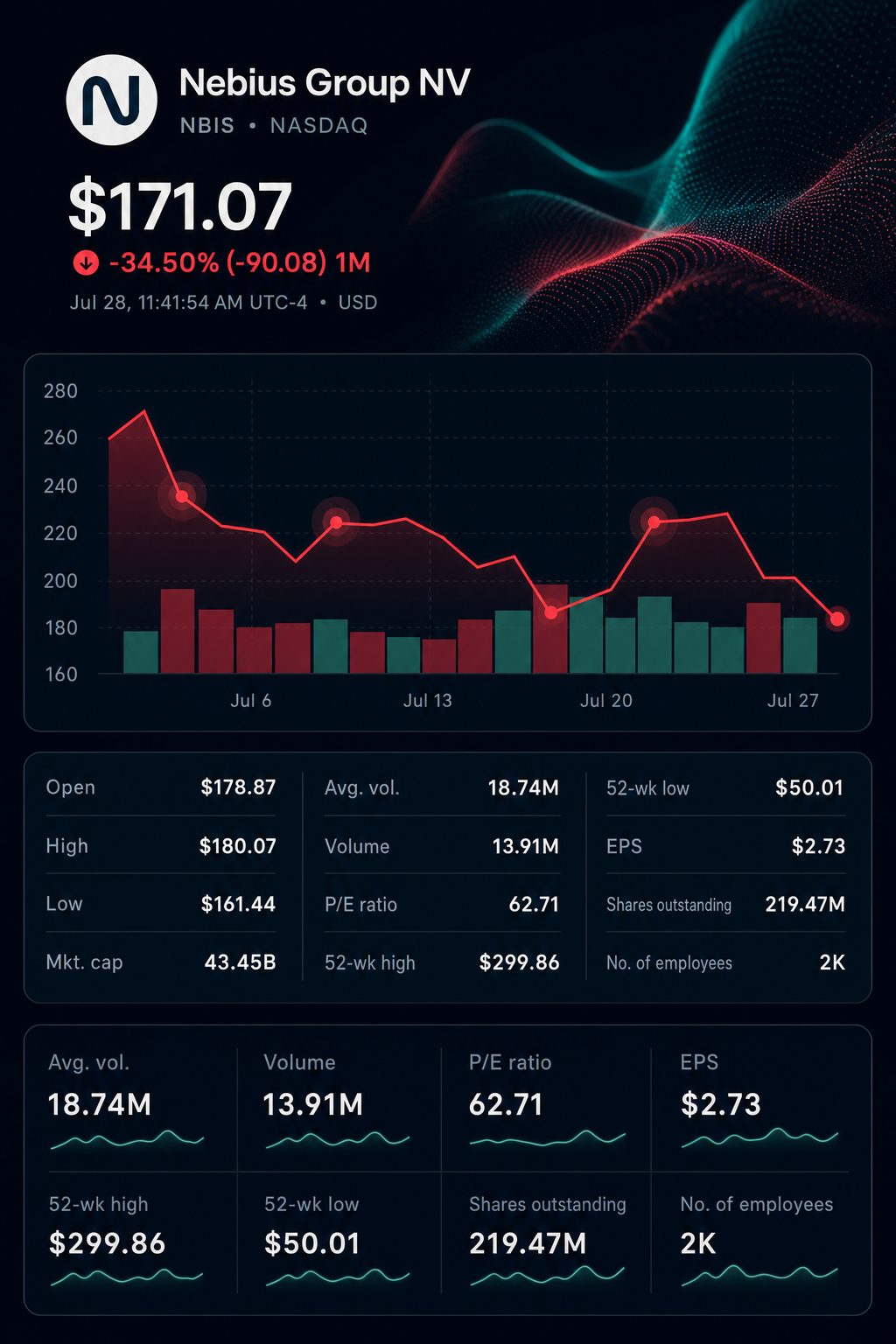
Nebius dropped 12.0% to $165.30 in early U.S. trading.
The AI-cloud adjusted EBITDA margin stood at 45%, while depreciation accounted for 53% of the group’s revenue.
Initial estimates indicate that intended capital expenditure for 2026 will equal 5.9–8.3 times the forecasted revenue.
Nebius Group NASDAQ:NBIS slid 12.0% to $165.30 during morning trade on Tuesday, sharply underperforming the broader Nasdaq, which also declined early.
The valuation depends on whether gains from software can outpace GPU depreciation. Numbers are still divided.
The AI-cloud division at Nebius reported an adjusted EBITDA margin of 45% for the first quarter. This figure, however, does not account for depreciation and amortization. Group depreciation and amortization totaled $212 million, representing 53% of revenue. The group experienced an operating loss of $128 million.
AI-cloud revenue surged 841% to $389.7 million, indicating swift growth. However, first-quarter capital expenditure totaled $2.47 billion, equivalent to 6.2 times group revenue.
Metric
Reported figure
Investor read-through
AI-cloud revenue
$389.7 million, up 841%
Rapid growth in capacity demand
AI-cloud adjusted EBITDA
$174 million; 45% margin
Does not include depreciation
Group D&A
$212 million; 53% of revenue
Owning GPUs continues to be expensive
Group operating result
$128 million loss
No GAAP earnings breakthrough
First-quarter capex
$2.47 billion; 6.2 times revenue
Funding needs remain high
2026 capex versus revenue guidance
$20–25 billion versus $3.0–3.4 billion
5.9–8.3 times revenue
The preliminary ratio is based on company guidance and does not represent a profit forecast.
This split highlights the significance of Nebius’s asset-light strategy announced on July 15. Under this model, partners would supply funding and possess the equipment, while Nebius would handle the architecture, software, service commitments and customer connections.
Chief Executive Arkady Volozh said, “Our software allows partners to reach a much wider customer base with much better margins.” Nebius
Nebius stated it had reached preliminary agreements under the model. The disclosure did not name any partners nor specify capacity commitments. No timelines or estimated cost reductions were provided. Any short-term impact on capital expenditure is therefore still tentative.
Debt and customer funds continue to underpin the current build. Nebius secured $775 million via secured debt financing on July 17. The facility carries the Secured Overnight Financing Rate with an added 2.50 percentage points.
The loan is secured by deployed GPUs alongside contracted customer cash flows. Nebius stated that these cash flows, together with the loan, fully finance the infrastructure’s capex requirements.
The company pointed to over $40 billion in contracted revenue from Microsoft NASDAQ:MSFT and Meta Platforms NASDAQ:META. These deals may allow for additional borrowing at the asset level.
Nebius reported cash holdings of $9.30 billion as of March 31. The company’s total debt was about $8.45 billion, approximately twice what it was at the end of the year.
Operating cash flow for the first quarter stood at $2.26 billion. This amount factored in a $3.20 billion rise in deferred revenue. Customer prepayments are consequently providing significant financing support.
CoreWeave NASDAQ:CRWV declined by 7.8%, while Nvidia NASDAQ:NVDA remained largely steady. The Nasdaq slipped 1.16% at the start of trade as investors weighed returns from AI investments. Nebius posted a sharper decrease, reflecting additional worries about financing amid broader sector softness.
Nebius shares surged roughly 19% last week after Nvidia revealed a 9.3% beneficial stake. The turnaround on Tuesday highlights the rapid shift from strategic confidence to caution around capital expenditure.
Risks: Returns may be pressured by customer concentration, delivery setbacks, outdated GPUs, and rising funding expenses. Reduced utilization would increase the impact of depreciation. Those risks could be mitigated by quicker partner rollouts or improved pricing strength.
The next key milestone is not a new major contract. Investors require evidence of partner capacity, fee structure, and tangible decreases in owned capex. Until those are demonstrated, Nebius maintains software-level margins on an infrastructure-heavy balance sheet.
What is causing NBIS to drop so significantly today?
NBIS was last down 11.7% at $165.87 at 10:48 a.m. Eastern on July 28, with shares moving between $161.69 and $183.23 on 10.3 million shares. CoreWeave fell 7.2%, while global chip stocks declined. Reuters reported Chinese rivals, concerns about AI investment, and high valuations as factors. Reuters Nebius’s filing on July 27 outlined a renewal of an existing 20% issuance authorization, potentially increasing dilution concerns. No public offering was detailed.
Does authorizing a 20% share increase guarantee dilution will take place?
No, dilution does not occur automatically. The proposal gives permission—but does not mandate—the issuance of new Class A shares. It applies to a maximum of 20% of outstanding capital and allows for pre-emptive rights to be set aside. The authorization is valid for five years and could facilitate either funding activities or acquisitions. SEC The same 20% authorization was approved by shareholders at the August 2025 meeting. Whether dilution takes place depends on if, how many, and at what price new shares are issued.
Is Nvidia's newly revealed 9.3% holding a recent acquisition?
No, this primarily involved an earlier deal becoming subject to reporting rules. The July filing mainly reflected a pre-funded warrant obtained in March. Nvidia disclosed 22.26 million beneficial shares, representing a 9.3% stake in Class A. Of these, roughly 21.07 million are tied to warrants, with just 1.19 million as direct ownership. SEC The warrant cannot be exercised, nor can shares be sold, prior to September 11. Nebius had previously received Nvidia's $2.0 billion investment in the first quarter.
Did Nebius report a profit for the first quarter?
On a GAAP basis, that is correct. Net income for Q1 reached $621.2 million, with an operating loss reported at $128.0 million. The bulk of profit came from a $780.6 million non-cash investment revaluation. Adjusted net loss totaled $100.3 million. Adjusted EBITDA moved into positive territory at $129.5 million. SEC The AI cloud segment delivered $174.0 million in adjusted EBITDA with a 45% margin.
What do the upcoming results need to demonstrate to back the 2026 guidance?
Management is aiming for revenue in the range of $3.0–$3.4 billion and year-end ARR of $7–$9 billion. SEC First quarter revenue totaled $399 million, with ARR at $1.92 billion as of March. Nebius Assets That leaves $2.60–$3.00 billion to be generated over the following quarters, or $867 million–$1.00 billion on a quarterly basis. Year-end ARR targets require an increase to about 3.6–4.7 times March levels. Nebius expects Q3 to show major capacity gains, with 800MW to 1GW slated for connection by year-end. Progress on sequential ARR growth and utilization will be key to tracking ramp-up.
Is Nebius able to finance $20–$25 billion in capital expenditure without significant dilution?
Nebius increased its 2026 capex outlook to $20–$25 billion. Reuters The company finished March with $9.30 billion in cash, while Q1 capital expenditures reached $2.47 billion. Total debt in March was about $8.45 billion, reflecting significant convertible-note holdings. SEC Its $775 million secured facility arranged in July carries SOFR plus 2.50%, backed by specific projects. Customer inflows combined with this facility fully cover the company’s GPU-related capex. Nebius Nebius’ May statement highlighted debt, received prepayments, and an unused ATM program as available sources. Substantial dilution remains a possibility.
What is the level of security around the demand commitments from Meta and Microsoft?
Meta has pledged to $12 billion in capacity through 2027, with an additional $15 billion contingent on unsold capacity and therefore not assured. Microsoft holds a separate $17.4 billion agreement. Reuters As of March 31, Nebius disclosed $33.59 billion in remaining performance obligations, of which only 29% is estimated to be recognized as revenue in the next 24 months. This figure contains projected variable consideration, meaning values could shift. Demand remains visible, though timing of delivery and major client concentration continue to be important factors.
Does the shift to an asset-light model significantly cut capital exposure?
Possibly, though the business case is yet to be demonstrated. Hardware investment and ownership will fall to the partners, while Nebius contributes the software and markets the available capacity. The company describes the structure as demanding little additional capital, pursuing high-margin sales. Early-stage agreements have been reached, though no participating partners or financial details have been disclosed. Nebius Guidance for 2026 capital spending was left unchanged, maintaining the figure at $20–$25 billion. Investors seek information on available capacity, how revenue will be split, and when the service will go live.
Has NBIS become undervalued following the latest selloff?
On a straightforward price-to-sales basis, the answer is no. With 253.90 million shares as of March, a price of $165.87 gives an equity valuation of about $42.1 billion. That equates to approximately 12.4 to 14.0 times management’s projected 2026 revenue. This figure is a rough calculation, since the share count is from March. SEC Nvidia’s warrant could convert to 21.07 million shares. The $4.34 billion convertible notes from March convert at around $180–$183 per share, a premium to the current price. SEC While growth is outsize, the level of financing and execution risk remains elevated.
What are the main drivers this week?
Meta and Microsoft are due to release earnings after markets close Wednesday, July 29. Their statements on AI investments and external capacity may trigger rapid moves in NBIS. Meta The Federal Reserve also meets Wednesday, with markets assigning a 36% probability to a quarter-point rate hike. Reuters Nebius has not announced a Q2 earnings date; there are no updates on its events calendar. The next confirmed event is the August 25 annual meeting. Nebius In the meantime, sector sentiment and customer feedback are likely to lead direction until an earnings date is set.
Jerzy Lewandowski is a senior markets editor at TS2.tech. His coverage ranges from stocks and semiconductors to AI and the broader global markets. He studied economics at the University of Warsaw and worked in investment analysis before becoming a financial journalist. Follow Jerzy Lewandowski on Google News.
A figure above or below the 12.0 consensus could impact Treasury yields, the dollar, and cyclical stocks by influencing short-term growth outlooks.
#2
NAHB Housing Sentiment
A reading above or below 33 will influence expectations for housing demand, mortgage rate trends, and homebuilder stocks.
#3
Fabrinet After the Close
Investors are focusing on revenue, margins, and comments on datacom as key factors for companies involved in optical networking and AI infrastructure supply chains.