Bloom Energy (NYSE:BE) surges 26% as single client drives 73% of Q2 sales
30 July 2026
2 mins read

Bloom Energy (NYSE:BE) surges 26% as single client drives 73% of Q2 sales

NEW YORK, July 30, 2026, 10:06 EDT — Shares of Bloom Energy rose 26% at the U.S. market open after the company disclosed that one counterparty represented 73% of its second-quarter sales.

  • At 9:51 a.m. EDT, Bloom was up 26.4%, rising $43.25 to $207.00.
  • Bloom Energy reported Q2 revenue of $1.065 billion and adjusted diluted earnings per share of $0.78.
  • Initial assessment indicates the main contractual counterparty contributed approximately $778 million.

Bloom shares rallied Thursday, recovering from a 1.8% drop on Wednesday. Quarterly revenue topped forecasts by about 29%. Adjusted EPS was almost twice the consensus estimate.
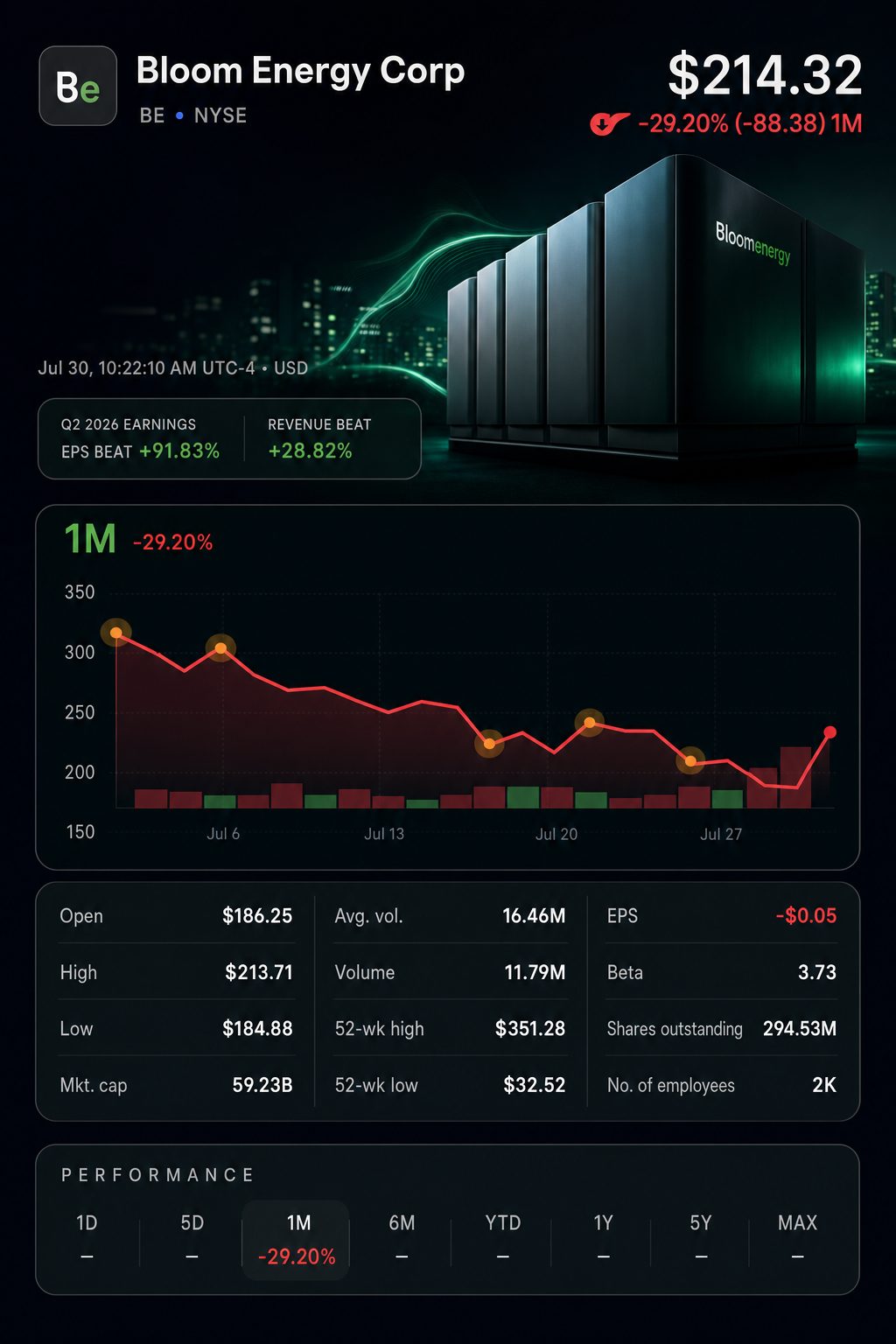
Stock chart for NYSE:BE

The revised filing shifts the perspective for investors. A single contractual partner accounted for 73% of revenue in the second quarter. Still, the updated annual guidance midpoint calls for only slight growth in the latter half.

MetricQ2 2026ComparisonDifference
Revenue$1.065 billion$826.1 million consensus+28.9%
Adjusted diluted EPS$0.78$0.41 consensusApproximately +90%
GAAP gross margin33.4%26.7% in Q2 2025+6.7 points
Operating cash flow$226.4 million$(213.1) million in Q2 2025+$439.5 million

Bloom’s earnings and consensus estimates as published by Barron’s and Investor’s Business Daily.

Revenue jumped 165.5% from a year earlier, with product sales climbing 215.4%. GAAP operating margin improved to 17.1%, compared to negative 0.9%. Chief Executive KR Sridhar stated, “Bloom is now a standard for AI onsite power.” Bloom Energy

Caution is needed with the 73% statistic. Bloom refers to its “customer” as the entity it contracts with. In certain agreements, the counterparty is a project-finance subsidiary rather than the ultimate consumer. SEC

Customer-concentration measureQ2 2026Q2 2025
Top reported counterparty73%30%
Total share from reported counterparties73%74%
Number of counterparties reported14
Initial estimate, revenue from top counterparty$777.7 million$120.4 million

Early estimates are based on stated quarterly revenue figures and revealed percentages.

The total of reported customer shares remained almost the same at 73%, compared with 74%. However, the composition shifted, with four specified counterparties consolidating into one leading counterparty.

Leading indicators improved. Customer deposits increased to $360.6 million, up from $78.2 million since December. Product and installation revenue under contract but not yet recognized grew 12% to $442.4 million.

Management has increased its 2026 sales forecast for a second time. The revenue midpoint set in July is 26.6% higher compared to February’s level. The midpoint for adjusted EPS is now up 92%.

Outlook dateRevenue rangeRevenue midpointAdjusted EPS rangeEPS midpoint
February 5$3.1–$3.3 billion$3.20 billion$1.33–$1.48$1.41
April 28$3.4–$3.8 billion$3.60 billion$1.85–$2.25$2.05
July 28$3.9–$4.2 billion$4.05 billion$2.55–$2.85$2.70

Midpoints reflect Bloom’s disclosed guidance ranges.

With the updated midpoint, Bloom must secure $2.234 billion in the latter half, equating to $1.117 billion each quarter, which is just 4.8% higher than the second quarter. The upper range scenario represents an average just 11.9% ahead of Q2.

Full-year sales scenarioNeeded H2 salesH2 quarter averageAverage compared to Q2
$3.90 billion$2.084 billion$1.042 billion-2.2%
$4.05 billion midpoint$2.234 billion$1.117 billion+4.8%
$4.20 billion$2.384 billion$1.192 billion+11.9%

Figures are based on first-half revenue of $1.816 billion and Bloom’s most recent full-year forecast range.

The revenue target appears achievable, but the valuation remains steep. Priced at $207, the shares trade at a straightforward 77 times the midpoint of adjusted EPS.

Risk exposure remains high. At June 30, three clients accounted for 87% of receivables. Warranty and product-performance obligations increased to $77.8 million, up from $20.0 million.

The following challenge is breadth. Investors are seeking additional counterparties as adjusted gross margin remains close to 34%. Even another billion-dollar quarter might not resolve this issue.

TS2 TECH • EXTENDED COVERAGE

Further analysis

What is driving the rise in Bloom Energy shares today?

BE shares were up 25.7% at $205.89 as of 9:52 Eastern time, with trading volume already at 8.5 million shares. The sharp gains came after the company released record quarterly earnings and raised its full-year outlook. The stock’s intraday range spanned $161.40 to $209.69, an unusually large band for the session. Despite trading at $205.89, shares were still roughly 41% lower than their June high of $351.28. The latest price was a real-time quote, not the session’s closing value. Bloom Energy

What was the magnitude of the second-quarter earnings outperformance?

Revenue totaled $1.065 billion, representing a 165.5% increase over the year-ago quarter and surpassing FactSet’s $826.1 million estimate by around 29%. Adjusted diluted EPS stood at $0.78, nearly twice the consensus of $0.41. GAAP diluted EPS climbed to $0.62, up from last year’s $0.18 loss. Product revenue jumped 215.4% to $935.4 million, accounting for the majority of the quarterly gain. It marked a significant beat. Bloom Energy

By how much did management increase its forecast for 2026?

The company raised its revenue outlook to $3.9–$4.2 billion, up from the previous $3.4–$3.8 billion range given in April. The midpoint advanced 12.5% to $4.05 billion from $3.60 billion. Adjusted EPS guidance was lifted to $2.55–$2.85, above the prior $1.85–$2.25 range, with the midpoint jumping 31.7% to $2.70 from $2.05. Management continues to expect a full-year adjusted gross margin of about 34%. Bloom Energy

What does Bloom need to achieve in the second half?

Combined Q1 and Q2 sales brought first-half revenue to $1.816 billion. Bloom now requires $2.084–$2.384 billion in revenue over the second half, translating to about $1.042–$1.192 billion per quarter. Adjusted EPS for the first half stood at $1.22. To meet its target, Bloom must deliver $1.33–$1.63 in the remainder of the year, or around $0.67–$0.82 per quarter. FactSet’s latest consensus sees Q3 EPS at $0.65 and Q4 at $0.83. Bloom Energy

Have margins and cash flow reached a sustainable level?

GAAP gross margin for the second quarter rose to 33.4%, up 668 basis points from a year earlier. GAAP operating income stood at $182.2 million, compared to a $3.5 million loss. Operating cash flow for the quarter improved to $226.4 million from negative $213.1 million. For the first half, operating cash flow reached $300.0 million, reversing a negative $323.8 million. While the improvement is notable, its sustainability is not yet established. Bloom omitted $113.4 million in first-half stock-based compensation from its adjusted results. Bloom Energy

What is the significance of the $25 billion Brookfield framework?

Brookfield has increased its financing arrangement with Bloom from $5 billion up to $25 billion, targeting fuel-cell projects supporting AI infrastructure and data centres worldwide. The framework is designed to help scale deployment capacity. The $25 billion figure does not represent booked revenue for Bloom; actual revenue will be determined by finalized deals, project timelines, financing arrangements, and client acceptance. According to management, Bloom’s systems have been validated by every major U.S. hyperscaler, but this claim is management’s and has not been independently verified. Reuters

Is reliance on a few key customers currently the main operational risk?

Customer concentration stands out as one of Bloom’s most significant short-term operational risks. A single contractual customer accounted for roughly 73% of the company’s second-quarter revenue. During the first half, two customers jointly made up about 44% and 21% of total revenue. Three customers were responsible for 36%, 34%, and 17% of stated accounts receivable. Bloom updated its filing after it had initially switched its three-month and six-month categories. The revised disclosure continues to indicate high concentration. Contractual customers could be project-finance affiliates, not necessarily the final end users. SEC

What issues have yet to be settled in the disagreement between the short-seller and those involved with scandium?

Hunterbrook stated it may benefit if Bloom shares fall. The July report from Hunterbrook questioned both Bloom’s accounting practices and its statements about scandium supply. Bloom refuted the allegations, emphasizing the accuracy of its audited financials. Bloom also said its available scandium inventory meets both present demand and its backlog. According to Bloom, supply visibility is adequate for 25 gigawatts of annual output. These assertions come from Bloom’s management. The public information examined here does not independently resolve the ongoing dispute over supply chain details. SEC

Is Bloom able to support growth without seeking another significant capital injection?

As of June 30, Bloom reported $2.667 billion in cash and equivalents. Recourse debt stood at $2.475 billion, consisting primarily of convertible notes coming due in 2030. The company had access to an undrawn revolver worth $510 million for immediate borrowing. Principal maturities for the remainder of 2026 amount to just $7.4 million. Liquidity looks ample in the near term, and management projects at least twelve months of coverage ahead. However, future expansion may call for additional debt or equity issuance. Shares were up 4.8%. Bloom Energy

How do analysts project BE’s performance, and is its valuation considered reasonable?

FactSet projects EPS at $2.60 for 2026 and $4.80 for 2027. With shares at $205.89, BE is trading at close to 79 times the current 2026 forecast. The valuation appears stretched. Analyst price targets after results range from $176 to $314, with a simple median of $262, while Benzinga’s average from 22 analysts sits at $201. The broad disparity may reflect differences in update timing. As a result, the accuracy of any twelve-month price target is more uncertain than usual. The Wall Street Journal

Roman Perkowski is a senior markets reporter at TS2.tech, specializing in stocks, technology and macroeconomic trends. A graduate of the Cracow University of Economics, he previously worked in investment research and corporate finance. His coverage helps readers understand the key forces driving global financial markets and emerging industries. Follow Roman Perkowski on Google News.

AI PORTFOLIO

Top Stock Picks

Today’s highest-ranked model selections.

#1 BUY ON PULLBACK

Microsoft

NASDAQ: MSFT 94 / 100
#2 BUY

L3Harris Technologies

NYSE: LHX 90 / 100
#3 BUY

Xylem

NYSE: XYL 89 / 100
#4 BUY IN TRANCHES

Lam Research

NASDAQ: LRCX 87 / 100
#5 BUY ON WEAKNESS

GE HealthCare

NASDAQ: GEHC 84 / 100
View full portfolio
Editorial model selection. Not personalised advice.
Jersey Mike’s $1 bln IPO (NYSE:JMKE) delivers 68% to selling holders, focuses on debt hurdle (Reuters)
Previous Story

Jersey Mike’s $1 bln IPO (NYSE:JMKE) delivers 68% to selling holders, focuses on debt hurdle (Reuters)

Arm Holdings (NASDAQ:ARM) Shares Surge with Rapid Growth in AI Core Shipments
Next Story

Arm Holdings (NASDAQ:ARM) Shares Surge with Rapid Growth in AI Core Shipments