Browse Category

Scientific Discoveries News 4 November 2025 - 4 January 2026

SOHO spots water gushing from interstellar comet 3I/ATLAS after its Sun pass

SOHO spots water gushing from interstellar comet 3I/ATLAS after its Sun pass

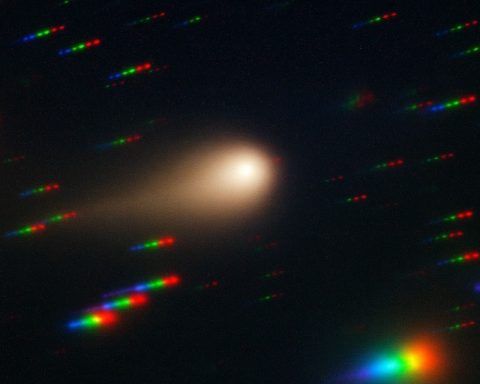
Scientists using the SOHO spacecraft measured water production from interstellar comet 3I/ATLAS peaking at 3.17 x 10^29 molecules per second in early November 2025, then dropping sharply by December. The data, posted as a preprint, provide rare post-perihelion measurements for only the third confirmed interstellar object to enter the solar system. NASA says the comet poses no threat to Earth.

4 January 2026
Interstellar comet 3I/ATLAS spills its secrets as scientists clock its water loss and radio silence

Interstellar comet 3I/ATLAS spills its secrets as scientists clock its water loss and radio silence

NEW YORK, January 2, 2026, 12:50 ET Astronomers have measured water streaming from interstellar comet 3I/ATLAS after it passed closest to the Sun, using ultraviolet observations that track hydrogen released as water breaks apart, a report published on Friday said. Phys The finding matters because 3I/ATLAS is only the third confirmed object known to have entered the solar system from interstellar space. Scientists treat such visitors as time-limited samples of material formed around another star, and this one is still being followed as it recedes. NASA has said the comet is on a hyperbolic trajectory — a one-time flyby rather
Hubble’s new 3I/ATLAS data show twin jets as rare interstellar comet fades

Hubble’s new 3I/ATLAS data show twin jets as rare interstellar comet fades

NEW YORK, December 29, 2025, 06:44 ET NASA’s Hubble Space Telescope has carried out a new observation of interstellar comet 3I/ATLAS, with the Space Telescope Science Institute’s status report showing a Dec. 27 visit now archived. (STScI visit status report) stsci.edu The update comes as 3I/ATLAS fades rapidly from view after swinging past Earth this month, while continuing on an outbound path that will next take it past Jupiter in March, NASA officials said in an Associated Press report. (AP) AP News That timing matters because 3I/ATLAS is only the third confirmed interstellar visitor ever spotted in the solar system, according to
Comet 3I/ATLAS Today (Dec. 25, 2025): What’s New After the Flyby, What NASA and ESA Just Saw, and Why It Matters

Comet 3I/ATLAS Today (Dec. 25, 2025): What’s New After the Flyby, What NASA and ESA Just Saw, and Why It Matters

December 25, 2025 marks the strange, quiet “afterglow” phase of Comet 3I/ATLAS—the third confirmed interstellar object ever found passing through our solar system. The comet’s closest approach to Earth is already behind us (it passed at a safe distance), but the science story is still unfolding fast: Breakthrough Listen has now reported results from an ultra-sensitive “are you broadcasting?” radio search, while NASA and ESA continue to publish spacecraft observations that help pin down what this visitor is actually made of—and how it behaves when the Sun starts cooking it. SETI Institute The quick recap: what is 3I/ATLAS, and why
25 December 2025
Comet 3I/ATLAS Today: December 24, 2025 Updates on the Interstellar Visitor

Comet 3I/ATLAS Today: December 24, 2025 Updates on the Interstellar Visitor

December 24, 2025 — Comet 3I/ATLAS (also cataloged as C/2025 N1 (ATLAS)) is already past its closest point to Earth, fading and drifting outward again — but the science and the headlines are accelerating, not slowing down. Today’s developments include a newly released Breakthrough Listen radio search that reports no sign of artificial transmissions, fresh discussion about the comet’s cyanide chemistry, and continued analysis of the comet’s rare sunward-facing “anti-tail” and wobbling jet behavior. NASA Science+3arXiv+3The Economic Times+3 Where is Comet 3I/ATLAS today? As of December 24, 2025, ephemeris trackers place 3I/ATLAS at roughly 1.81 AU from Earth and 2.44
24 December 2025
Comet 3I/ATLAS Today (22 December 2025): The Latest Science, Spacecraft Views, and “Radio Signal” Reality Check

Comet 3I/ATLAS Today (22 December 2025): The Latest Science, Spacecraft Views, and “Radio Signal” Reality Check

As of 22.12.2025, the interstellar comet 3I/ATLAS—only the third confirmed object from beyond our solar system—is already on its way out again. Its closest pass by Earth happened just days ago, and while the comet never came anywhere near “close” in a human sense, the flyby has triggered a wave of fresh data releases, rapid-response observations, and (inevitably) some internet-fueled mythology. Here’s what’s new right now: what scientists have actually seen, what they haven’t seen, and what comes next as 3I/ATLAS heads toward the outer solar system. NASA Science+1 The big headline today: 3I/ATLAS is leaving—but the best data is
Interstellar Comet 3I/ATLAS Nears Closest Earth Flyby on Dec. 19: New X‑ray Views, UN Tracking, and What Scientists Know Now

Interstellar Comet 3I/ATLAS Nears Closest Earth Flyby on Dec. 19: New X‑ray Views, UN Tracking, and What Scientists Know Now

December 15, 2025 — A rare visitor from beyond our solar system is making its final, headline-worthy sweep through the inner neighborhood — and the countdown to its closest pass by Earth is nearly over. Interstellar comet 3I/ATLAS (also designated C/2025 N1 (ATLAS)) will reach its closest approach to Earth on Friday, December 19, 2025, staying a safe ~1.8 astronomical units away — about 270 million kilometers (167–170 million miles), roughly twice the average Earth–Sun distance. It poses no threat to Earth, but the timing is ideal for professional observatories — and for skilled backyard stargazers with telescopes — to squeeze out precious data before the comet continues outward on
Comet 3I/ATLAS Update (Dec. 13, 2025): New Green Glow, First X‑Ray Views, and What’s Next for the Interstellar Visitor

Comet 3I/ATLAS Update (Dec. 13, 2025): New Green Glow, First X‑Ray Views, and What’s Next for the Interstellar Visitor

On December 13, 2025, Comet 3I/ATLAS—the third confirmed interstellar object ever found crossing our solar system—is back in the headlines as astronomers release fresh observations that deepen the mystery (and the science) of this rare cosmic flyby. It’s not just “another comet”: 3I/ATLAS is an outsider from beyond the Sun’s gravitational family, racing through on a hyperbolic path that proves it wasn’t born here. NASA Science+1 Today’s developments add two eye-catching chapters to the story: All this arrives just days before the comet’s closest approach to Earth on December 19, 2025—a safe but scientifically valuable alignment that researchers are treating
NASA’s Interstellar Comet 3I/ATLAS: New Images, Life’s Ingredients and What Comes Next After the December Flyby

NASA’s Interstellar Comet 3I/ATLAS: New Images, Life’s Ingredients and What Comes Next After the December Flyby

As of December 10, 2025, NASA and partner observatories are racing to squeeze every last photon out of interstellar comet 3I/ATLAS — a green-glowing, ice‑volcano‑blasting visitor loaded with the chemical “ingredients for life.” Here’s the latest on what we’ve learned and what to watch in the days ahead. What is 3I/ATLAS, and why is it such a big deal? 3I/ATLAS — also cataloged as C/2025 N1 (ATLAS) — is only the third confirmed object ever seen passing through our solar system from another star system, after 1I/ʻOumuamua in 2017 and 2I/Borisov in 2019.NASA Science+1 It was discovered on July 1,
Interstellar Comet 3I/ATLAS: Ice Volcanoes, Life’s Building Blocks and the December 19 Flyby — Latest Updates as of December 8, 2025

Interstellar Comet 3I/ATLAS: Ice Volcanoes, Life’s Building Blocks and the December 19 Flyby — Latest Updates as of December 8, 2025

As of December 8, 2025, interstellar comet 3I/ATLAS (also known as C/2025 N1 (ATLAS)) has gone from an obscure discovery to a global headline-maker. New observations are revealing cryovolcano‑like eruptions, an atmosphere rich in prebiotic molecules, and spectacular images from NASA and ESA ahead of its December 19 close approach to Earth— all while fringe claims about aliens and “electromagnetic sickness” swirl online. Here’s a clear, evidence-based look at what we actually know right now about 3I/ATLAS, and why this visitor from another star system matters. What is Comet 3I/ATLAS? 3I/ATLAS is the third confirmed interstellar object ever seen in our Solar System, after 1I/ʻOumuamua (2017) and 2I/Borisov (2019).Wikipedia+1 Key facts: Crucially, the comet will not
Interstellar Comet 3I/ATLAS Lights Up December Skies: New Images, ‘Ice Volcanoes’ and Life‑Linked Molecules

Interstellar Comet 3I/ATLAS Lights Up December Skies: New Images, ‘Ice Volcanoes’ and Life‑Linked Molecules

Published December 7, 2025 Interstellar comet 3I/ATLAS – only the third confirmed visitor ever seen passing through our Solar System from another star – is putting on its biggest show yet this December. As it brightens again after looping behind the Sun, astronomers are releasing a flood of new results: Hubble and ESA’s Juice spacecraft have snapped fresh images, radio telescopes have detected the comet’s first “radio signal,” and new chemistry measurements reveal surprisingly large amounts of methanol and hydrogen cyanide, molecules tied to both the origins and the destruction of life. Live Science+3Live Science+3IFLScience+3 At the same time, speculative claims that 3I/ATLAS might be an
Interstellar Comet 3I/ATLAS: December 2025 Close Approach, New Hubble Images and ‘Ice Volcano’ Surprises

Interstellar Comet 3I/ATLAS: December 2025 Close Approach, New Hubble Images and ‘Ice Volcano’ Surprises

Interstellar comet 3I/ATLAS – also known as C/2025 N1 (ATLAS) – has just become the most closely watched visitor in the night sky. On 4 December 2025, a wave of new observations and images from NASA and ESA revealed that this third-known interstellar object is far more active and scientifically intriguing than astronomers first expected. NASA Science+2European Space Agency+2 Fresh Hubble photos, a surprise “teaser” image from ESA’s Juice spacecraft and new reports of vigorous activity around the comet are converging just as 3I/ATLAS heads toward its closest approach to Earth later this month, offering scientists and skilled amateur astronomers
Interstellar Comet 3I/ATLAS: Cryovolcanoes, Expanding Coma and ‘Heartbeat’ Pulses – Latest Updates as of December 3, 2025

Interstellar Comet 3I/ATLAS: Cryovolcanoes, Expanding Coma and ‘Heartbeat’ Pulses – Latest Updates as of December 3, 2025

Published: December 3, 2025 Interstellar comet 3I/ATLAS – only the third known visitor from another star system – is putting on one of the strangest shows astronomers have ever seen. In the last 48 hours alone, new research and images have revealed: All of this is happening as 3I/ATLAS climbs back into the pre‑dawn sky after whipping around the Sun in late October and heading toward its closest approach to Earth on December 19, 2025, at a safe distance of about 170 million miles (270 million km). EarthSky+1 Here’s what you need to know today about this once‑in‑a‑lifetime interstellar visitor. What Is Interstellar Comet 3I/ATLAS?
Interstellar Comet 3I/ATLAS on 18 November 2025: New Multi‑Tailed Image, NASA’s Big Reveal and a Planetary‑Defense Rehearsal

Comet 3I/ATLAS Today: NASA’s Big Image Reveal, ISRO’s New Data and How to Follow the Interstellar Visitor (Nov. 19, 2025)

On Wednesday, November 19, 2025, the interstellar comet 3I/ATLAS is center stage: NASA is set to unveil its sharpest images yet of this rare object, while ISRO scientists in India share fresh observations from their Mount Abu telescope. Here’s everything you need to know today about what’s happening, why it matters, and how to watch. India Today+3Reuters+3NASA+3 Today’s Big 3I/ATLAS Headlines (Nov. 19, 2025) NASA’s live reveal at 3 p.m. ET NASA is holding a live media event at 3 p.m. Eastern Time today from Goddard Space Flight Center in Greenbelt, Maryland, to unveil new imagery of 3I/ATLAS collected by multiple space- and ground-based observatories. NASA+2NASA
Earth’s New ‘Quasi‑Moon’ 2025 PN7: What NASA’s Data and Astronomers Say Today (Nov. 18, 2025)

Earth’s New ‘Quasi‑Moon’ 2025 PN7: What NASA’s Data and Astronomers Say Today (Nov. 18, 2025)

Earth has a tiny new traveling companion. Here’s what’s actually confirmed—and what isn’t—about 2025 PN7, plus how it fits into the bigger story of quasi‑moons and mini‑moons. What happened today Coverage of Earth’s “extra moons” picked up again on November 18, 2025, with fresh explainers highlighting that our planet frequently hosts transient mini‑moons and quasi‑moons—small natural bodies that either briefly orbit Earth or share our year around the Sun. The broader context matters: Earth’s newly discussed quasi‑moon 2025 PN7 is real, but it’s not a second Moon. It’s an asteroid in a special co‑orbital dance with Earth, and modeling suggests
18 November 2025
Alien Probe or Cosmic Relic? Interstellar Comet 3I/ATLAS Baffles Scientists (updated 27.10.2025)

3I/ATLAS Today (Nov. 13, 2025): Interstellar comet’s tail keeps growing, ‘radio signal’ confirmed natural, and a different ATLAS comet fragments

Published Thursday, November 13, 2025 Fresh observations today keep 3I/ATLAS—the third confirmed interstellar object—firmly in the “strange but natural comet” camp. Meanwhile, a different ATLAS‑discovered comet in our solar system, C/2025 K1 (ATLAS), is visibly fragmenting. Here’s what changed today, what didn’t, and how to tell these two “ATLAS comets” apart. ScienceAlert+2NASA Science+2 What’s new today (Nov. 13) The science behind the week’s biggest talking points The “radio signal” explained.MeerKAT detected OH absorption at the familiar radio frequencies used to trace water loss in comets. That’s direct evidence that 3I/ATLAS is venting water as it warms—exactly what a coma should
13 November 2025
MeerKAT Detects Radio Signal From Interstellar Comet 3I/ATLAS — OH Lines Confirm Natural Origin (Nov. 13, 2025)

MeerKAT Detects Radio Signal From Interstellar Comet 3I/ATLAS — OH Lines Confirm Natural Origin (Nov. 13, 2025)

Dateline: Nov. 13, 2025 South Africa’s MeerKAT radio array has picked up the first confirmed radio signal from the interstellar comet 3I/ATLAS, a detection that strongly supports the object’s natural, cometary identity and undercuts recent “alien probe” speculation. The signal—two narrow features at 1665 and 1667 MHz—matches classic hydroxyl (OH) absorption produced when sunlight breaks apart water vapor outgassed from a warming comet. The Astronomer’s Telegram What astronomers actually detected The team reported OH absorption in both the 1665 MHz and 1667 MHz lines while observing 3I/ATLAS on Oct. 24, 2025, when the comet sat just 3.76° from the Sun
Alien Probe or Cosmic Relic? Interstellar Comet 3I/ATLAS Baffles Scientists (updated 27.10.2025)

Comet 3I/ATLAS on Nov. 12, 2025: Tail Keeps Growing, First Radio Signal Confirmed, and How to See the Interstellar Visitor

Published: 12 November 2025 The interstellar comet 3I/ATLAS is putting on fresh science today. New images show its ion tail lengthening and sharpening as the object climbs back into our predawn sky after its late‑October swing around the Sun. Meanwhile, astronomers have confirmed the first radio detection from this visitor—evidence of ordinary comet chemistry rather than extraterrestrial tech. Here’s what’s new, why it matters, and how to spot it. Space+1 Today’s key updates What the new images show Today’s coverage features a crisp sequence from Nov. 10–11: against moonlit, low‑altitude conditions, 3I/ATLAS displays a brighter nucleus and a longer, well‑defined
Alien Probe or Cosmic Relic? Interstellar Comet 3I/ATLAS Baffles Scientists (updated 27.10.2025)

Third Interstellar Comet 3I/ATLAS Stuns Scientists With Surprising Brightening and Blue Glow

Discovery and Interstellar Identity Comet 3I/ATLAS (officially Interstellar Comet 3I/ATLAS) was first spotted on July 1, 2025, by the NASA-funded ATLAS (Asteroid Terrestrial-impact Last Alert System) telescope in Río Hurtado, Chilenewsweek.com. Right away, its orbit stood out as hyperbolic, meaning it isn’t bound to the Sun by gravity and is just passing through. This identified 3I/ATLAS as an interstellar object – a rare visitor from another star system. It is only the third such interstellar traveler ever detected, after the mysterious cigar-shaped 1I/ʻOumuamua in 2017 and the comet 2I/Borisov in 2019space.com. The “3I” designation literally means third interstellar, and “ATLAS”
4 November 2025
Interstellar Comet 3I/ATLAS Stuns Scientists with Surprising Bright Outburst and Ancient Origins

Interstellar Comet 3I/ATLAS Stuns Scientists with Surprising Bright Outburst and Ancient Origins

A Visitor From Beyond the Solar System In July 2025, astronomers discovered something extraordinary: a dim, fuzzy comet hurtling toward the inner solar system on a path not bound to the Sun. Follow-up observations confirmed this object – now named 3I/ATLAS (for the ATLAS survey that found it) – was on a hyperbolic trajectory, meaning it came from interstellar space and would soon depart forever Nasa Wikipedia. The “3I” designation marks it as the third interstellar object ever observed, after the asteroid-like 1I/ʻOumuamua and comet 2I/Borisov Nasa. Unlike ʻOumuamua (which was small, oddly shaped, and showed no coma), 3I/ATLAS immediately

Stock Market Today

Oracle stock rebounds from eight-day skid as $20 billion share-sale plan looms

Oracle stock rebounds from eight-day skid as $20 billion share-sale plan looms

7 February 2026
New York, Feb 7, 2026, 11:15 AM EST — Market closed. Oracle Corp shares rose 4.65% on Friday to close at $142.82, snapping an eight-session losing streak. The stock is still down roughly 22% from Jan. 27’s close and off about 26% from early January levels, after a sharp pullback that has kept volume elevated. (Investing.com) The bounce does not settle what investors are arguing about into next week: how Oracle funds a fast expansion in cloud data centers without leaning too hard on existing shareholders. Oracle said it expects to raise $45 billion to $50 billion of gross cash
ASML stock price snaps back as AI spending bets return, with ex-dividend date next

ASML stock price snaps back as AI spending bets return, with ex-dividend date next

7 February 2026
ASML shares rose 3.84% Friday in Amsterdam to 1,193.80 euros, rebounding with global chip stocks after Amazon signaled a sharp increase in AI-related capital spending. The stock goes ex-dividend Feb. 9 ahead of a 1.60-euro interim payout. ASML’s Nasdaq shares climbed 4.64% to $1,413.01. Despite Friday’s gains, the Amsterdam listing finished the week about 2.5% lower.
Mastercard stock price: MA slips as Dow hits 50,000; jobs and CPI data next week

Mastercard stock price: MA slips as Dow hits 50,000; jobs and CPI data next week

7 February 2026
Mastercard shares closed down 0.6% at $548.74 Friday, trailing gains in Visa and American Express. The Dow Jones Industrial Average surged 2.47% to a record 50,115.67. Mastercard disclosed a new cybersecurity partnership in the UAE and raised compensation for two top executives. U.S. jobs and inflation data, delayed by a government shutdown, are due next week.
Go toTop