Browse Category

Space News 5 June 2025 - 22 June 2025

100 Game-Changing Space & Satellite Companies Shaping Our Future in Orbit

100 Game-Changing Space & Satellite Companies Shaping Our Future in Orbit

The global space economy was valued at around $630 billion in 2023 and is projected to reach $1.8 trillion by 2035. SpaceX revolutionized orbital launch with reusable Falcon 9 and Falcon Heavy rockets and operates the Starlink broadband satellite constellation. OneWeb has deployed a Low Earth Orbit broadband constellation of about 648 small satellites for global connectivity. Intuitive Machines is developing the Nova-C lunar lander to deliver payloads to the Moon under NASA’s CLPS program. Astrobotic is developing the Peregrine and Griffin lunar landers to carry payloads under NASA’s CLPS program. Axiom Space is building the first commercial modules for
22 June 2025
Sky Watchers: The 2025–2033 Boom in Weather & Climate Satellite Constellations

Sky Watchers: The 2025–2033 Boom in Weather & Climate Satellite Constellations

Over 5,400 Earth observation satellites are projected to be launched globally from 2024 to 2033, nearly triple the previous decade. NOAA’s GeoXO program will deploy at least three geostationary satellites (with options up to four more) to upgrade GOES-R and extend Western Hemisphere coverage, following a $2.27 billion contract awarded to Lockheed Martin in 2024. NOAA/NASA plan JPSS-3 for 2027 and JPSS-4 for 2032 to provide critical morning-orbit polar data for numerical weather models. Europe’s MTG and MetOp-SG programs will deliver six MTG satellites (four MTG-I imagers and two MTG-S sounders) and the MetOp-SG A1/B1 pair by 2025, with MTG
100 Space Startups Shaping the New Space Economy Worldwide

100 Space Startups Shaping the New Space Economy Worldwide

SpaceX (USA, founded 2002 by Elon Musk) achieved the first private orbital rocket launch in 2008, performed the first booster landing in 2015, and launched the Starlink mega-constellation. Blue Origin (USA, founded 2000 by Jeff Bezos) completed the first vertical landing of a New Shepard booster in 2015, flew the first crewed suborbital flight in July 2021, and conducted the first orbital New Glenn launch in January 2025. Rocket Lab (New Zealand/USA, founded 2006 by Peter Beck) achieved orbit with its Electron rocket in January 2018, establishing itself as a leading small-launch provider with over 30 Electron missions. Astra (USA,
Rocketing Satellite Stocks: Global Space Industry Performance & Bold 2025 Forecasts

Rocketing Satellite Stocks: Global Space Industry Performance & Bold 2025 Forecasts

In 2024, Rocket Lab surged over 360%, Intuitive Machines jumped 720%, and Redwire climbed 436% amid a wave of small-cap space-stock rallies. By early 2025, many space stocks retraced 40–60% from their 2024 highs as investors reassessed profitability and valuations. Rocket Lab USA (NASDAQ: RKLB) reported Q1 2025 revenue of $122.6 million, up 32% year over year, with a backlog of $1.07 billion, five Electron launches in the quarter, and Neutron selected for a $5.6 billion U.S. Space Force launch program, while 2025 revenue guidance remains about 30% higher. Virgin Galactic (NYSE: SPCE) saw its stock fall about 50% in
10,000 Satellites and 5 Million Users: Inside the Satellite Internet Revolution of 2025

10,000 Satellites and 5 Million Users: Inside the Satellite Internet Revolution of 2025

Starlink has launched over 8,000 satellites since 2019 and serves more than 5 million users across 125+ countries as of 2025. Amazon’s Project Kuiper launched its first 27 satellites in April 2025 on an Atlas V, aiming for a 3,236-satellite constellation with Ka-band and user terminals around $400. The EU’s IRIS² plan is a €10.6 billion multi-orbit network targeting about 300 satellites by 2030. China began launching the first of 13,000 Guowang satellites, with 64 craft launched by the end of 2024. OneWeb has about 650 satellites and merged with European operator Eutelsat in September 2023 to form a GEO-LEO
Space Force’s Secret 480-Satellite MILNET: Inside SpaceX’s New Military “Starlink” Revolution

Space Force’s Secret 480-Satellite MILNET: Inside SpaceX’s New Military “Starlink” Revolution

MILNET is a secret Space Force project that will be a government-owned, contractor-operated LEO satcom constellation of about 480 satellites, announced in June 2025. On June 18, 2025, Breaking Defense revealed that Space Force is funding MILNET in partnership with SpaceX, with SpaceX building and flying the satellites while Space Force Delta 8 oversees operations and the NRO manages the program. MILNET will use SpaceX’s Starshield platform, delivering enhanced encryption and security, with Starshield ground terminals derived from Starlink hardware able to interoperate with Starlink via laser cross-links. The network is designed as a hybrid mesh that will fuse DoD
21 June 2025
Zombie Satellite! Defunct NASA Orbiter Emits Blazing Radio Burst After 60 Years

Zombie Satellite Awakens: Defunct 1960s NASA Orbiter Blasts Earth with Mysterious Radio Pulse

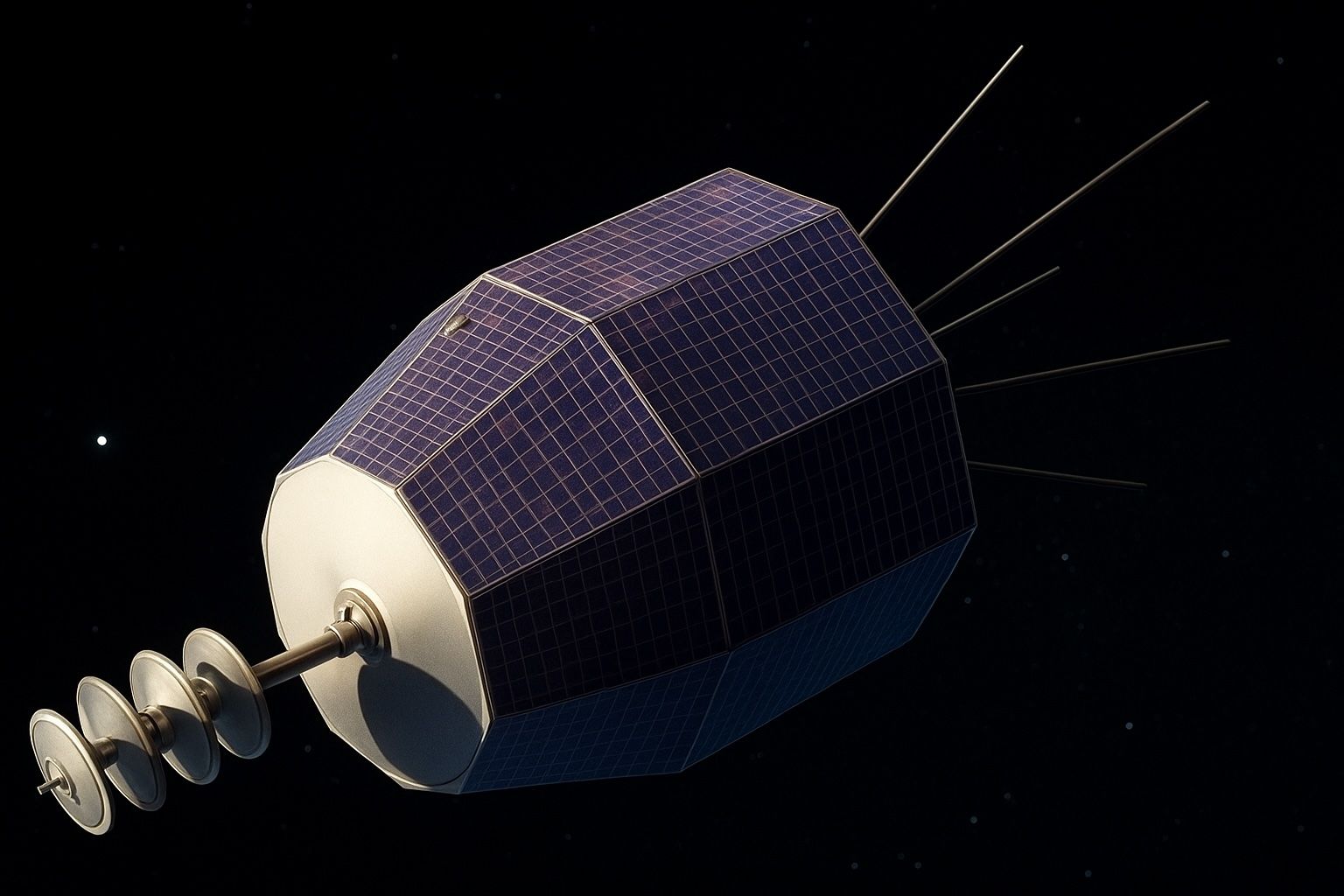
Relay 2 was a NASA experimental communications satellite built by RCA, launched January 21, 1964, atop a Delta B rocket from Cape Canaveral, designed to relay television signals and study Earth’s radiation belts. Ground support for Relay 2 ended by September 1965, and its transmitters began failing, with the first transponder dying on November 20, 1966. The second transponder failed on June 9, 1967, leaving Relay 2 officially defunct and transmitting for less than three years. Relay 2 weighed about 78 kg (172 lb) at launch and orbited in an elliptical medium Earth orbit roughly 1,870 km by 7,600 km.
21 June 2025
France Tightens Grip on Space: Inside the €1.35 Billion Eutelsat Power Play

France Tightens Grip on Space: Inside the €1.35 Billion Eutelsat Power Play

In June 2025 the French government announced a €1.35 billion capital injection into Eutelsat, via the Agence des participations de l’État, with €717 million to be injected and Bpifrance’s 13.6% stake absorbed, lifting France’s holding to 29.99%. France becomes Eutelsat’s largest shareholder as a result of the stake transfer, solidifying the 29.99% holding. The move is designed to create a European satellite champion to counter Starlink and to secure sovereign access to space infrastructure amid geopolitical tensions. Eutelsat was founded in 1977, pioneered Europe’s direct-to-home TV in the 1990s, merged with OneWeb in July 2022, and the deal closed on
21 June 2025
Pentagon’s Space Internet Nightmare: Why the Unified Satellite Network Keeps Stalling

Pentagon’s Space Internet Nightmare: Why the Unified Satellite Network Keeps Stalling

The Pentagon aims to field a software-defined, multi-layer Enterprise SATCOM network that seamlessly routes data across DoD, allied, and commercial satellites in LEO, MEO, and GEO to support Joint All-Domain Command and Control (JADC2). In 2020 the Space Force and DoD CIO committed to the shift, with the SDA launching the National Defense Space Architecture (NDSA), later renamed the Proliferated Warfighter Space Architecture (PWSA), to field hundreds of small satellites as a mesh-layer backbone. Interoperable Hybrid Terminals would allow a single device to talk to any authorized satellite by software, with the Air Force aiming to field its first multi-network
Solar Tempests & Orbital Guardians: The Secret Life of Space-Weather Satellites

Solar Tempests & Orbital Guardians: The Secret Life of Space-Weather Satellites

1859: British astronomer Richard Carrington observed a powerful solar flare, and within a day telegraph systems worldwide went haywire while auroras appeared near the equator—the Carrington Event, the largest geomagnetic storm on record. During the 1957–58 International Geophysical Year, Explorer-1 became the first U.S. satellite to discover the Van Allen radiation belts encircling Earth. SOHO, launched in 1995, sits at the Sun–Earth L1 point and uses the LASCO coronagraph to image CMEs, providing continuous data for 1–3 day storm forecasts and imaging the Sun for over 25 years. ACE (launched 1997) and DSCOVR (launched 2015) operate upstream solar-wind monitors at
20 June 2025
Inside Israel’s Space Power: Satellites, Services, and the Secret Strength of the Israel Space Agency

Inside Israel’s Space Power: Satellites, Services, and the Secret Strength of the Israel Space Agency

On September 19, 1988, Ofek-1 became Israel’s first indigenous satellite, making Israel the eighth nation to orbit its own spacecraft. The Israel Space Agency (ISA) was established in 1983 under physicist Yuval Ne’eman to oversee Israel’s civilian space activities. The Shavit launch vehicle is a 20-meter-tall, three-stage solid-fuel rocket that can loft about 380 kg to a low Earth orbit when launching westward from Palmachim. The VENμS environmental satellite, launched in 2017 and operated through 2023, is a ~265 kg microsatellite built by Israel Aerospace Industries with France’s CNES to monitor vegetation and environmental parameters. AMOS-1, Israel’s first commercial telecom
20 June 2025
Inside China’s Space Empire: Satellites, Services, and the Secret Power of CNSA

Inside China’s Space Empire: Satellites, Services, and the Secret Power of CNSA

The China National Space Administration (CNSA) was established in 1993 as China’s civil space authority. By the end of 2024, China operated more than 1,060 active satellites in orbit, a count that has grown more than six-fold since 2015. Chang’e-4 achieved the first landing on the Moon’s far side in 2019. Micius (Mozi), launched in 2016, became the world’s first quantum communications satellite enabling space-based quantum key distribution. BeiDou reached full global coverage with the final BDS-3 satellite launched in June 2020. The Guowang LEO megaconstellation targets about 13,000 satellites, with three batches launched by April 2025 and an initial
20 June 2025
Iranian Satellites and Space Agency: Capabilities, Missions, and Strategic Vision

Iranian Satellites and Space Agency: Capabilities, Missions, and Strategic Vision

February 2009: Iran becomes the ninth country to launch an indigenous satellite with its own rocket, sending Omid into orbit on the Safir launcher. Khayyam (2022) is a 600 kg Earth-observation satellite with 1-meter resolution, built with Russian collaboration and launched by a Russian Soyuz to a ~500 km orbit. Noor-1, Iran’s first military satellite, was launched in April 2020 on the Qased rocket into a ~425 km orbit and weighed about 25 kg. Noor-2 (2022) followed Noor-1, about 27 kg, placed in a ~500 km LEO using the Qased launcher and remains in orbit. Noor-3 (2023) is the third
20 June 2025
Space Showdown: How Military Satellites Are Shaping the Ukraine‑Russia War

Space Showdown: How Military Satellites Are Shaping the Ukraine‑Russia War

SpaceX deployed 5,000 Starlink terminals to Ukraine within days of the 2022 invasion, rising to about 15,000 active terminals by June 2022, with Ukraine at one point accounting for roughly 58% of global Starlink traffic. Russia attempted to jam Starlink signals on the battlefield, SpaceX rolled a software update to bypass the jamming, and by 2023–2024 reports noted illicit Starlink terminals in Russian hands that had to be disabled. On February 24, 2022, Russia launched a cyberattack against Viasat’s KA-SAT network that crippled thousands of Ukrainian modems and disrupted satellite links across Europe. In August 2022, Ukraine crowdfunded $20 million
Satellite TV Secrets Unveiled: From Space-Age Origins to the Future of Television

Satellite TV Secrets Unveiled: From Space-Age Origins to the Future of Television

Telstar 1 (NASA) transmitted the first live television signals via satellite in 1962, linking Europe and North America. Syncom 2 became the first geosynchronous satellite in 1963, and Syncom 3 in 1964 broadcast the Tokyo Olympics to the United States. Intelsat I (Early Bird) was launched in 1965 as the world’s first commercial communications satellite carrying regular transoceanic TV service. Astra 1A, launched in 1988, used Ku-band to enable small 90 cm dishes and sparked a European satellite TV boom. In 1979 the FCC ruled that anyone could install a home satellite earth station without a federal license, accelerating consumer
Spies in the Sky: The Ultimate Guide to Spy Satellites and Their Secrets

Spies in the Sky: The Ultimate Guide to Spy Satellites and Their Secrets

The CORONA (Discoverer) program operated from 1959 to 1972 as the United States’ first photo-reconnaissance satellite program, with Discoverer XIV achieving the first mid-air film recovery in August 1960. KH-11 KENNEN (CRYSTAL), first launched in 1976, introduced electro-optical digital imaging with about 15 cm per-pixel resolution, and a 2019 declassified image from USA-224 reportedly achieved around 10 cm resolution. Lacrosse/Onyx, the US SAR reconnaissance program begun in 1988, used large radar antennas for all-weather imaging and was succeeded by the smaller Topaz (FIA Radar) satellites in the 2010s. The USSR’s Zenit series began in 1961 with over 500 launches using
13,000-Year-Old Alien Satellite? Unraveling the Black Knight Conspiracy Theory

13,000-Year-Old Alien Satellite? Unraveling the Black Knight Conspiracy Theory

The Black Knight legend links Nikola Tesla’s 1899 reports of periodic radio signals from Colorado Springs to the idea of an ancient satellite in Earth orbit. In 1927 Jørgen Hals observed long-delayed echoes, and in 1973 Duncan Lunan claimed a star map pointing to Epsilon Boötes suggesting a 13,000-year-old alien probe, later retracting parts of the interpretation. In 1954 Donald Keyhoe asserted the Air Force had detected two unknown satellites, a claim with little evidence and likely a publicity stunt. In February 1960 the U.S. military detected an unidentified dark object in polar orbit, later identified as Discoverer 8 debris
19 June 2025
Internet Access in Macedonia: From Fiber to the Final Frontier

Internet Access in Macedonia: From Fiber to the Final Frontier

MakTel’s FTTH network passes over 270,000 households and offers up to 1 Gbps on fiber, with DSL available nationwide at about 50–60 Mbps where fiber is not yet present. A1 Macedonia (formerly One.Vip) operates a hybrid cable and fiber network and had 56% of the population with 5G-ready fiber or cable by 2022, with up to 200 Mbps symmetric fiber in bundles. Telekabel runs its own network in 17 cities and has 100% fiber coverage in at least four cities, offering fiber plans around 40 Mbps for MKD 600 per month. By 2022, about 75.6% of Macedonian households had access
17 June 2025
Space at Stake: The Boom in Satellite Insurance & Risk Management (2025–2032)

Space at Stake: The Boom in Satellite Insurance & Risk Management (2025–2032)

In 1965 Lloyd’s of London issued the first space insurance policy for an early Intelsat satellite. In 2019 insured losses reached about $788 million against roughly $500 million in premiums, following major failures such as a Vega launch with a ~$414 million loss. The global space insurance market was valued at about $3.6 billion in 2023 and is forecast to reach about $12 billion by 2032, with a CAGR in the 8–11% range. A record 180 orbital launches occurred in 2022, driving launch-insurance demand. In 2024 North America accounted for about $1.7 billion of the market (projected to $3.2 billion
16 June 2025
The Space Race for the Internet: Inside the Billion-Dollar Satellite Mega-Constellation Boom

The Space Race for the Internet: Inside the Billion-Dollar Satellite Mega-Constellation Boom

As of mid-2025, Starlink operates about 7,500 active satellites, the largest fleet in history, accounting for more than 60% of all active satellites. Starlink’s next-generation satellites (v2) weigh about 800 kg each, vs 260 kg for v1, and use inter-satellite laser links to route data across continents. Amazon’s Project Kuiper plans 3,236 LEO satellites at roughly 600 km altitude, with more than $10 billion invested, the first 27 operational satellites launched in April 2025, and a target to deploy half the constellation by July 2026. OneWeb completed its Gen1 constellation with 618 of 648 satellites in 1,200 km polar orbits

Stock Market Today

Nu Holdings stock jumps to $17.40 — what to watch next for Nubank shares

Nu Holdings stock jumps to $17.40 — what to watch next for Nubank shares

8 February 2026
Nu Holdings shares closed at $17.40 Friday, up 3.5%, as the Dow topped 50,000 for the first time. The Brazil-based fintech recently received conditional U.S. approval to form a national bank but still needs further regulatory sign-offs. Investors await Nu’s fourth-quarter earnings on Feb. 25.
AMD stock jumped Friday on AI-spending signals — here’s what to watch before Monday’s open

AMD stock jumped Friday on AI-spending signals — here’s what to watch before Monday’s open

8 February 2026
AMD shares jumped 8.2% to $208.44 Friday, leading a rally in chip stocks after Amazon and Alphabet signaled higher data-center spending. Nvidia gained 7.8%, Broadcom rose 7.1%, and the PHLX semiconductor index climbed 5.7%. The sector’s rebound followed a midweek drop after AMD’s revenue forecast disappointed. U.S. jobs and inflation data next week could sway markets further.
Apple stock heads into Monday with iPhone price question back on the table

Apple stock heads into Monday with iPhone price question back on the table

8 February 2026
Apple closed at $275.97 Friday, last indicated up 0.8% at $278.12. A global memory-chip shortage is raising questions about whether Apple will hike iPhone prices or absorb higher costs. CEO Tim Cook warned of rising chip prices but gave no details on Apple’s response. Traders are watching upcoming U.S. payrolls and inflation data that could affect rate-cut expectations.
Go toTop