
Today: 1 July 2026
Browse Category

Space 26 June 2025 - 29 June 2025

SpaceX Wins $81.6 Million U.S. Space Force Deal to Launch WSF-M2 Weather Satellite in 2027

Space News Roundup – June 29, 2025

It has been an exceptionally busy period for orbital launches around the globe. Japan’s H-2A rocket flew its 50th and final mission, drawing the curtain on a 24-year career. The liquid-fueled H-2A, developed by Mitsubishi Heavy Industries and JAXA, successfully lofted an Earth-observation satellit into a sun-synchronous orbit on June 28 spacenews.com spacenews.com. The payload, nicknamed GOSAT-GW, will monitor greenhouse gas levels and the water cycle from space spacenews.com. Crowds of onlookers in Tanegashima cheered the nighttime launch, which achieved a long-held reliability goal of 98% success for the H-2A series english.kyodonews.net. “I was more nervous than ever about the launch… We achieved our long-cherished goal of a 98 percent success rate,” said Mitsubishi launch director Keiji Suzuki as Japan shifts to the newer H3 rocket going forward english.kyodonews.net. The final H-2A flight was one of four orbital launches within 13 hours on June 28, bookended by other commercial missions spacenews.com. Blue Origin’s New Shepard rocket lifts off from West Texas on June 29, 2025, carrying six space tourists on a 10-minute suborbital flight.Blue Origin notched a space tourism milestone this weekend, launching its 13th crewed suborbital flight and sending its 70th person to space space.com. The New Shepard rocket
Quiet Goodbye, Bold Hello: Japan’s H3 Rocket Takes the Torch from H-2A to Slash Costs and Double Cadence

Quiet Goodbye, Bold Hello: Japan’s H3 Rocket Takes the Torch from H-2A to Slash Costs and Double Cadence

Japan’s workhorse H-2A rocket concluded nearly 25 years of service with its 50th and final launch on June 28, 2025, carrying the GOSAT-GW climate-monitoring satellite into orbit Space Space. Debuting in 2001, the H-2A achieved a 98% success rate – a testament to its reliability Space. Over its lifetime, H-2A lofted critical payloads such as the SELENE lunar orbiter, Akatsuki Venus probe, Hayabusa 2 asteroid sample-return, and even the Emirates Mars Mission, showcasing Japan’s launch capabilities on the world stage Space Arstechnica. This storied rocket is now retired to make way for H3, Japan’s next-generation launcher designed to be more cost-effective and flexible while carrying on a legacy of dependable service Space. The transition from H-2A to H3 was set in motion over a decade ago. In 2013, JAXA decided that a new rocket was needed to address H-2A’s limitations in cost and cadence Forecastinternational. Funding for H3 development was approved in 2014, with Mitsubishi Heavy Industries as the prime contractor Forecastinternational. Originally envisioned to launch by 2020, H3’s debut was delayed by technical challenges – particularly with its new LE-9 engines – pushing the first flight out to 2023 Forecastinternational. These delays coincided with a rapidly changing launch industry,
29 June 2025
ForgeStar-1: Pioneering the UK’s Orbital Chip Foundry in Space

ForgeStar-1: Pioneering the UK’s Orbital Chip Foundry in Space

ForgeStar-1 is a groundbreaking in-space manufacturing satellite developed by Welsh startup Space Forge – a project aimed at creating the world’s first orbital semiconductor foundry. Launched in June 2025, ForgeStar-1 became the UK’s first in-space manufacturing mission, designed to produce advanced semiconductor materials in the microgravity environment of Low Earth Orbit spaceforge.com. Built entirely in Cardiff, Wales, this reusable satellite platform leverages the unique conditions of space – weightlessness, ultra-clean vacuum, and extreme temperatures – to fabricate electronics that would be difficult or impossible to make on Earth spaceforge.com gov.wales. The mission represents a major breakthrough for British space technology and materials science, marking the first time the UK has sent a spacecraft to orbit with the explicit purpose of manufacturing new materials spaceforge.com. Space Forge’s bold vision is to kick-start a “new industrial revolution in space” by forging high-performance chips and super-materials off-planet and returning them for use on Earth gov.wales spaceforge.com. If successful, ForgeStar-1 could lay the groundwork for an entire fleet of orbital factories, positioning the UK at the forefront of a nascent space-based manufacturing industry. This comprehensive report examines ForgeStar-1’s technological innovations, manufacturing goals, launch history, and strategic significance in both the semiconductor sector and the
29 June 2025
SpaceX Wins $81.6 Million U.S. Space Force Deal to Launch WSF-M2 Weather Satellite in 2027

SpaceX Wins $81.6 Million U.S. Space Force Deal to Launch WSF-M2 Weather Satellite in 2027

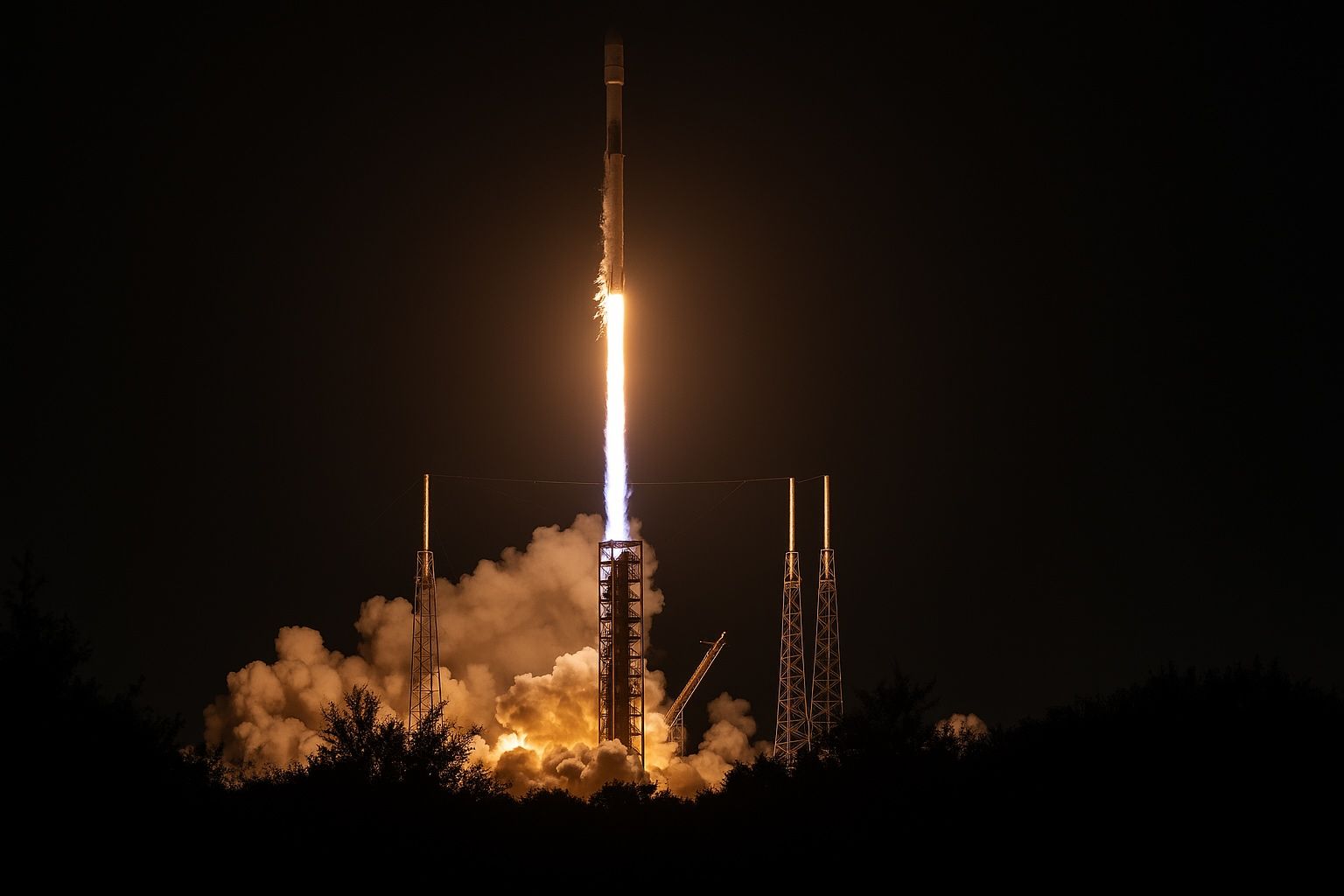
The U.S. Space Force has tapped SpaceX for a $81.6 million National Security Space Launch Phase 3 Lane 1 task order to loft the Weather System Follow-on–Microwave 2 satellite and a rideshare stack of small DoD spacecraft in the first half of fiscal 2027. The award—designated mission USSF-178—marks SpaceX’s third straight win under the new NSSL contracting framework and underscores the company’s tightening grip on U.S. national-security launches. Below is a deep-dive on what the contract covers, why the WSF-M satellites matter, and how the deal reshapes the military-launch market. David Betz, SSC WSF-M program manager, said at the 2023 contract option exercise: “The second WSF-M space vehicle extends our ability to measure wind speed and direction over the Earth’s oceans and provide timely tropical-cyclone intensity data beyond the first vehicle’s end-of-life.” americaspace.com
29 June 2025
Space News Digest: June 2025 / Updated: 2025, June 29th, 07:59 CET

Space News Digest: June 2025 / Updated: 2025, June 29th, 07:59 CET

Space Coast launches set records with 93 launches in 2024 and up to 156 projected for 2025, driven by SpaceX, ULA, and Blue Origin. SpaceX’s Starlink megaconstellation has surpassed 7,900 satellites in orbit. Two Falcon 9 missions deployed 53 Starlink satellites within 13 hours, marking SpaceX’s 81st launch of 2025 and the 468th booster recovery. Amazon’s Project Kuiper has 54 satellites in orbit toward a planned 3,200-satellite constellation, with AWS data processing integration. Japan’s H-2A rocket completed its 50th and final mission, deploying the greenhouse gas monitoring satellite GOSAT-GW, as the H3 rocket begins to replace H-2A. The Vera C.
29 June 2025
Space News Digest: June 2025 / Updated: 2025, June 29th, 00:31 CET

Space News Digest: June 2025 / Updated: 2025, June 29th, 00:31 CET

Rocket Lab completed two Electron launches within 48 hours at Launch Complex 1 in New Zealand, including the Get the Hawk Outta Here mission that deployed four satellites: three Hawkeye 360 RF geolocation microsatellites and the Kestrel-0A experimental satellite. Amazon expanded Project Kuiper by launching 27 new satellites into low Earth orbit, while SpaceX’s Starlink added 80 satellites in a single week, pushing its active constellation past 7,900. Japan marked the 50th and final H-2A launch by deploying the GOSAT-GW greenhouse gas and water-cycle satellite, part of a fleet that achieved 66 launches (63 successful) over 31 years. South Korea’s
29 June 2025
June 2025 Space News: Breakthroughs, Missions, and the Expanding Frontier / Updated: 2025, June 28th, 16:00 CET

June 2025 Space News: Breakthroughs, Missions, and the Expanding Frontier / Updated: 2025, June 28th, 16:00 CET

Shubhanshu Shukla became India’s 634th person in space, traveling to the ISS on the Axiom-4 mission after a 28-hour journey and a 41-year hiatus. NASA and Roscosmos are conducting investigations as four astronauts arrive at the ISS amid a mysterious air leak detected in the Russian Zvezda module. The Vera C. Rubin Observatory achieved first light with a 3,200-megapixel camera, discovering over 2,000 asteroids in 10 hours and planning to image the entire sky every few nights for a decade. The James Webb Space Telescope directly imaged its first exoplanet, TWA 7b, a Saturn-mass world about 111 light-years away. Japan’s
June 2025 Science Breakthroughs and Projects: Medicine, Space, Climate, AI & More

June 2025 Science Breakthroughs and Projects: Medicine, Space, Climate, AI & More

June 2025 has been a landmark month for science, with breakthroughs across medicine, space exploration, climate science, physics, artificial intelligence, energy, biology, and more. This comprehensive report reviews the latest scientific news from June 2025 and looks ahead to major projects and trends for the remainder of 2025. We cover recent discoveries and studies, provide context and expert insights, and highlight what to watch in the coming months. Cancer Breakthroughs and Therapies: Researchers uncovered a novel mechanism that cancer cells use to boost their energy and spread – by literally stealing power from the nervous system. A study published in Nature shows tumor cells can grow microscopic tubes to siphon mitochondria from nearby nerve cells Nature. This “energy theft” increases cancer cells’ resilience during metastasis. “Now we have a new culprit for metastasis, which means we have a new target to block it,” said co-author Simon Grelet Nature. Blocking this mitochondrial hijacking could lead to treatments that prevent cancer from spreading, a critical advance since metastasis is the deadliest aspect of cancer Nature. In another early-detection breakthrough, a separate study found that tumor DNA can be detected in blood years before diagnosis, raising hopes for blood tests that catch cancer
Major Astronomy News in June 2025: Webb’s Exoplanet Discovery, Rubin’s First Images, Space Missions & More

Major Astronomy News in June 2025: Webb’s Exoplanet Discovery, Rubin’s First Images, Space Missions & More

Webb Directly Images a Saturn-Mass Exoplanet: For the first time, the James Webb Space Telescope has discovered an exoplanet previously unknown – a young gas giant roughly the mass of Saturn orbiting the star TWA 7 science.nasa.gov reuters.com. This object, dubbed TWA 7 b, is about 50 AU from its star and is the lightest planet ever captured in a direct image science.nasa.gov reuters.com. It lies in a gap of TWA 7’s debris disk, matching predictions that a planet of this mass was sculpting the disk’s structure science.nasa.gov science.nasa.gov. “Our observations reveal a strong candidate for a planet shaping the structure of the TWA 7 debris disk, and its position is exactly where we expected,” said lead author Anne-Marie Lagrange science.nasa.gov. This marks Webb’s first direct exoplanet discovery – previously the telescope had studied known exoplanets, but not found new ones reuters.com reuters.com. Only
28 June 2025
Texting From Space: The T-Mobile–Starlink ‘T-Satellite’ Launch Heralds the Direct-to-Device Era

Texting From Space: The T-Mobile–Starlink ‘T-Satellite’ Launch Heralds the Direct-to-Device Era

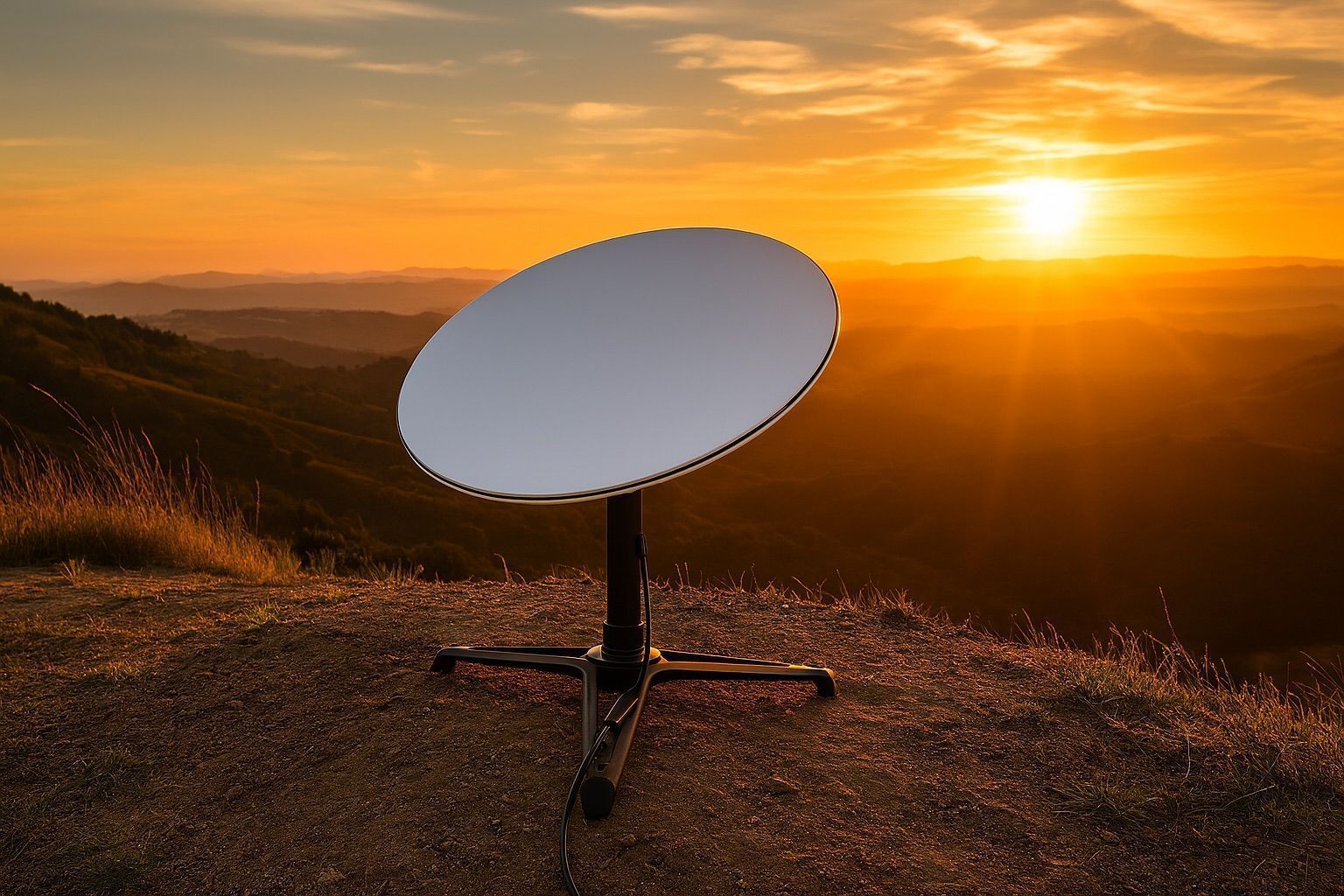
In August 2022, T-Mobile and SpaceX announced an ambitious partnership called “Coverage Above and Beyond,” aiming to end mobile dead zones by connecting standard smartphones to SpaceX’s Starlink satellitest-mobile.comt-mobile.com. Under this vision, Starlink’s low-Earth-orbit satellites would broadcast using T-Mobile’s cellular spectrum, essentially acting as space-based cell towers. The goal: provide “near complete coverage” in regions previously unreachable by cell signals, from national parks and mountains to remote highwayst-mobile.comt-mobile.com. T-Mobile CEO Mike Sievert framed it as “two industry-shaking innovators challenging the old ways… to create something entirely new”, while SpaceX chief Elon Musk declared it means “no dead zones anywhere in the world for your cell phone”t-mobile.com. The initiative, now branded by T-Mobile as “T-Satellite with Starlink,” targets roughly 500,000 square miles of U.S. territory that lack any cellular coverage geekwire.com. Instead of forcing people to carry special satellite phones, T-Satellite is designed to work with the phone already in your pocket, requiring no extra hardware or attachmentst-mobile.com rcrwireless.com. Most recent smartphones will be compatible, automatically connecting to a satellite when terrestrial signal is lost. This inclusive approach even extends to subscribers of other carriers. T-Mobile opened the service to competitors’ customers during the beta, and “hundreds of thousands” of AT&T
This Week in Space: New Frontiers, Private Astronauts, and the Next Era of Observation / Updated: 2025-06-28 08:00

This Week in Space: New Frontiers, Private Astronauts, and the Next Era of Observation / Updated: 2025-06-28 08:00

China’s Zhongxing-9C satellite was launched on June 20, 2025, atop a Long March 3B from Xichang, marking the full localization of Chinese broadcast satellites in the 582nd Long March flight. SpaceX launched the Starlink 10-34 mission from Cape Canaveral Space Force Station, deploying 27 Starlink satellites and bringing the active constellation to nearly 8,000, with the booster marking its fifth flight. Rocket Lab’s Get The Hawk Outta Here mission placed four HawkEye 360 satellites into orbit, including three microsats for RF geolocation and the experimental Kestrel-0A. EarthDaily launched its first satellite to begin a ten-satellite constellation delivering AI-powered daily global
28 June 2025
Today in Space / June 28, 2025 0:00

Today in Space / June 28, 2025 0:00

SpaceX’s Starship suffered a further explosion during a static-fire test at Starbase, Texas, as the company has now completed nine Starship test flights with a record launch cadence in 2024–2025. SpaceX’s Axiom-4 mission docked with the International Space Station, marking India’s return to human spaceflight after 41 years as Group Captain Shubhanshu Shukla became the first Indian to reach the ISS, with Peggy Whitson leading a two-week, 60+ experiment research phase. NASA and Northrop Grumman conducted the Booster Obsolescence Life Extension (BOLE) solid rocket motor test for the Artemis program, which ended with a nozzle explosion but yielded data for
28 June 2025
SpaceX: Mid-2025 Comprehensive Report (June 27th, 2025)

SpaceX: Mid-2025 Comprehensive Report (June 27th, 2025)

SpaceX’s Starship vehicle lifting off on its ninth test flight from Starbase, Texas in May 2025. Starship is the company’s next-generation, fully-reusable rocket system under development. In summary, by mid-2025 SpaceX is breaking launch records, advancing Starship’s development amid regulatory hurdles, expanding its Starlink network, and securing a growing share of civil and commercial space contracts. The following sections provide an in-depth analysis of the company’s history, technology, strategy, competition, and outlook.
Space Technology News Roundup: Satellites, Launches & Deep Space Updates / Updated: 2025-06-27 16:54

Space Technology News Roundup: Satellites, Launches & Deep Space Updates / Updated: 2025-06-27 16:54

ESA’s Biomass satellite, the first with a P-band SAR, released its initial high-resolution images and enables 3D mapping of forest structure for carbon accounting. Rocket Lab’s 67th Electron launch deployed four satellites—three HawkEye 360 Cluster 12 microsatellites and the experimental Kestrel-0A—marking the ninth Electron mission in 2024. Amazon’s Project Kuiper added 27 satellites to reach a total of 54, launched on an Atlas V, intensifying competition with SpaceX’s Starlink. WISeSat.Space plans a 100-satellite secure LEO constellation by 2027 to deliver encrypted IoT connectivity using post-quantum encryption. Finland acquired its first military SAR satellites from ICEYE, expanding independent reconnaissance and surveillance
Beaming the Watts Down: NASA × Ascent Solar’s Thin-Film Array Sets the Stage for Space-to-Earth Power Transmission

Beaming the Watts Down: NASA × Ascent Solar’s Thin-Film Array Sets the Stage for Space-to-Earth Power Transmission

Space-based solar power is the ambitious concept of harvesting solar energy in space and beaming it down to Earth. The idea dates back to 1968, when engineer Peter Glaser first proposed placing giant satellites in orbit to collect sunlight and transmit power wirelessly to Earth space.com. In theory, SBSP could tap a virtually unlimited 24/7 supply of solar energy in orbit, free from weather or nightfall. Experts note that orbital solar panels could generate 8 times more power than the same area on Earth’s surface pv-magazine-usa.com. Unlike ground solar or wind farms that stop producing at night or in bad weather, space solar stations could deliver continuous clean energy day and night, potentially displacing fossil fuels and stabilizing grids space.com. Interest in SBSP has surged in recent years thanks to technological advances and the urgency of climate change. Advocates argue that modern robotics, more efficient wireless power transmission, and cheaper heavy-lift rockets like SpaceX’s Starship could finally make SBSP feasible space.com. For example, Starship’s ability to loft large payloads might enable assembly of huge solar arrays in orbit at far lower cost than before. A constellation of satellites in geosynchronous orbit could continuously beam gigawatts of power via microwaves to
Technology Trends 2025: Global Innovations in AI, Green Tech, Space, and More (Updated: June 27th, 2025)

Technology Trends 2025: Global Innovations in AI, Green Tech, Space, and More (Updated: June 27th, 2025)

2025 is shaping up as a pivotal year in technology, marked by rapid innovation across industries worldwide. From artificial intelligence transforming business and daily life, to breakthroughs in biotech and health, to a surge in clean energy and electric vehicles, the pace of change is unprecedented. Emerging technologies like quantum computing and space tech are transitioning from research to real-world impact, while established domains such as fintech, semiconductors, telecommunications, cloud computing, and cybersecurity are evolving in response to new demands. This report provides a comprehensive overview of key technology trends in mid-2025, highlighting the latest developments, market dynamics, regional perspectives, and expert forecasts in each sector. All signs point to a future where technology’s role in the global economy will only continue to expand, though not without challenges in regulation, security, and inclusion. AI continues to dominate tech headlines in 2025, driving innovation and economic growth across the globe. The global AI market is estimated around $758 billion in 2025 and projected to surge to several trillion in the next decade ts2.tech. Analysts liken AI’s impact to the Industrial Revolution – for example, a PwC study projects AI could boost global GDP by over 15% by 2035 ts2.tech. Over the
State of Space and Satellite Technologies in 2025 (Updated: June 27th, 2025)

State of Space and Satellite Technologies in 2025 (Updated: June 27th, 2025)

The Artemis I mission lifts off in a spectacular night launch on November 16, 2022, marking the first flight of NASA’s Space Launch System mega-rocket. Artemis I sent an uncrewed Orion spacecraft around the Moon and back, laying the groundwork for future crewed lunar missions nasa.gov. This milestone exemplifies the rapid resurgence of lunar exploration and the growing capabilities of modern space technology. The global space industry has entered an unprecedented era of growth and innovation as of 2025. What was once the domain of superpower governments is now a vibrant landscape of public agencies and private companies pushing the frontiers of technology. The “space economy” – encompassing everything from rockets and satellites to space-enabled services – reached an estimated $570 billion in annual revenue in 2023, nearly double its size a decade ago pwc.com. Commercial activities account for roughly 80% of this value, reflecting a major shift toward private-sector leadership in space pwc.com. With declining launch costs, smaller and cheaper satellites, and surging demand for space-based data, humanity’s presence in orbit has expanded dramatically. Over 11,000 active satellites now serve Earth spinoff.nasa.gov ndtv.com, a number growing by the day thanks to large “megaconstellations.” This report provides a comprehensive overview
Global Technology Trends in June-2025: AI, Quantum, EVs, Space & Beyond

Global Technology Trends in June-2025: AI, Quantum, EVs, Space & Beyond

June 2025 marks a pivotal moment in the tech world, with transformative innovations unfolding across industries. From the AI boom supercharging software and chips, to EVs hitting record sales, to breakthroughs in biotech and space, the global technology landscape is evolving at an unprecedented pace. In this report, we delve into the latest developments and expert insights across key sectors – Artificial Intelligence, Consumer Electronics, Quantum Computing, Blockchain/Web3, Biotechnology, Semiconductors, Renewable Energy/EVs, and Space – to paint a comprehensive picture of tech trends as of June 2025. Artificial Intelligence continues to dominate tech headlines in 2025, accelerating innovation and economic growth. The global AI market is valued around $758 billion in 2025, with forecasts projecting a surge to $3.68 trillion by 2034 ahrefs.com ahrefs.com. Analysts compare AI’s impact to the Industrial Revolution – PwC estimates AI could boost global GDP by 15+% by 2035, reshaping the economy on a similar scale to 19th-century industrialization ahrefs.com. Crucially, generative AI and large language models exploded into the mainstream over the past two years, driving a 76% jump in generative AI spending in 2025 alone ahrefs.com. AI adoption is now widespread: 78% of companies use AI in at least one function globenewswire.com, and
Bridging 5G and Space: Inside France 2030’s End-to-End NTN Pilot With Dual LEO Satellites

Bridging 5G and Space: Inside France 2030’s End-to-End NTN Pilot With Dual LEO Satellites

The push to bridge 5G and space is rapidly becoming a strategic priority for France and Europe. By integrating non-terrestrial networks – essentially satellite communication links – into terrestrial 5G infrastructure, operators hope to achieve truly global connectivity. Under the France 2030 investment plan, an ambitious end-to-end NTN pilot has been launched, leveraging dual low-Earth orbit satellites to extend 5G coverage far beyond the reach of cell towers. Recent demonstrations under this program have showcased how a 5G signal can be beamed from Earth to orbit and back, seamlessly connecting devices in remote areas via satellite reuters.com ericsson.com. This report delves into France’s national objectives for 5G-space convergence, the latest updates on the pilot project, insights from industry experts, and the broader implications for global telecom and space-based internet services. Launched in 2021 as a €30 billion investment blueprint, France 2030 seeks to transform key sectors of the economy and secure French technological sovereignty by the end of the decade latribune.fr. One of its ten flagship objectives is to “play our role in new space adventures”, underlining the country’s commitment to New Space innovation and satellite-enabled services latribune.fr. Within this framework, extending 5G coverage via satellites has emerged as a
26 June 2025
China’s AO-MDR Laser Link Delivers 1 Gbps from Geostationary Orbit

China’s AO-MDR Laser Link Delivers 1 Gbps from Geostationary Orbit

Chinese researchers have achieved a record-breaking 1 gigabit-per-second data downlink from a satellite in geostationary orbit using an optical laser link – with a laser device as weak as a “night light” or candle in power scmp.com scmp.com. In a recent demonstration, a 2-watt laser beam transmitted data to a ground station at 1 Gbps, a speed about five times faster than SpaceX’s Starlink network typically delivers to users scmp.com interestingengineering.com. This milestone showcases a new technology dubbed “AO-MDR synergy,” which allowed the laser signal to punch through Earth’s turbulent atmosphere without significant quality loss scmp.com defencepk.com. The achievement, led by Prof. Wu Jian of Peking University of Posts and Telecommunications and Liu Chao of the Chinese Academy of Sciences, opens the door to next-generation satellite communications that rival terrestrial fiber-optic speeds. At the core of this breakthrough is the AO-MDR synergy method – a combination of Adaptive Optics and Mode Diversity Reception. Atmospheric turbulence normally distorts and scatters laser beams, turning a tightly focused signal into a faint, hundreds-of-meters-wide patch by the time it reaches the ground scmp.com. AO tackles this by sharpening the distorted wavefront of the incoming laser light in real time, using deformable mirrors to cancel
26 June 2025

Stock Market Today

  • Alico (ALCO) Sets $0.05 Quarterly Dividend, Ex-Date July 2
    July 1, 2026, 10:58 AM EDT. Alico, Inc. (ALCO) is set to go ex-dividend on July 2, 2026, with a $0.05 per share payout due July 16. At the latest $41.68 share price, that works out to a 0.12% yield for the quarter, 0.48% annualized. The stock has traded from $31.32 to $45.01 in the past year, recently closing at $41.28. Shares were up roughly 0.8% in the latest session. Some investors look to dividend record and recent price action when gauging income opportunities; Dividend Channel reminds that dividend payments can change, so history could provide some insight.
Go toTop