Sandisk’s 55% July Rout Erases Nearly $200 Billion as Earnings Bar Rises

Sandisk’s 55% July Rout Erases Nearly $200 Billion as Earnings Bar Rises

NEW YORK, July 30, 2026, 05:11 EDT —

  • Sandisk closed at $1,015.89, down 7.3%, before slipping 0.4% in premarket trade.
  • A preliminary calculation shows nearly $198 billion erased from its June record value.
  • Fourth-quarter EPS consensus stands 5.1% above management’s guidance ceiling.

Sandisk has lost a preliminary $198 billion in equity value since its June record. The estimate uses its latest share count and Wednesday’s closing price. U.S. cash markets were closed, with premarket trading underway.

The stock peaked at $2,354.39 on June 22. That implied an equity value near $349 billion. Wednesday’s close left the company worth about $150 billion.

The larger investor issue is not an earnings downgrade. Fourth-quarter EPS consensus rose 48% during the past three months. It now stands at $34.67, above Sandisk’s $30-to-$33 guidance.

That makes the August 5 report an expectations test. The numbers suggest investors require another large beat, not merely strong growth.
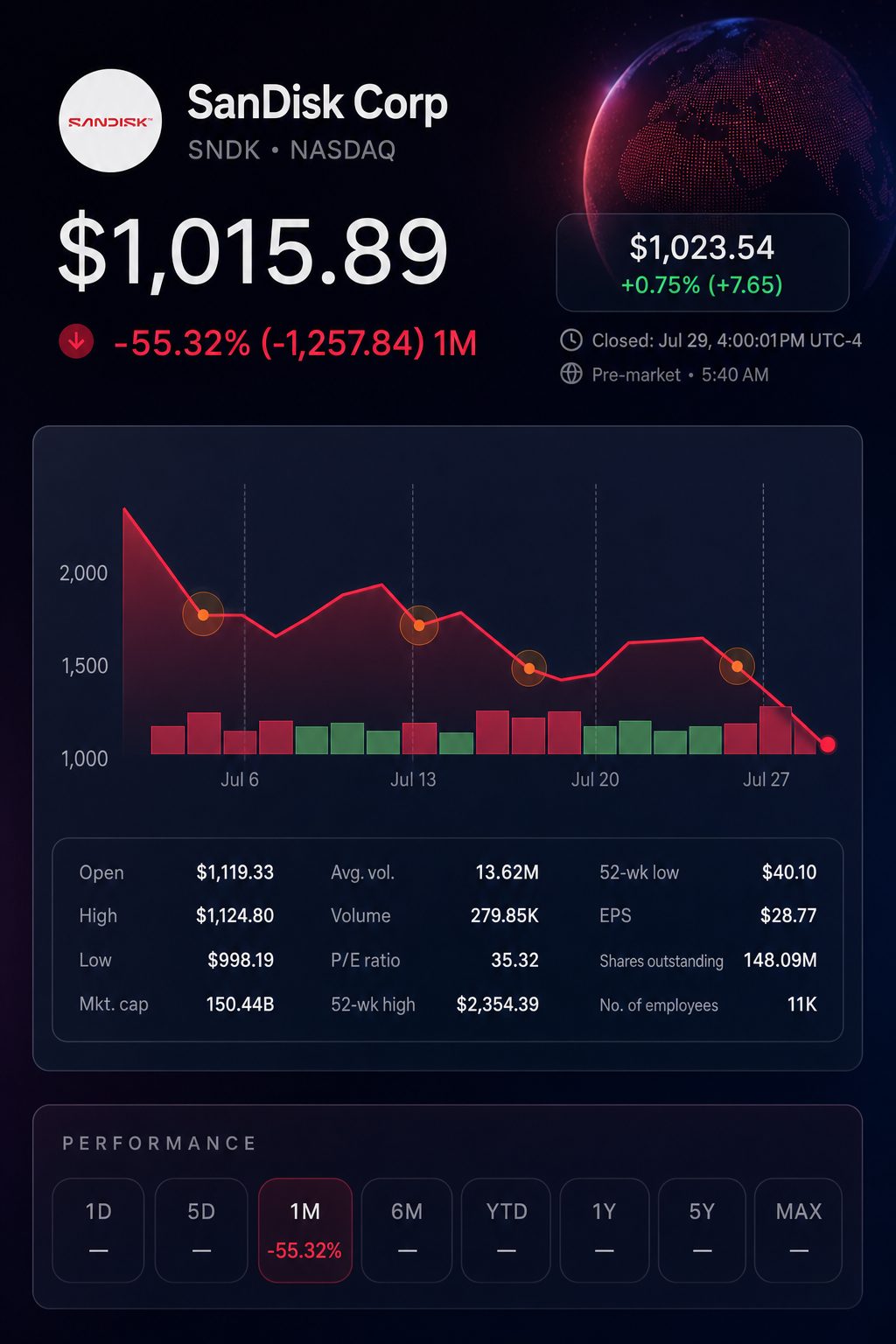
Stock chart for NASDAQ:SNDK

Selling accelerated across four sessions, cutting the shares by 36.9%. The sequence included three consecutive double-digit declines.

SessionClosing priceDaily move
July 24$1,436.56-10.8%
July 27$1,278.23-11.0%
July 28$1,096.10-14.2%
July 29$1,015.89-7.3%

Wednesday’s volume reached 24.5 million shares. That was about 79% above the 65-day average. Heavy turnover showed that the selling remained broad.

Sandisk also performed far worse than relevant U.S. storage peers. Micron Technology lost 36.0% during July. Western Digital fell 27.7%.

CompanyJune 30 closeJuly 29 closeJuly move
Sandisk$2,273.73$1,015.89-55.3%
Micron Technology$1,154.29$739.00-36.0%
Western Digital$638.72$462.04-27.7%

Sandisk remains the momentum outlier. Its July fall exceeded Micron’s by 19 percentage points. Yet the shares were still up 2,267% over 12 months and 328% this year.

Analyst profit forecasts have moved in the opposite direction. Both near-term consensus estimates have risen by roughly half since April.

Earnings benchmarkEarlier figureCurrent barChange
Fiscal Q4 EPS consensus$23.38 three months ago$34.67+48.3%
Fiscal Q1 2027 EPS consensus$28.81 three months ago$43.94+52.5%
Fiscal Q4 company guidance$30-$33$34.67 consensus5.1% above ceiling

Sandisk’s latest results support the bullish forecasts. Revenue reached $5.95 billion, while adjusted EPS hit $23.41. Management then guided fourth-quarter revenue to $7.75 billion-$8.25 billion.

Guidance implies about 35% sequential EPS growth at its midpoint. Current consensus implies roughly 48%. That 13-point gap leaves little room for execution problems.

Fresh sector evidence remains strong. Samsung Electronics said memory shortages could extend into 2028. “Almost all customers are requesting multi-year supply contracts,” executive Jaejune Kim said. Reuters

Yet Samsung fell 0.7% after initially gaining 8.4%. SK Hynix dropped 5.6% despite bumper results. “The chip narrative has weakened,” Mirae Asset analyst Kim Seok-hwan said. Reuters

China has added another pressure point. Investors reacted to a major Chinese memory IPO and domestic chip-tool advances. Those developments raised fears of future supply growth and weaker pricing power.

Risks: Durable NAND flash pricing or another earnings beat could produce a sharp rebound. Weaker margins, softer guidance or faster Chinese capacity growth could extend the reset.

Sandisk reports fiscal fourth-quarter results on August 5 at 4:30 p.m. EDT. Its investor day follows on August 13. Those events should determine whether estimates fall toward guidance or the share price recovers toward consensus.

TS2 TECH • EXTENDED COVERAGE

Further analysis

What is SNDK’s current trading position, and how significant is the decline?

Sandisk finished Wednesday, July 29, at $1,015.89, down 7.32%. Premarket trading just before 5:00 a.m. ET Thursday indicated a price around $1,009.58. Trading volume Wednesday totaled 24.49 million shares, about 81% higher than usual. The stock’s closing price on Wednesday was 56.9% under its 52-week peak of $2,354.39. Nevertheless, SNDK is still about 328% higher so far in 2026. The Wall Street Journal

What caused SNDK’s steep decline in July?

SanDisk shares plunged about 54% through Wednesday, marking the S&P 500’s steepest July drop. Over three sessions ending Tuesday, the stock lost approximately 32% of its market capitalization. An additional 7.32% was wiped from the share price on Wednesday. Barron’s The firm had not updated its guidance publicly by early July 30. Meanwhile, investors exited crowded positions in AI and memory shares throughout the sector. Competition concerns grew as China’s CXMT moved to list and local lithography advanced. Long-term risks have increased, though the short-term impact on NAND remains unclear. SanDisk Investor Relations

How did Sandisk perform in its most recent quarter?

Revenue for the fiscal third quarter totaled $5.95 billion, up 97% from the previous quarter and 251% from the same period last year. GAAP net income came in at $3.62 billion, or $23.03 per diluted share. Adjusted earnings per share reached $23.41, well surpassing the FactSet consensus of $14.62. Gross margin climbed to 78.4%, and adjusted free cash flow was $2.96 billion. The company posted a significant earnings beat. Sandisk

What business areas are contributing to Sandisk’s expansion?

Datacenter revenue reached $1.47 billion, up 233% on a sequential basis and advancing 645% year-over-year. Edge revenue more than doubled from the previous quarter to $3.66 billion. Consumer revenue fell 10% from the prior quarter but rose 44% on the year. Datacenter and Edge combined accounted for about 86% of total quarterly revenue. The change in mix bolsters pricing but heightens dependence on enterprise customers. Sandisk

What does Sandisk need to disclose on August 5 in order to restore investor confidence?

Sandisk is set to announce its fiscal fourth-quarter results on Wednesday, August 5. The company projects revenue between $7.75 billion and $8.25 billion, with the midpoint indicating roughly 34% quarter-over-quarter growth. Adjusted EPS is forecast between $30 and $33, and gross margins are expected between 79% and 81%. FactSet’s consensus EPS estimate is higher, at $34.67. Investors may be let down by results that only match estimates, following the recent record-breaking run. SanDisk Investor Relations

Following the crash, is SNDK now attractively valued, or does it remain pricey?

With SNDK closing at $1,015.89 on Wednesday, the stock traded at roughly 35.3 times its trailing earnings. That figure drops to 15.2 times when measured against FactSet’s $66.87 EPS estimate for fiscal-2026. Based on the $206.12 forecast for fiscal-2027, the price-to-earnings ratio shrinks to just 4.9 times. This attractive valuation is contingent on robust NAND prices and sustained strong margins. However, memory cycles rarely maintain a steady direction. The Wall Street Journal

What indications does Wall Street’s latest price-target range provide?

FactSet data indicates an average price target of $2,363.65 and a median of $2,500. Analyst targets span from $1,000 to $3,169. The average forecast points to a potential 133% gain from Wednesday’s close. The lowest estimate is roughly 1.6% beneath the current market value. Data from an alternative source shows a target at $2,217.77, underlining significant variation among providers. Forecasts remain volatile as earnings are closely linked to memory pricing. The Wall Street Journal

What is a practical short-term outlook for SNDK shares?

Trading is expected to stay volatile in the near term ahead of the August 5 report. If performance is in line with guidance, a likely base range is $900–$1,300. Should revenue surpass $8.25 billion with an improved outlook, a bullish scenario could push the range to $1,300–$1,700. If margins deteriorate or orders soften, prices may trend towards $750–$900. These scenarios incorporate a 3.06 beta and account for the 54% pullback in July. They are intended as analytical frameworks rather than specific forecasts. Sandisk

Khadija Saeed is a financial markets reporter at TS2.tech, specializing in stocks, technology and emerging industries. She studied economics and finance at the London School of Economics and previously worked in market research before moving into financial journalism. Her coverage focuses on the companies, innovations and economic trends influencing global investors. Follow Khadija Saeed on Google News.

Uniper Canada LNG Agreement Reduces Ksi Lisims FID Shortfall to 1–2 Mtpa
Previous Story

Uniper Canada LNG Agreement Reduces Ksi Lisims FID Shortfall to 1–2 Mtpa

Microsoft (NASDAQ:MSFT) shares surge close to 9% after easing of AI order backlog tempers spending worries
Next Story

Microsoft (NASDAQ:MSFT) shares surge close to 9% after easing of AI order backlog tempers spending worries