American Airlines (NASDAQ:AAL) Shares Bounce Back Amid Oil Price Drop, Yet Fuel Prices Remain Key Concern
28 July 2026
2 mins read

American Airlines (NASDAQ:AAL) Shares Bounce Back Amid Oil Price Drop, Yet Fuel Prices Remain Key Concern

NEW YORK, July 28, 2026, 05:00 EDT – American Airlines stock staged a recovery as oil prices slid, although concerns about ongoing fuel costs continue to overshadow gains.

  • U.S. regular trading did not take place, but Nasdaq premarket trading remained open.
  • American closed at $14.95 on Monday, rising 3.3% compared to its finish on Friday.
  • An increase of 10 cents in fuel costs amounts to roughly $460 million in yearly spending. According to an initial estimate, this is equivalent to 4.6% of American’s market value.

American Airlines Group Inc. finished the session on Monday at $14.95, marking a 3.3% rise. The increase came after Brent crude slid about 9%. The move represented relief rather than a full solution.

As of June 30, American held no active fuel hedges. A one-cent rise in fuel prices per gallon boosts yearly fuel costs by approximately $46 million. A 10-cent per gallon increase would result in an added $460 million in expenses, equivalent to 4.6% of its $9.9 billion market cap. This figure is an initial estimate.
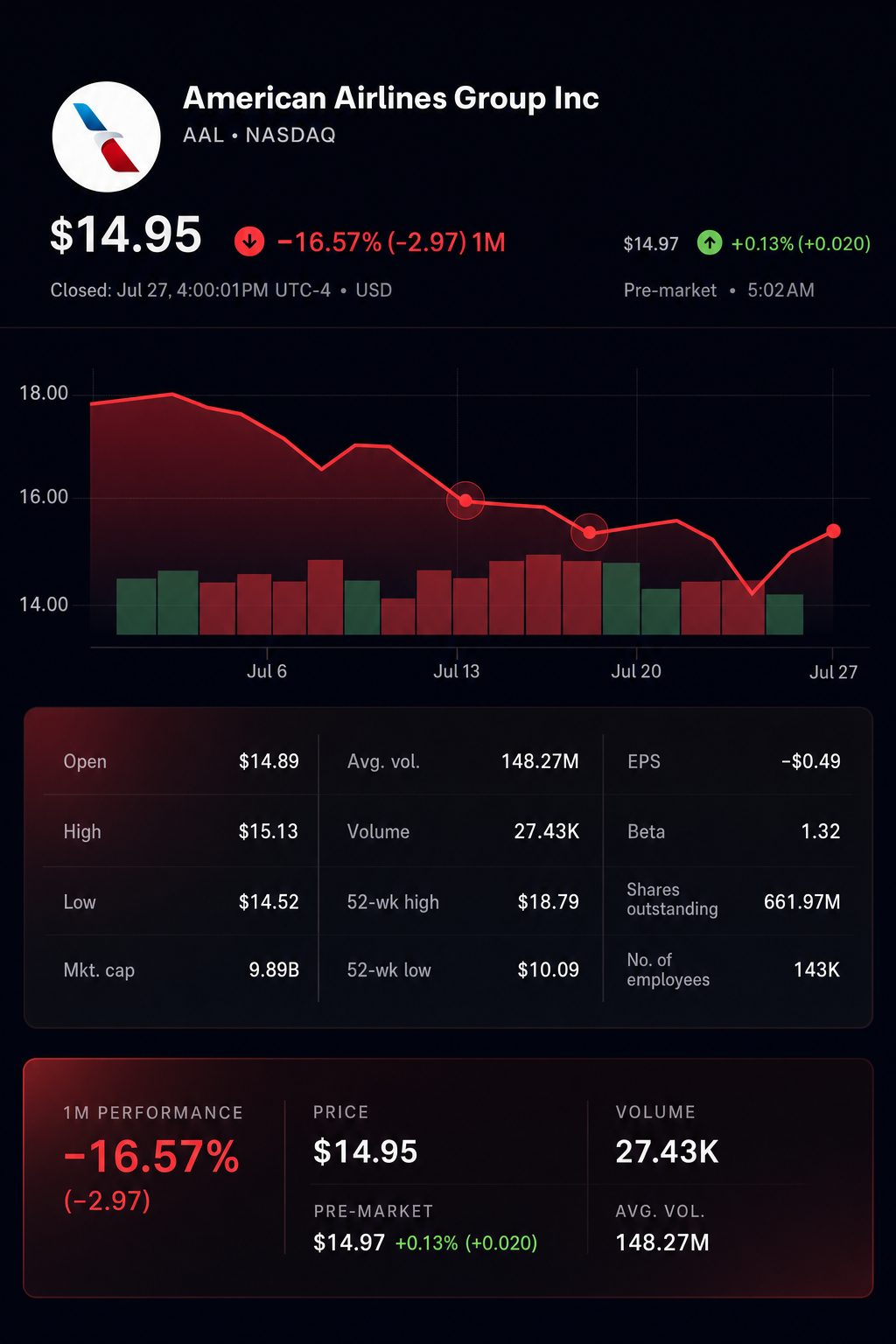
Stock chart for NASDAQ:AAL

American’s expected fuel expenses through the end of the year have climbed by almost $1.6 billion since early July. That sum represents 16.2% of its present market capitalization. The initial estimate does not account for ticket pricing adjustments, tax effects or any timing offsets.

The second quarter highlights the strain. Revenue climbed significantly, yet fuel expenses grew at an even quicker pace.

MetricQ2 2026Q2 2025Change
Operating revenue$16.7 billion$14.4 billionup 16.3%
Fuel expense$4.9 billion$2.7 billionup 83.3%
Fuel as share of revenue29.3%18.8%higher by 10.6 points
Pretax income$107 million$838 milliondown $731 million
Net income$71 million$599 millionlower by $528 million

Initial estimate based on approximate corporate data.

Fuel expenditures accounted for almost 30% of revenue in the quarter by this estimate. Pretax margin declined to around 0.6% from 5.8%. The rise in revenue was nearly equal to the $2.2 billion rise in fuel costs.

Commercial profit growth was seen across the board. Managed corporate revenue climbed 26%, achieving a fifth consecutive quarter of double-digit growth. Premium unit revenue advanced by over 13%. AAdvantage sign-ups jumped more than 30%, and spending on cards increased by 8%.

The fuel curve wiped out most of those gains. “Just three weeks ago, we were expecting to guide to full-year pre-tax earnings approaching $1.5 billion,” Chief Financial Officer Devon May said.

American forecasts its adjusted full-year outcome to range from a loss of 65 cents per share to a profit of 65 cents, placing the midpoint at zero, compared to its earlier midpoint of 35 cents. For the third quarter, the company projects an adjusted loss between 70 cents and 10 cents per share. Revenue is expected to increase by 16% to 19%.

Delta Air Lines Inc. kept its annual profit guidance unchanged. United Airlines Holdings Inc. increased its minimum forecast. American reduced its projection. Direct comparisons are still limited, since airlines used varying dates for fuel-price calculations.

American dropped 8.4% on its earnings report, finishing at $13.555. Shares then rebounded by 10.3% between Friday and Monday from Thursday’s closing level. Despite this recovery, Monday’s price was still 2.2% under Tuesday’s $15.28.

Looking to the coming week, crude oil by itself does not tell the whole story. According to IATA’s most recent weekly reading, jet fuel is at $160.06 a barrel, a rise of 7.1%. The main question is if the drop in crude seen on Monday will impact airlines’ fuel costs. On July 21, American had projected $3.75 per gallon for the third quarter.

American reduced its third-quarter capacity growth forecast to between 3% and 5%, with the midpoint two percentage points lower than initially planned. Management is evaluating its fourth-quarter operations. At the end of June, the company had $11.3 billion in liquidity.

Risks: Oil prices might recover, and jet-fuel spreads could stay elevated. Demand may soften before increased ticket prices offset the extra costs. Without hedges, American faces both potential gains and losses.

The investor case remains heavily focused. American is seeing better revenue quality, though earnings are still mostly driven by cents per gallon. The upcoming challenge is whether fuel relief will persist.

What level is AAL trading at following its earnings-related decline?

Shares of American Airlines ended Monday at $14.95, up 3.3%. The previous Thursday, the stock had dropped 8.4% to $13.56. Monday’s closing price was above Wednesday’s pre-earnings finish of $14.79. However, the shares are still trading 20.4% lower than their 52-week peak at $18.79. The company’s current market capitalization is about $9.9 billion. Investing.com

What led management to lower its profit forecast for 2026?

Revenue for the second quarter hit an all-time high of $16.74 billion, up 16.3%. However, fuel costs surged 83.3% to $4.88 billion. GAAP net income dropped to $71 million from $599 million. Adjusted earnings stood at $0.15 per share, topping projections of $0.03 to $0.05. American’s latest guidance predicts results between a $0.65 loss and a $0.65 gain. The January outlook anticipated earnings of $1.70 to $2.70 per share.

How vulnerable is American to a further increase in jet fuel prices?

Fuel costs are notably sensitive, with management indicating that a one-cent jump would raise annual expenses by around $46 million. Third-quarter forecasts include an estimated fuel price of about $3.75 per gallon with taxes. The Argus U.S. Jet Fuel Index stood at $3.66 on Monday. Brent crude hovered near $86.61 early Tuesday, almost 2% lower. American anticipates its quarterly fuel spending will increase by $1.7 billion compared to last year. Reuters

Are higher fares enough to balance the fuel price shock?

Not entirely, at least for now. Passenger yield in the second quarter climbed 11.9% compared to a year ago. Passenger revenue per available seat mile went up 10.0%. These increases offset nearly half of the $2.2 billion rise in fuel expenses. Fares impact only tickets that haven’t been sold yet, whereas changes in fuel costs take effect right away. That lag in timing is still a key issue.

What does the guidance for the third quarter suggest regarding pricing power?

American forecasts revenue growth of between 16% and 19% with capacity expanding 3% to 5%. At the midpoint, this suggests revenue per available seat mile will be about 13% higher, based on analysis rather than official guidance. Adjusted nonfuel unit costs are expected to climb by 2.5% to 4.5%. Adjusted earnings are projected to fall between a loss of $0.70 and a loss of $0.10. Fuel remains the main immediate factor. American Airlines Newsroom

Are premium, corporate, and loyalty investment strategies resulting in tangible growth?

Revenue indicators currently show positive results. Premium passenger unit revenue increased by 13.4% in the second quarter, while Main Cabin unit revenue rose by 8.8%. Managed corporate revenue advanced 26%, marking the fifth consecutive quarter of double-digit growth. AAdvantage enrollments were up over 30%, and Citi card spending rose by 8%. These improvements still need to translate into sustainable margins. American Airlines Newsroom

What caused margins to decline even as sales reached a record high?

Operating margin in the second quarter slid to 2.7%, down from 7.9%. Operating income declined by 60.7% to $446 million. Capacity expanded 5.4%, while load factor dropped by 1.5 points to 83.2%. Adjusted nonfuel cost per seat mile climbed 2.5%. When profit sharing is also excluded, that cost was up 2.9%. Revenue saw solid growth, but cost pressures outweighed gains.

Is American’s balance sheet able to withstand ongoing market volatility?

At the end of the second quarter, liquidity reached $11.3 billion. Debt and finance leases were about $28.9 billion, with operating lease liabilities adding $6.8 billion more. Operating cash flow for the first half totaled $4.69 billion, while capital expenditures and aircraft deposits amounted to $1.63 billion. The company’s management projects positive free cash flow for the year at the midpoint of its guidance and anticipates year-end net debt will decline. However, a prolonged fuel price increase could limit that result. American Airlines Newsroom

Which developments should investors monitor in the upcoming week?

Oil continues to be the primary driver. Brent dropped almost 2% to $86.61 early Tuesday, following fresh U.S.-Iran negotiations. This relief could fade if shipping or regional supply threats intensify. American has not scheduled any investor events before its July 23 earnings call. As a result, fuel costs and industry fare hikes stay in focus as the key near-term factors. With limited premarket liquidity, initial share price movements warrant caution. Reuters

Marcin Frąckiewicz is the founder and CEO of TS2 Space, a satellite communications company serving customers around the world. A graduate of the Warsaw School of Economics (SGH), he has more than two decades of experience in telecommunications, satellite services and technology ventures. He writes about satellite communications, space technology, artificial intelligence and the stock market, with a particular focus on technology companies, semiconductors, emerging industries and the trends shaping global innovation. Follow Marcin Frąckiewicz on Google News, Facebook. or Linkedin.

Stock Market Today

  • Barclays PLC Shares Drop 5% as Q2 Profit Tops Forecasts but Costs Surge
    July 28, 2026, 7:13 AM EDT. Shares of Barclays PLC (LON:BARC) declined 5.26% to 502.5 pence after the bank delivered a 31% year-on-year increase in pretax profit to £3.252 billion and 16% growth in income to £8.338 billion, figures that surpassed consensus by £132 million and £218 million respectively. Although Barclays benefited from a £225 million portfolio sale, operating expenses rose by 8.7%, overshooting estimates by £154 million-fueling investor concerns and curbing gains in the stock. The bank also revealed a £1 billion share buyback and lifted its interim dividend to 5.9 pence.
Ondas stock climbs again as $70 million order burst raises execution bar
Previous Story

Ondas (NASDAQ:ONDS) shares dip in U.S. premarket as Pentagon drone shortfall weighs on orders

Nokia (HEL:NOKIA) Shares Climb with €2.8 Billion in AI Deals Set for Financing Scrutiny
Next Story

Nokia (HEL:NOKIA) Shares Climb with €2.8 Billion in AI Deals Set for Financing Scrutiny