NEW YORK, July 29, 2026, 11:07 a.m. EDT — Sandisk shares have tumbled 55% this July, leaving the stock trading at what appears to be a discount, but the outlook hinges on whether the company’s 80% margins remain intact.
- Sandisk dropped 6.4% to $1,026.08, pushing its loss in July to 54.9%.
- As of Tuesday, three straight double-digit declines had wiped out 31.9%.
- Initial sensitivity analysis indicates annualized earnings multiples range from 8 to 35 times.
Sandisk Corporation NASDAQ:SNDK declined 6.4% to $1,026.08 during late-morning trade on Wednesday. The stock reached a low of $1,004.15 as its selloff extended into a fourth consecutive session.
Sandisk’s drop in July has reached 54.9% from its closing price on June 30. Three straight double-digit losses have wiped away 31.9% as of Tuesday.
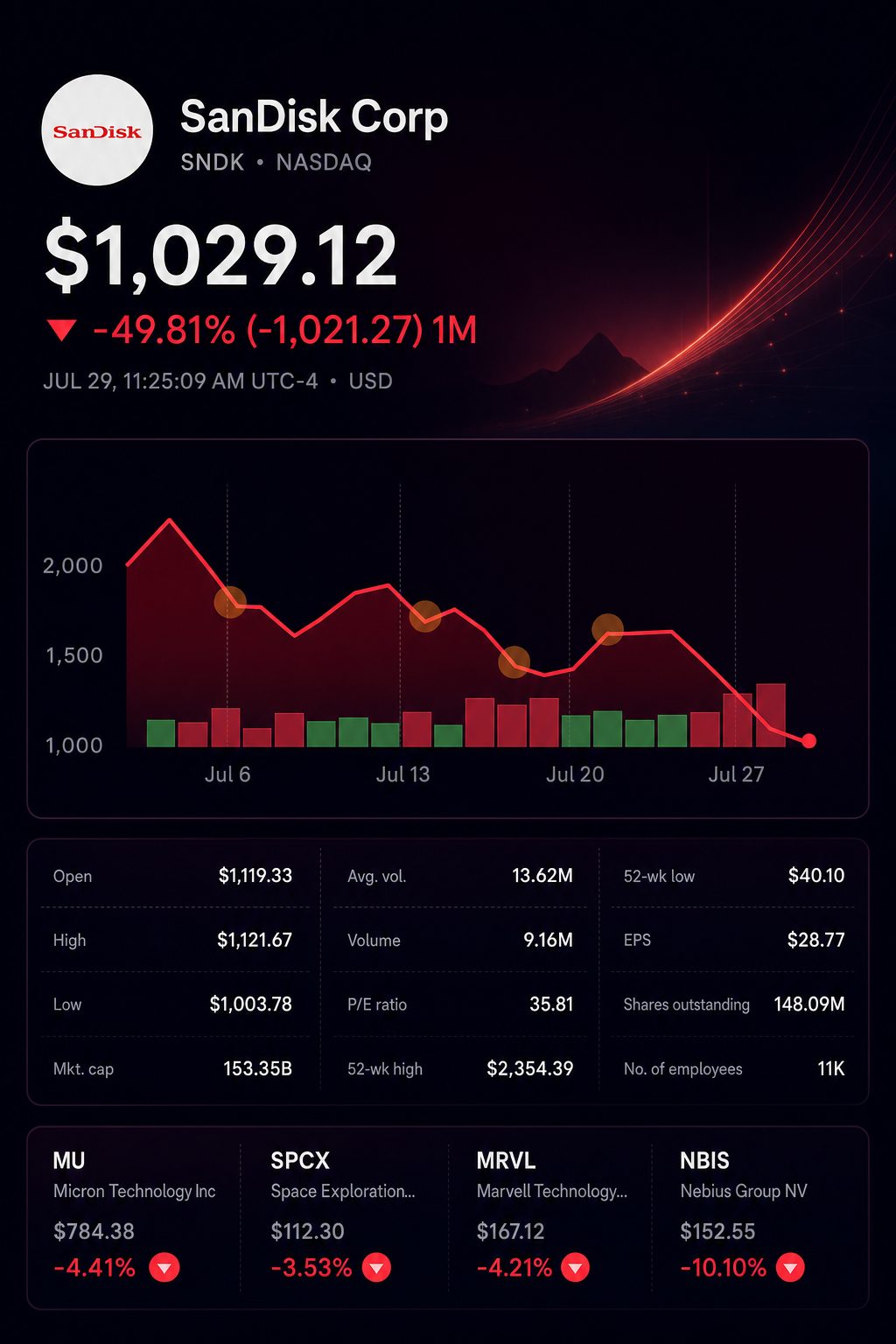
The drop leaves the stock appearing inexpensive based on projected run-rate earnings. However, the valuation is not attractive if existing margins decline.
Sandisk’s shares closed Wednesday at a trailing price-to-earnings ratio of 35.7. Applying the $31.50 fourth-quarter adjusted earnings guidance midpoint on an annualized basis results in a multiple of 8.1.
Margins account for nearly all of the difference. Adjusted gross margin for the third quarter was 78.4%, up from 51.1% the previous quarter and 22.7% in the same period last year. The company expects a gross margin between 79% and 81% in the fourth quarter.
Initial estimate: The sensitivity shown uses $8 billion as the quarterly revenue. It applies $490 million in adjusted operating costs and assumes 158 million diluted shares. The 13.9% tax rate follows guidance. This does not represent a forecast.
| Adjusted gross margin scenario | Projected quarterly EPS | Annualized P/E at $1,026.08 |
|---|---|---|
| 80.0% — midpoint of guidance | $32.3 | 7.9x |
| 60.0% | $23.6 | 10.9x |
| 40.0% | $14.9 | 17.2x |
| 22.7% — same period last year | $7.3 | 35.0x |
With the stock at its current level, Sandisk trades at nearly eight times annualized earnings assuming margins remain at 80%. If last year’s margin is used instead, the price-to-earnings multiple increases to roughly 35 times.
This is the fundamental investor play. Investors are wagering that a remarkable profit division is now permanent. Their bets go beyond just an increase in flash-memory demand.
Chief Executive David Goeckeler described the most recent quarter as a “fundamental inflection point.” He noted that multiyear customer agreements are expected to provide “more durable earnings power.” SanDisk Investor Relations
By April 30, Sandisk had entered into five similar agreements. Revenue from data centers jumped 233% compared to the prior quarter.
SanDisk will report fiscal fourth-quarter earnings after markets close on August 5. The company’s Investor Day is scheduled for August 13.
Micron Technology, Inc. NASDAQ:MU dropped 4.4% on Wednesday. Western Digital Corporation NASDAQ:WDC rose 0.2%. Both showed considerably less volatility than Sandisk in morning trading.
Investors in memory chips are considering whether unprecedented AI-driven demand can be sustained amid potential new supply. Concerns about expanded production in China and a possible slowdown in AI investment have prompted questions over how long current prices can hold.
Options market pricing suggests low expectations for a muted reaction post-earnings. Bloomberg figures referenced on Wednesday indicate an anticipated 12% swing after the August 5 results. In four out of the previous five quarters, Sandisk’s actual share movement outpaced the implied options move.
Trefis placed one-year implied volatility at 115%, nearly matching the 111% realized volatility. The figure was derived using Monday’s reference price of $1,278.23, prior to the most recent drop.
Risks: Acceleration in NAND flash-memory supply, reduced AI expenditure, or a return to typical margins could eliminate the currently low run-rate multiple. Conversely, robust contract pricing or another positive earnings surprise could lead to a pronounced recovery.
The August 5 test is more limited in scope than a simple revenue beat. Investors require proof that margins close to 80% are sustainable through the cycle.
Related articles: NASDAQ:SNDK