NEW YORK, July 30, 2026, 05:08 EDT — U.S. premarket
- Revenue increased by 32%, reaching $1.31 billion. Adjusted earnings came in at 48 cents, surpassing the 44-cent consensus from LSEG.
- Event-contract revenue totaled $156 million, coming in higher than equities revenue at $129 million and crypto revenue at $100 million.
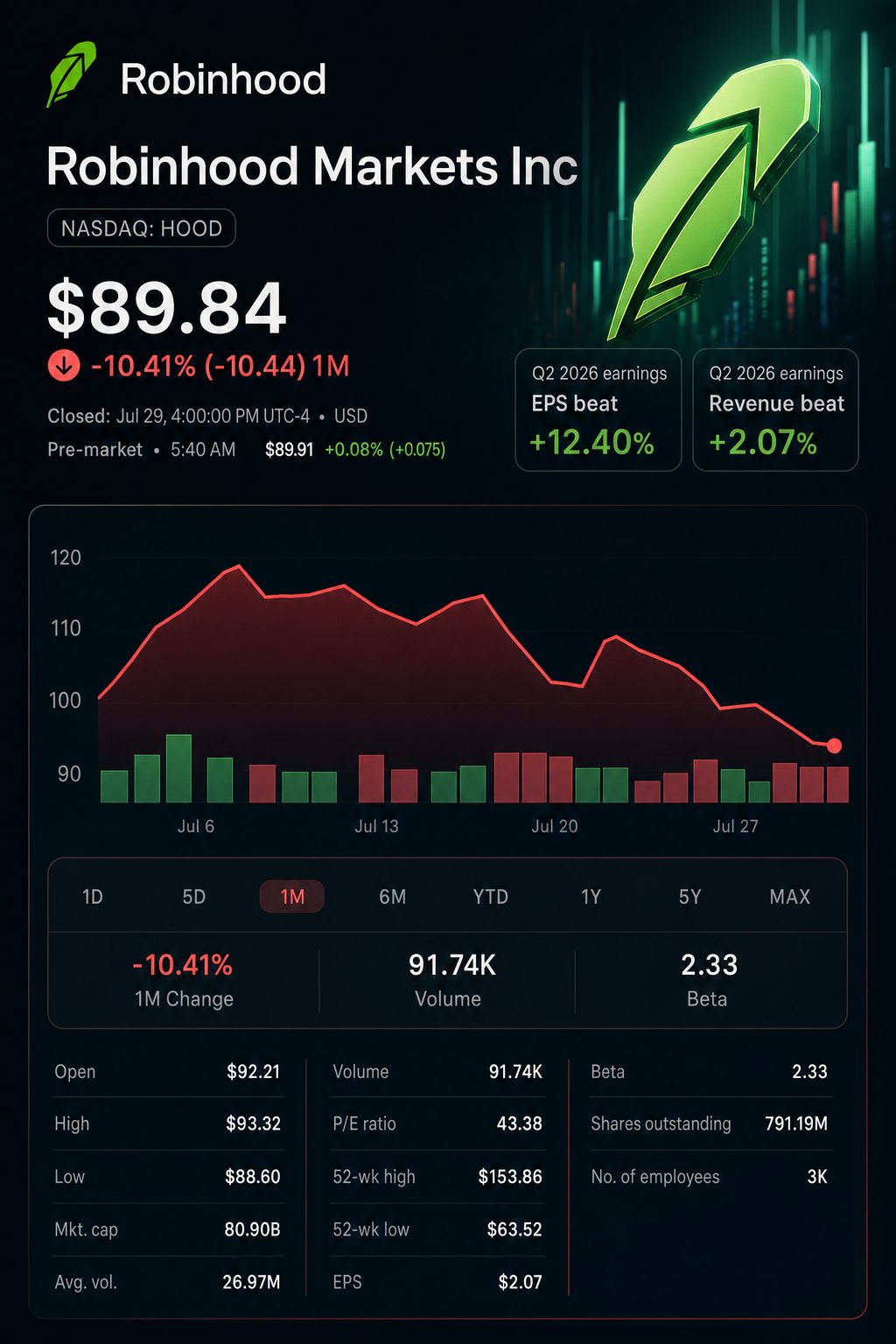
- Robinhood shares ended down 3.2% at $89.84, retreating a further 1% in after-hours trade.
Shares of Robinhood Markets NASDAQ:HOOD declined after the company reported results that exceeded second-quarter earnings expectations. U.S. regular trading had not yet begun at time of publication.
The most notable investor takeaway this quarter came from the revenue breakdown. Event contracts, which are prediction-market offerings linked to real-world events, produced higher revenue than either cryptocurrencies or equities. This remained true even excluding the contribution from Rothera, the latest exchange launch.
The firm disclosed the breakdown of its transaction-driven revenue. Percentages derive from internal data.
| Q2 transaction business | Revenue | Year-on-year change | Revenue share |
|---|---|---|---|
| Options | $342 million | up 29% | 44.1% |
| Event contracts | $156 million | over 10 times higher | 20.1% |
| Equities | $129 million | up 95% | 16.6% |
| Cryptocurrency | $100 million | down 38% | 12.9% |
| Other transactions | $49 million | up 29% | 6.3% |
| Total | $776 million | up 44% | 100% |
Robinhood’s top trading segment continued to be options. However, event contracts accounted for 20% of transaction revenue, compared to 16.7% in the previous quarter. Meanwhile, crypto’s portion dropped to 12.9%, down from 21.5%.
Growth in the prediction-market segment appears driven by higher volumes. Robinhood’s event hub handled 13.6 billion contracts, marking a 55% increase from the previous period. Revenue from core events, not including Rothera’s $17 million, climbed approximately 34% to $139 million.
| Prediction-market measure | Contracts | Revenue | Estimated revenue per contract |
|---|---|---|---|
| Q1 2026 Robinhood event hub | 8.8 billion | $104 million | 1.18 cents |
| Q2 2026 hub, minus Rothera revenue | 13.6 billion | $139 million | 1.02 cents |
| Q2 2026 Rothera | 2.1 billion | $17 million | 0.81 cents |
These are initial estimates and do not represent company-reported performance indicators. Rothera applies a separate method for counting contracts, which makes straightforward comparison less dependable.
The basic yield estimate declined by around 14% compared to the first quarter, indicating weaker unit economics. This also indicates that the revenue increase was largely driven by increased customer activity.
Chief Financial Officer Shiv Verma said the company was “firing on all cylinders,” pointing to record activity in equity, options, and event-contract volumes. Third Bridge analyst Jacob Zuller called prediction markets potentially the most significant growth catalyst for Robinhood. Robinhood Markets, Inc.
The company’s top-line financial performance saw significant gains. All dollar figures listed are in millions, unless stated otherwise for per-share data.
| Metric | Q2 2025 | Q1 2026 | Q2 2026 | Year-on-year |
|---|---|---|---|---|
| Total net revenue | $989 | $1,067 | $1,308 | up 32% |
| Transaction revenue | $539 | $623 | $776 | up 44% |
| Net income | $386 | $346 | $573 | up 48% |
| Diluted EPS | $0.42 | $0.38 | $0.62 | up 48% |
| Operating expenses | $550 | $656 | $734 | up 33% |
| Adjusted EBITDA | $549 | $534 | $741 | up 35% |
One adjustment must be made to the reported profit figure. Net income reflected a $129 million gain linked to the deconsolidation of Robinhood Ventures Fund I, accounting for roughly 23% of stated profit and boosting diluted EPS by 14 cents.
Adjusted earnings reached 48 cents per share, surpassing the LSEG estimate of 44 cents. This core result topped expectations even without the benefit from the fund gain.
Operating expenses increased by 33%, closely tracking the 32% rise in revenue. However, adjusted EBITDA margin improved to 57% compared to 56%.
Management revised down its forecast for adjusted operating expenses and stock-based compensation, now estimating a range of $2.675 billion to $2.775 billion, compared to the previous projection of $2.7 billion to $2.825 billion. This guidance reflects expected expenditures for Rothera and WonderFi.
Customer and asset metrics served as a more stable offset to fluctuations in trading.
| Operating measure | Q2 2026 | Change or context |
|---|---|---|
| Funded customers | 28.4 million | Up 7% year-on-year |
| Total platform assets | $369 billion | Increase of 32% |
| Quarterly net deposits | $21.7 billion | Hit a record; annualized growth at 28% |
| Gold subscribers | 4.8 million | Growth of 39% |
| Annualized revenue per user | $187 | Rose 24% |
Gold adoption climbed to 17% among funded users. Approximately 40% of new funded users signed up during the quarter. These subscriptions generate more stable revenue compared to trading commissions.
Coinbase Global NASDAQ:COIN will release its results after markets close on Thursday, offering insight into whether Robinhood’s crypto downturn signals a broader industry trend. Coinbase shares dropped 4.7% to $160.09 on Wednesday.
Robinhood’s valuation is still considered high. The company closed Wednesday trading at roughly 43.5 times its trailing earnings, with a market capitalization of $81 billion. “If there’s one concern, it’s valuation,” Zacks strategist David Bartosiak said. The Wall Street Journal
Risks: Prediction markets continue to face potential regulatory hurdles at both federal and state levels. Robinhood confronts increased credit provisions, elevated operating expenses, and subdued crypto trading. The company cautions that changes in regulations ahead may limit or prohibit event contracts.
Investors are now looking for continued contract growth and consistent revenue per contract. Thursday’s trading will reveal whether this focus surpasses the impact of the single profit boost.
Related articles: NASDAQ:HOOD