Micron (NASDAQ:MU) Declines Nearly $92 Billion Amid Scrutiny Over Longevity of Memory Rally

Micron (NASDAQ:MU) Declines Nearly $92 Billion Amid Scrutiny Over Longevity of Memory Rally

NEW YORK, July 30, 2026, 05:10 EDT

  • Micron ended Wednesday’s session down 9.94% and slipped a further 1.27% in premarket trading ahead of Thursday’s open.
  • An initial assessment shows that equities lost about $92.1 billion in value on Wednesday—roughly five times the most recent quarterly adjusted free cash flow.
  • Robust peer profits indicate ongoing demand. However, investors are focusing on margins, the stability of contracts, and Chinese production capacity.

Micron lost about $92 billion in market capitalization on Wednesday, based on its 1.13 billion shares outstanding. The stock ended the session at $739 and fell to $729.65 in premarket trading.

U.S. cash markets were shut at the dateline. Nasdaq saw activity in premarket hours, ahead of its regular opening at 09:30 EDT.

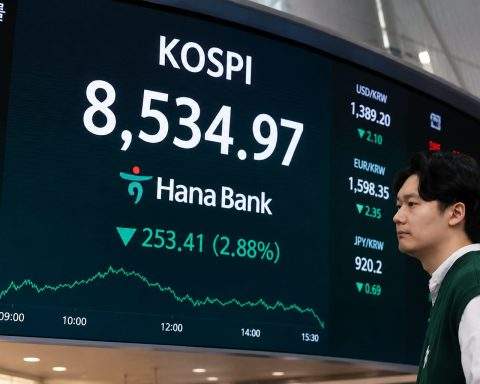
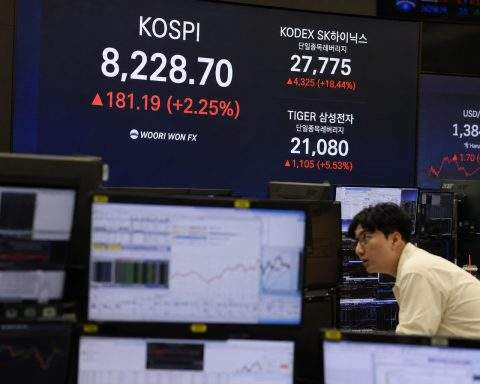
The downturn was widespread but particularly sharp. The Nasdaq slipped 1.74%, and Micron tumbled 9.94%. SK Hynix delivered record profits, yet these results did not match high expectations.

The divergence is evident in the referenced reports. The Motley Fool emphasized ongoing constraints in memory supplies. Seeking Alpha underscored positive supply-demand trends and stock valuation. Meanwhile, BoiseDev drew attention to issues related to China.
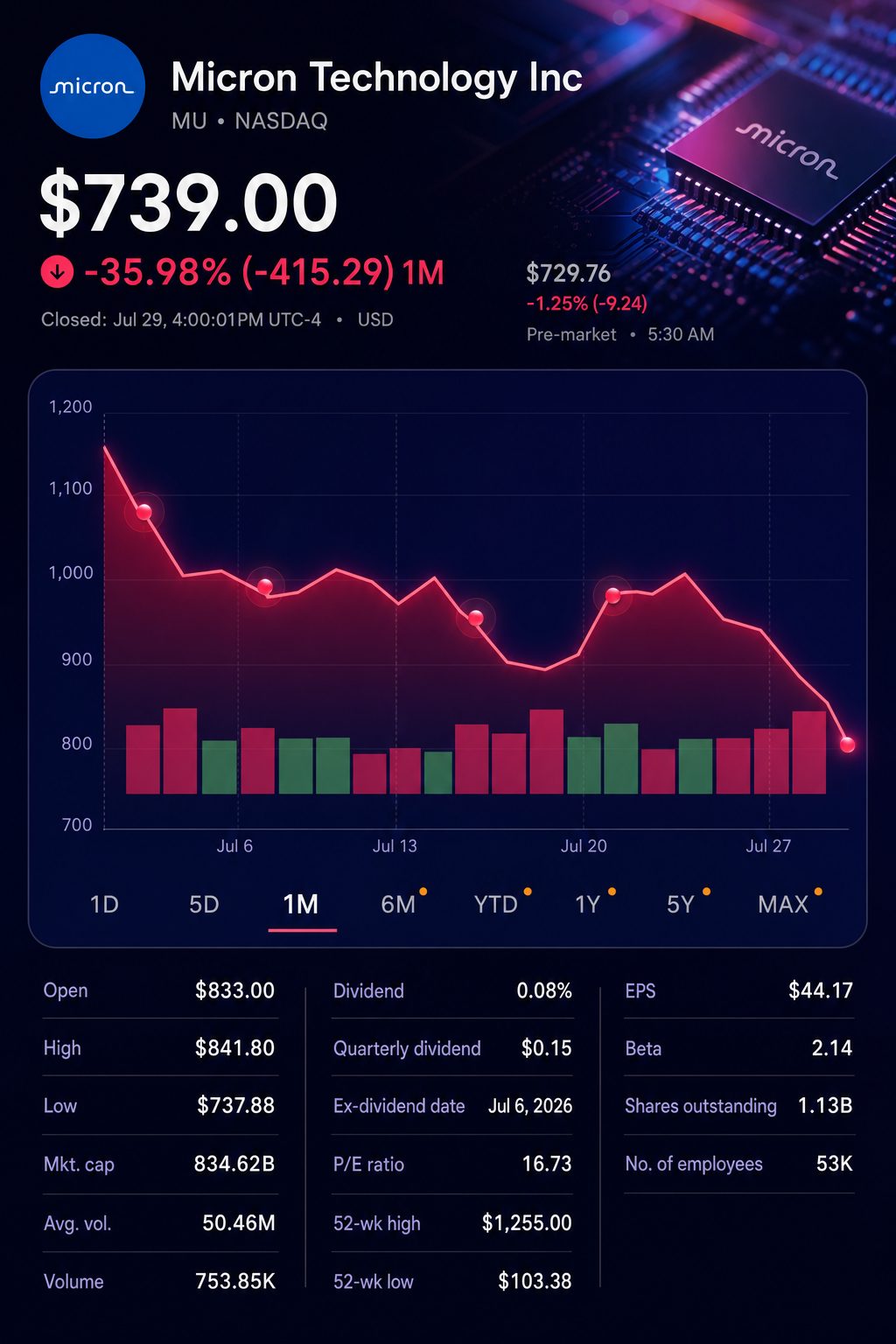
Stock chart for NASDAQ:MU

Micron’s swift price shift

Reference pointPrice or valueChange
July 23 close$990.21
July 29 close$739.00-25.4%
52-week high$1,255.00-41.1%
July 30 premarket, 05:04 EDT$729.65-1.27% from close
Provisional loss in value Wednesday$92.1 billionPreliminary

The figures are based on reported closing prices and Micron’s most recent share count.

Micron’s most recent quarter demonstrated outstanding performance, with revenue climbing to $41.46 billion, an increase of roughly 346% compared to the same period last year. The GAAP operating margin stood at 80.4%.

The company projected fiscal fourth-quarter revenue at $50 billion, with a potential variation of $1 billion. Gross margin is anticipated to be around 86%. HBM4 memory was reported as shipping in high volumes.

SK Hynix issued a comparable update on Wednesday, reporting that preliminary revenue surged by 257% and operating profit climbed 557%. However, its stock dropped 10%.

Samsung Electronics posted a surge in chip profit exceeding 250 times. The semiconductor margin climbed to 70%, but shares finished down 0.7% on Thursday. “Investors are questioning how long their record-high margins will be sustainable,” said Mirae Asset analyst Kim Seok-hwan. Reuters

Record activity, limited equity reaction

CompanyLatest revenue growthReported operating marginLatest cited share move
MicronUp 346% compared to previous year80.4% GAAPShares fell 9.94% on Wednesday
SK HynixUp 257% from a year earlier76%Shares dropped 10% on Wednesday
Samsung ElectronicsUp 130% compared with a year ago70% chip unitShares were down 0.7% on Thursday

The figures from SK Hynix are preliminary. Samsung’s revenue growth reflects the entire group, while its margin pertains specifically to semiconductors.

Contract structure has emerged as the latest investor variable. Micron expects that multi-year customer deals will enhance financial visibility. SK Hynix has secured agreements with roughly 10 customers.

Samsung plans to secure multi-year contracts for about two-thirds of its memory production, with agreements lasting at least five years and featuring minimum price guarantees. Executive Jaejune Kim said: “Almost all customers are requesting multi-year supply contracts.” Reuters

These terms may transform peak pricing into more consistent cash flow. However, this is an assumption rather than a proven effect. New supply could continue to challenge future contract renewals.

Comparison of trailing valuations

CompanyTrailing P/EDifference from Micron
SK Hynix12.5225% below
Samsung Electronics16.591% below
Micron16.73
Western Digital 27.6365% above
Sandisk 35.32111% above

Micron is priced lower than U.S.-listed storage firms, but its valuation is not below that of its main South Korean memory rivals.

The cash-flow argument appears more compelling, though it involves higher risk. Micron’s market value of $834.62 billion represents 11.4 times its annualized adjusted free cash flow for the third quarter. This initial pace is not a projection; it presumes the record quarter continues as is.

China continues to represent the most prominent long-term threat. According to reports, domestic manufacturers aim to produce five immersion lithography systems in the current year, increasing to 20 in 2027. In comparison, ASML Holding delivered 131 similar systems in 2025. Analysts at JPMorgan described the medium-term impact as contained while cautioning over mounting long-term risks.

Upcoming memory market drivers this week

CompanyDate and timeEvent
Kioxia Holdings July 31, 15:30 JSTFirst-quarter results for fiscal 2026
SandiskAugust 5, 16:30 EDTResults for fiscal fourth quarter and the full year

Kioxia is set to report on Friday, offering a gauge of NAND prices and the sector’s supply discipline. Sandisk’s fiscal-year results are due the following week.

Risks: Memory continues to show significant cyclicality. Reduced AI investment, rapid growth by Chinese competitors, or less favorable contract agreements might pressure margins. Ongoing supply shortages and the possibility of enforceable minimum prices, however, could mean Wednesday’s drop proves overdone.

TS2 TECH • EXTENDED COVERAGE

Further analysis

What is MU’s current trading level, and how significant is the decline?

Micron ended trading on July 29 at $739.00, declining 9.94% with a volume of 69.8 million shares. In early premarket action July 30, the stock traded around $730, down another approximately 1.2%. The S&P 500 dropped 1.52% and the technology sector slipped 2.93%. MU lagged both indexes by over seven percentage points. Shares are now about 41% off the June peak of $1,255. The Wall Street Journal

What is causing Micron’s decline even as it reports record operating performance?

SK Hynix’s latest quarterly results, which fell short of high expectations, served as the immediate catalyst. The earnings miss was interpreted by investors as a cautionary sign regarding peak memory margins. Despite Samsung achieving record profits in its chip business, concerns in the sector were not alleviated. Wednesday’s steep decline in the market occurred without any new earnings announcement from Micron, indicating a potential shift in sector valuation rather than a fresh issue specific to Micron. Barron’s

How did Micron perform in its most recent quarterly results?

Micron Technology posted fiscal third-quarter revenue of $41.46 billion, up 74% from the prior quarter and 346% from a year earlier. Non-GAAP gross margin was 84.9%. Adjusted earnings per share reached $25.11. Operating cash flow rose to $25.39 billion, more than double the previous quarter’s level. Adjusted free cash flow came in at $18.3 billion, following $7.1 billion in capital expenses. Data-center revenue surpassed $25 billion, reflecting robust, widespread AI demand. The results stand out, even amid a strong memory market upswing. Micron Technology

How is Micron projecting its financial results for the fiscal fourth quarter?

Management forecast revenue at $50.0 billion, with a possible variance of $1.0 billion. The company projects a gross margin near 86% and adjusted EPS close to $31.00. The revenue target midpoint suggests sequential growth of about 20.6% from fiscal Q3, while the EPS midpoint indicates around 23.5% growth from the previous quarter. Management also anticipates a significant slowdown in the pace of price increases. Growth remains strong, although the rate is losing momentum. Micron Technology

What is the long-term resilience of AI and HBM expansion?

Micron has generated over $1 billion in HBM4 revenue shipments so far. The ramp-up of its HBM4 12-high is progressing at double the pace of HBM3E. Management anticipates that DRAM and NAND markets will continue to face tightness past 2027. Samsung projects that the broader chip shortage will last into 2028. However, Samsung also forecasts HBM4 revenue to increase more than threefold this quarter. Demand continues to appear resilient. Competitive pressures are rising.

Do Micron’s latest customer agreements help mitigate memory-cycle risk?

Micron has entered into 16 strategic, multi-year customer agreements promising take-or-pay volume commitments. Management puts the total value of minimum-price commitments across these deals at about $100 billion. The agreements feature $22 billion in deposits and related obligations, with approximately $18 billion expected to be received as cash deposits from these contracts. These agreements enhance visibility on demand and underpin planned capacity investments. However, they do not remove risks related to pricing, customers, or execution.

Is Micron able to support its growth plans while keeping the balance sheet intact?

Micron closed its fiscal third quarter with $30.2 billion held in cash and investments. The company reported $5.7 billion in outstanding debt, resulting in a net cash position of $24.4 billion. Capital expenditures for the quarter amounted to $7.1 billion, about 28% of the operating cash flow. Micron projects full-year capital expenditures for fiscal 2026 will approach $27 billion. Adjusted free cash flow for the third quarter stood at $18.3 billion, even after these investments. Financial resources remain robust, but the outlook for returns relies on managing supply levels. Micron Technology

Is MU undervalued following the recent decline?

MU is currently priced at $739, corresponding to a trailing earnings multiple of about 16.7. FactSet projects MU to report earnings per share of $73.22 in fiscal 2026 and $154.67 in 2027. Based on those projections, the stock is valued at approximately 10.1 times 2026 earnings and 4.8 times 2027 earnings. That level appears notably inexpensive for a company with growth, at least on paper. The challenge lies in the volatility of memory markets, which can rapidly shift earnings outlooks. If margins reach their peak ahead of expectations, earnings estimates could decline more rapidly than the share price. The Wall Street Journal

How do Wall Street analysts view MU’s outlook going forward?

FactSet data shows an average price target of $1,568.74 and a median estimate of $1,600. Current analyst price targets span from $361 to $2,200. With shares at $739, the average target points to an approximate 112% upside. The lowest target signals potential downside of about 51%. This range is significant, even among volatile semiconductor stocks. A positive view depends on Micron delivering Q4 results and maintaining its pricing power. The bearish scenario is possible if there are setbacks in AI investment, pricing, or HBM execution. The Wall Street Journal

Michał Rogucki is a senior markets reporter at TS2.tech, specializing in stocks, technology and macroeconomic developments. A graduate of Humboldt University of Berlin, he previously worked in investment research and market analysis before transitioning to financial journalism. He covers the trends and events that matter most to investors worldwide.

AI PORTFOLIO

Top Stock Picks

Today’s highest-ranked model selections.

#1 BUY ON PULLBACK

Microsoft

NASDAQ: MSFT 94 / 100
#2 BUY

L3Harris Technologies

NYSE: LHX 90 / 100
#3 BUY

Xylem

NYSE: XYL 89 / 100
#4 BUY IN TRANCHES

Lam Research

NASDAQ: LRCX 87 / 100
#5 BUY ON WEAKNESS

GE HealthCare

NASDAQ: GEHC 84 / 100
View full portfolio
Editorial model selection. Not personalised advice.
Visa (NYSE:V) Shares Dip as Cross-Border Income Trails Growth in Payment Volume
Previous Story

Visa (NYSE:V) Cuts Jobs as $563 Million Charge Highlights Cost Efficiency Measures

U.S. Premarket Opens; Normal Trading Set for 09:30 EDT as Second-Home Mortgages Climb 4.1% with Wealthier Buyers Returning, Though Activity Stays 65% Under Record High
Next Story

U.S. Premarket Opens; Normal Trading Set for 09:30 EDT as Second-Home Mortgages Climb 4.1% with Wealthier Buyers Returning, Though Activity Stays 65% Under Record High