
Today: 30 June 2026
Browse Category

Starlink 16 August 2025 - 20 September 2025

SpaceX: Comprehensive Overview of History, Technologies, Missions, and Future Plans

SpaceX Falcon 9 Starlink Launch Set for Sept. 21, 2025 – Mission Details, Viewing Tips & More

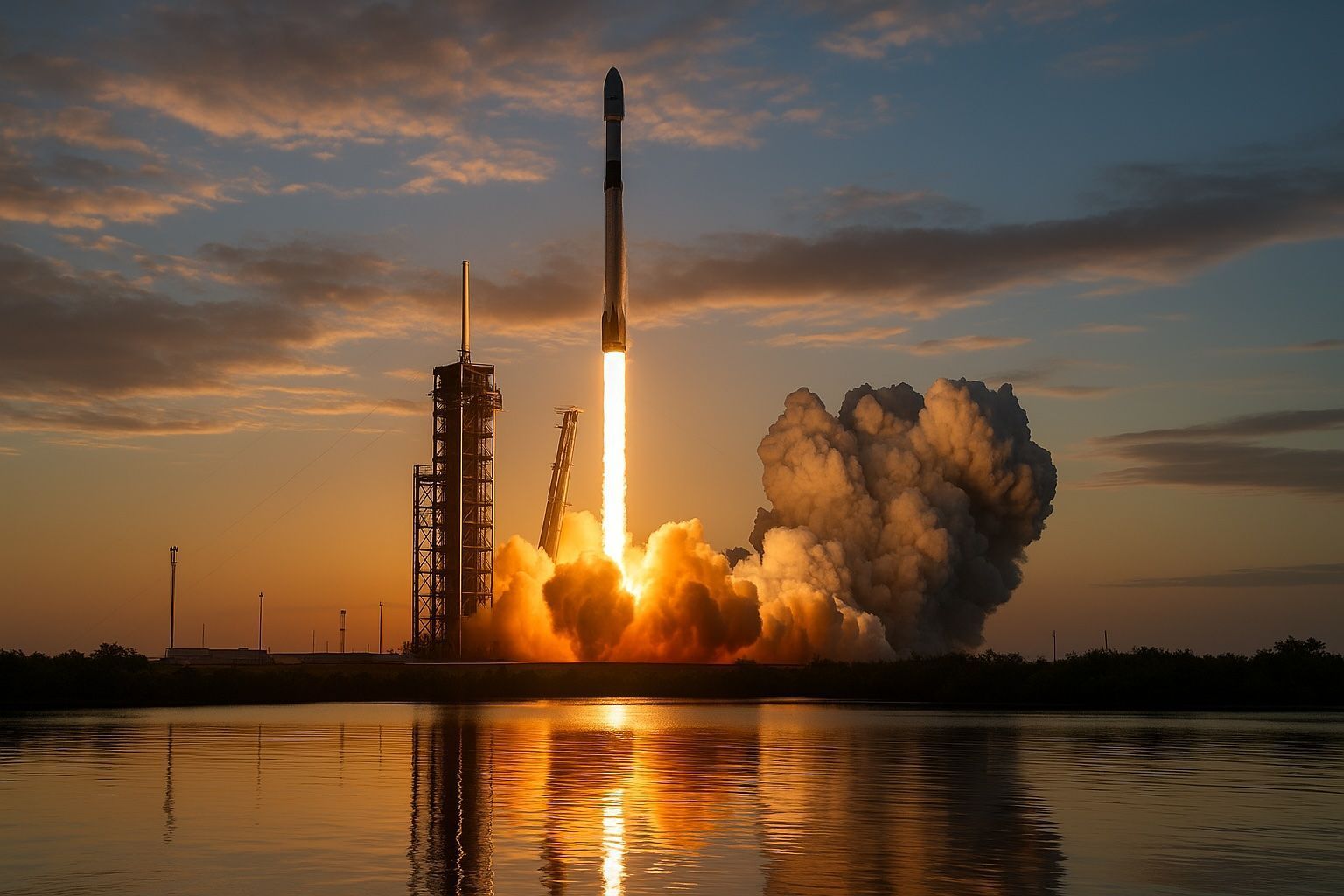
The sections below delve deeper into the mission details, rocket background, viewing opportunities, expert insights, recent developments, and how this launch fits into the broader spaceflight landscape. SpaceX is set to launch a Falcon 9 rocket before dawn on Sunday from Florida’s Cape Canaveral, carrying another batch of Starlink internet satellites to orbit. Liftoff is scheduled for 5:20 a.m. Eastern Daylight Time on Sept. 21 spaceflightnow.com, though the launch window remains open until 9:20 a.m. in case of minor delays mynews13.com. The mission, designated Starlink Group 10-27, will see the Falcon 9 travel on a northeasterly trajectory after liftoff nasaspaceflight.com, hugging the U.S. East Coast as it heads to the targeted orbit. This trajectory, inclined about 53° to Earth’s equator, is typical for Starlink missions launched from Florida, allowing the satellites to join one of Starlink’s mid-inclination orbital shells nasaspaceflight.com.
20 September 2025
Space Race Heats Up: Starlink Soars, New Shepard Returns & Mars Plans Unveiled – Sept 18–19, 2025 Space News

Space Race Heats Up: Starlink Soars, New Shepard Returns & Mars Plans Unveiled – Sept 18–19, 2025 Space News

SpaceX notched yet another Starlink mission on Sept. 18, flying 28 more Starlink satellites into orbit atop a Falcon 9 rocket from Cape Canaveral at 5:30 a.m. EDT space.com. The veteran first-stage booster – on its seventh flight – successfully landed on the droneship Just Read the Instructions downrange in the Atlantic, marking SpaceX’s 117th Falcon 9 launch of 2025 space.com. This cadence sets a blistering pace; over 70% of SpaceX’s flights this year have been dedicated to their Starlink internet constellation space.com. The mission highlights SpaceX’s routine of rapid reusability and high launch frequency, as the company continues to grow its broadband network in orbit. space.com space.com After a prolonged pause in suborbital launches, Blue Origin resumed New Shepard flights on Sept. 18 with a flawless morning liftoff from Launch Site One in West Texas space.com. Dubbed NS-35, this mission was uncrewed – instead of space tourists, the capsule was packed with over 40 research payloads ranging from student science experiments to technology demos space.com. Launching at 9:01 a.m. EDT, the booster propelled the capsule past the Kármán line, giving the experiments a few minutes of microgravity exposure space.com space.com. About 7½ minutes after liftoff, the reusable booster nailed
Space Race Heats Up: Starlink’s 300th Launch, Lunar Rocket Breakthrough & a Trillion-Dollar Space Shield – Sept 14–15, 2025 Roundup

Space Race Heats Up: Starlink’s 300th Launch, Lunar Rocket Breakthrough & a Trillion-Dollar Space Shield – Sept 14–15, 2025 Roundup

SpaceX notched a major milestone with its 300th Starlink mission, continuing its rapid deployment of the satellite internet constellation. A Falcon 9 lifted off from Vandenberg Space Force Base carrying 24 Starlink satellites on Sept. 13, bringing SpaceX’s tally to “the 300th Starlink mission… launched to date, according to the company” space.com. The booster successfully landed at sea for its 28th reuse, just two shy of SpaceX’s reuse record space.com. This landmark launch highlights SpaceX’s “ambitious plan to provide global internet coverage via an extensive satellite network,” as space industry trackers noted keeptrack.space. It was also the 115th Falcon 9 launch of the year, keeping SpaceX on pace for a record cadence space.com. On Sept. 14, a SpaceX Falcon 9 rocket lofted Northrop Grumman’s new Cygnus XL cargo spacecraft on its debut mission to the International Space Station space.com. The launch from Cape Canaveral at 6:11 pm EDT marked Northrop’s 23rd NASA resupply flight – but the first using the enlarged Cygnus XL, which can haul 33% more cargo than prior Cygnus vehicles spaceflightnow.com. In fact, Cygnus XL is carrying over 11,000 pounds of science experiments, crew supplies and hardware to the ISS space.com, including materials for semiconductor crystal growth
15 September 2025
Tech Turmoil: iPhone 17 Stuns, Starlink Outage, Cyber Hacks & Chip Wars – Non-AI News Roundup (Sept 14–15, 2025)

Tech Turmoil: iPhone 17 Stuns, Starlink Outage, Cyber Hacks & Chip Wars – Non-AI News Roundup (Sept 14–15, 2025)

Apple dominated headlines with a slate of new consumer devices launched at its Sept 9 “Awe Dropping” event, with products rolling out through mid-September. The company revealed four new iPhones – the iPhone 17, 17 Pro, 17 Pro Max, and a surprise iPhone Air – its slimmest iPhone ever at just 5.6 mm thick macworld.com. Despite the sleeker design and upgraded internals, pricing held steady: the base iPhone 17 starts at $799, and the Air at $999 macworld.com macworld.com. Reviewers noted that “we not only saw the thinnest iPhone ever, but also the longest-lasting iPhone battery ever,” thanks to efficiency gains and larger batteries across the range macworld.com. All four phones feature high-refresh 120 Hz ProMotion displays and camera upgrades like a new 18 MP front “Center Stage” camera and dual 48 MP rear cameras on the iPhone 17 macworld.com macworld.com. Shipping begins September 19 after brisk pre-orders since Sept 12 macworld.com macworld.com. Apple’s wearable lineup also got a boost. The new Apple Watch Series 11 debuted with advanced health-monitoring capabilities – most notably a cuff-less blood pressure monitoring feature. In a significant regulatory win for Apple’s health tech ambitions, the U.S. FDA cleared this blood-pressure detection feature for rollout
15 September 2025
Moon Race Heats Up, Starlink Hits 300 Launches, and Mars Life Clues – Space News Roundup (Sept 13–14, 2025)

Moon Race Heats Up, Starlink Hits 300 Launches, and Mars Life Clues – Space News Roundup (Sept 13–14, 2025)

The weekend saw robust support for the International Space Station from multiple partners. Northrop Grumman’s latest cargo mission, NG-23, thundered off Launch Complex 40 at Cape Canaveral on Sunday evening. Packed with over 11,000 pounds of experiments and provisions, the Cygnus freighter – named the S.S. Willie McCool in honor of the STS-107 Columbia pilot – is the first “Cygnus XL” variant, featuring an enhanced design that expands its payload capacity by about one-third nasa.gov spacepolicyonline.com. Because Northrop is still developing a new U.S.-built Antares rocket, this mission rode atop a SpaceX Falcon 9 under a launch services agreement spacepolicyonline.com. The booster performed flawlessly, inserting Cygnus into its rendezvous orbit. NASA confirmed the craft is on track to be captured by the ISS’s Canadarm2 on Sept. 17 nasa.gov. Once berthed, the crew will unpack a trove of research gear – from materials for growing semiconductor crystals in microgravity to a novel UV water purification system – as well as everyday supplies. Cygnus will spend about six months at the station before being filled with trash and commanded to a fiery reentry in Earth’s atmosphere nasa.gov. Just a day earlier, a Russian Progress freighter arrived at the ISS, illustrating how the
14 September 2025
Samoa’s Internet Revolution: From Undersea Cables to Starlink Skies

Samoa’s Internet Revolution: From Undersea Cables to Starlink Skies

Samoa’s internet infrastructure has transformed significantly in the past decade. The backbone of connectivity is now fiber-optic submarine cables. The first major cable, Tui-Samoa, went live in 2018, linking Samoa to Suva, Fiji ssccsamoa.com ssccsamoa.com. This cable dramatically increased international bandwidth and reduced Samoa’s dependence on satellites for backhaul. A second international cable, the Manatua One Polynesia cable, was completed around 2020, connecting Samoa to neighboring Polynesian islands subtelforum.com. Having two separate cables improves resiliency – if one fails, the other can keep Samoa online. There is also a cross-connection to American Samoa’s cable system, providing additional redundancy to global routes. On land, Samoa has been extending fiber-optic networks to deliver broadband to homes and businesses in urban areas. Vodafone Samoa offers Fiber-to-the-Home in parts of Apia, the capital. Speeds of up to 100 Mbps download are advertised on these fiber plans vodafone.com.ws. However, FTTH coverage is still limited to densely populated areas and some pilot rural sites. The majority of Samoan homes do not have a physical fiber or copper broadband line. In fact, fixed broadband subscriptions are very scarce – less than 1 per 100 people as of 2022 datahub.itu.int – indicating that only a few thousand households
7 September 2025
Starlink Blitz, Spy Satellite Surprises & Space Station Boost: Space News Roundup (Sept 5–6, 2025)

Starlink Blitz, Spy Satellite Surprises & Space Station Boost: Space News Roundup (Sept 5–6, 2025)

NASA kept busy on multiple fronts. On Sept. 5, NASA announced it will broadcast the launch and docking of Roscosmos’s Progress 93 cargo ship next week, as the Russian freighter carries ~3 tons of food, fuel and supplies to the International Space Station nasa.gov. This Progress launch and its six-month stay at the ISS come as NASA also tests new ways to maintain the station’s orbit. Notably, a SpaceX Dragon CRS-33 cargo vehicle performed the first-ever reboost of the ISS using its own engines on Sept. 3. Ground controllers fired Dragon’s new thruster kit for over 5 minutes, raising the ISS altitude by roughly a mile ts2.tech space.com. This successful test inaugurates a new capability for station-keeping – one that NASA plans to use regularly this fall – and reduces dependence on Russia’s Progress for routine boosts ts2.tech. “The test comes as NASA seeks alternatives to rely less on Russia’s vehicles for station-keeping,” agency officials noted ts2.tech. The station’s Expedition 73 crew continued science operations ranging from bone-loss studies to cardio experiments space.com. They also engaged in STEM outreach, answering questions from students in New York via a live Earth-to-space Q&A on Sept. 5 – with JAXA astronaut Kimiya Yui
6 September 2025
Starlink Blitz, Spy Sat Scare & Mission Milestones: Space News Roundup (Sept 4–5, 2025)

Starlink Blitz, Spy Sat Scare & Mission Milestones: Space News Roundup (Sept 4–5, 2025)

NASA & SpaceX – New Boosts and Milestones: In a notable first for ISS operations, SpaceX’s CRS-33 Dragon cargo ship successfully executed a reboost of the International Space Station on Sept. 3 nasa.gov. Firing new thrusters in its trunk for over five minutes, the uncrewed Dragon raised the ISS orbit by about a mile – inaugurating a capability that will be used periodically through fall 2025 to help maintain the station’s altitude nasa.gov nasa.gov. This test comes as NASA seeks alternatives to rely less on Russia’s Progress vehicles for station-keeping. Meanwhile, SpaceX is poised for a landmark booster recovery: the company’s next Starlink mission is set to achieve the 500th landing of a Falcon first stage if successful spaceflightnow.com. The Starlink 10-57 launch from Kennedy Space Center, scheduled for early Sept. 5, will mark SpaceX’s 111th flight of the year – keeping the company on pace for a record ~170 launches in 2025 spaceflightnow.com. The veteran Falcon 9 booster flying this mission is on its 27th reuse, underscoring SpaceX’s aggressive turnaround and reusability practices spaceflightnow.com. Weather was 70% favorable for the sunrise liftoff, with Space Force meteorologists monitoring coastal showers but expecting no organized storms during the launch window spaceflightnow.com.
Starlink Blitz, Spy Satellite Surprise & Moon Race Showdown – Space News Roundup (Sept. 3–4, 2025)

Starlink Blitz, Spy Satellite Surprise & Moon Race Showdown – Space News Roundup (Sept. 3–4, 2025)

On Sept. 3, NASA’s acting Administrator Sean Duffy announced a significant leadership move, naming longtime engineer Amit Kshatriya as the agency’s new Associate Administrator nasa.gov. This top civil-service post puts Kshatriya – previously head of NASA’s Moon-to-Mars architecture team – in charge of driving Artemis and deep-space exploration goals. The timing coincided with a strong show of support from the U.S. Senate for Project Artemis, amid worries about competition with China. In a Sept. 3 hearing pointedly titled “There’s a Bad Moon on the Rise: Why Congress and NASA Must Thwart China in the Space Race,” senators from both parties issued a “clarion call to get Americans back on the Moon and establish a sustainable presence before China puts taikonauts there.” They stressed staying the course on Artemis as currently planned spacepolicyonline.com, rejecting any drastic program cuts. Notably, this consensus clashes with the Trump Administration’s budget proposal to curtail Artemis after the first lunar landing – a plan lawmakers signaled they will fight to reverse spacepolicyonline.com spacepolicyonline.com. Experts at the hearing underscored the high stakes. Mike Gold, a former NASA official now with Redwire, warned that “the nation that controls the Moon will ultimately control the Earth, and we stand
4 September 2025
From Satellite Struggles to Starlink: Tuvalu’s Internet Revolution

From Satellite Struggles to Starlink: Tuvalu’s Internet Revolution

Tuvalu is a Polynesian microstate of about 10,000 people spread across nine coral atolls. Until recently, its internet infrastructure consisted solely of satellite links – there were no subsea fiber cables, and even regional microwave links to neighbors were absent due to the vast ocean distances. All international and inter-island data traveled via satellite, terminating at earth stations in Funafuti and smaller VSAT terminals on outer islands en.wikipedia.org prepaid-data-sim-card.fandom.com. This satellite dependency made Tuvalu’s internet expensive, bandwidth-constrained, and prone to outages. For most of the 2010s, Tuvalu’s connectivity was extremely limited. In 2012, the total bandwidth for the entire country was only 512 kbps uplink and 1.5 Mbps downlink en.wikipedia.org – essentially a single slow broadband connection shared by everyone. Even by 2016, total capacity was under 80 Mbps prepaid-data-sim-card.fandom.com. This bottleneck meant that basic web browsing was sluggish and data-intensive activities were nearly impossible. Internet access was described as high-cost and limited, contributing to Tuvalu’s status as “one of the least connected countries in the world” as of 2019scoop.co.nz.
Space Race Heats Up: Starlink Milestone, Venus Flyby & Solar Storms Mark a Stellar Weekend

Space Race Heats Up: Starlink Milestone, Venus Flyby & Solar Storms Mark a Stellar Weekend

Starlink Launch Surge: SpaceX punctuated the end of August with a sunrise Falcon 9 launch on Aug. 31, carrying 28 Starlink V2 Mini satellites to low Earth orbit spaceflightnow.com. Liftoff occurred at 7:49 a.m. EDT from Cape Canaveral’s SLC-40, and about 8½ minutes later the veteran booster nailed a landing on the Just Read the Instructions droneship spaceflightnow.com spaceflightnow.com. This mission – Starlink Group 10-14 – was SpaceX’s 9th Starlink launch of the month and 108th flight of 2025, extending the company’s record-breaking cadence spaceflightnow.com spaceflightnow.com. All told, over 1,900 Starlink satellites have been deployed in 2025, helping push SpaceX’s share of active satellites to roughly two-thirds of all in orbit spaceflightnow.com. Notably, SpaceX announced its Starlink internet service has grown to 7 million subscribers worldwide across 150+ countries spaceflightnow.com. To sustain demand, Starlink production is churning out satellites at an unprecedented clip. “Generally satellite manufacturing is a very slow process… At SpaceX, we iterate very fast and we have learned how to build satellites at a 70 sats per week rate,” said Cornelia Rosu, SpaceX’s senior director of Starlink production spaceflightnow.com. The Aug. 31 mission capped a month that also saw SpaceX achieve its 400th Falcon booster landing and
1 September 2025
Wi‑Fi Titans Clash: Starlink Gen3 vs TP‑Link Deco BE95 vs Netgear Orbi 970 – 2025 Mesh Router Showdown

Global Satellite Internet Showdown 2025: Starlink vs. Viasat vs. OneWeb – Who’s Winning the Race for Space Broadband?

Satellite internet has entered a new era in 2025. Once a niche last-resort service with slow speeds and tiny data caps, it’s now a fast-growing sector powering everything from rural homes to airplanes in flight. The charge has been led by SpaceX’s Starlink, the low-Earth orbit constellation that proved satellite broadband can be fast and relatively low-latency. Hot on its heels are legacy players like Viasat and HughesNet upgrading their systems, new LEO networks like OneWeb targeting businesses, and tech giants like Amazon’s Project Kuiper preparing to launch full services. Even regional and government initiatives are joining the fray to connect hard-to-reach populations. This report provides an in-depth comparison of all the major satellite internet services available globally as of August 2025. We cover offerings for residential consumers, commercial and enterprise users, maritime and aviation customers, and emerging markets. Key factors like pricing, performance, coverage, equipment, use cases, customer support, and future plans are examined for each provider. Recent developments – from Starlink’s surging subscriber counts to ViaSat-3’s issues and Amazon’s beta plans – are included with quotes from industry leaders and analysts. Read on to see how these competitors stack up and what it means for the future of
Internet Access Revolution: Starlink’s Global Surge, Broadband Booms & Outages – Aug 30–31, 2025

Internet Access Revolution: Starlink’s Global Surge, Broadband Booms & Outages – Aug 30–31, 2025

Low-Earth-Orbit satellite internet continues its explosive growth, dramatically expanding global internet access. SpaceX Starlink, the largest LEO constellation, hit a new milestone in late August 2025 with over 7 million active subscribers worldwide spaceflightnow.com – up from 4 million a year prior – served by roughly 1,900 satellites launched just in 2025 so far spaceflightnow.com spaceflightnow.com. On August 30, SpaceX launched yet another Falcon 9 rocket carrying 28 Starlink satellites, its 77th Starlink launch of the year spaceflightnow.com, underscoring the company’s unprecedented pace spaceflightnow.com. Starlink now operates in 150+ countries spaceflightnow.com, including many regions previously lacking reliable broadband. SpaceX recently announced crossing 7 million customers globally spaceflightnow.com after a surge in user uptake, and noted that Starlink satellites now make up about two-thirds of all active satellites in orbit spaceflightnow.com – a testament to how quickly LEO networks have scaled. Cornelia Rosu, SpaceX’s Starlink production director, said the company has learned to mass-produce satellites at “a 70 sats per week” rate, far faster than traditional aerospace timelines spaceflightnow.com. New market rollouts:
Northern Ireland’s Internet Access Revolution: Gigabit Broadband, 5G, and Starlink in 2025

Northern Ireland’s Internet Access Revolution: Gigabit Broadband, 5G, and Starlink in 2025

Northern Ireland’s internet infrastructure has undergone a rapid transformation, emerging as a standout success story in the UK. In 2025, NI boasts the most extensive high-speed broadband coverage of any UK nation, alongside near-ubiquitous mobile connectivity. This small region has leveraged aggressive fiber deployments, cable network upgrades, and mobile network expansion to ensure that almost every home and business can get online with fast speeds. Fixed Broadband: The backbone of NI’s internet is a highly developed fixed broadband network. The vast majority of connections are now delivered via modern fibre-optic cables – either full-fibre lines running directly to premises or hybrid fibre-coax systems in the case of cable. Over 93% of households can access FTTP broadband, a figure unrivaled in the rest of the UK ofcom.org.uk. When you include Virgin Media’s cable broadband coverage in cities, about 94–95% of NI homes have a gigabit-capable connection available ofcom.org.uk fibreprovider.net, meaning they could subscribe to ~1 Gbps service. This is a remarkable feat, considering just a few years ago gigabit coverage was in the double digits. Traditional copper-based broadband has largely been supplanted except in a few remaining locales. The government-defined “decent” service threshold is effectively universal – only ~2,000 premises in
29 August 2025
Panama’s Internet Revolution: Fiber, 5G, and Starlink Connecting Every Corner

Panama’s Internet Revolution: Fiber, 5G, and Starlink Connecting Every Corner

Panama has emerged as one of Central America’s most connected countries, with internet usage growing rapidly in recent years. As of early 2024, there were 3.54 million internet users in Panama – about 78.8% of the population datareportal.com. This marks a huge jump from just 32% of the population in 2010 trade.ec.europa.eu. Despite this progress, roughly one-fifth of Panamanians remained offline at the start of 2024 datareportal.com, highlighting a digital divide that the country is working to close. Broadband access has expanded due to significant infrastructure investments. Panama is strategically positioned as a regional internet hub – Panama City sits at the crossroads of multiple submarine fiber optic cables, bolstering the nation’s international bandwidth livinginpanama.com. In recent years, new submarine cable projects like the Aurora and Caribbean Express systems have further increased Panama’s global connectivity budde.com.au. Domestically, the government’s National Broadband Plan helped push broadband penetration to 70% by 2021 trade.ec.europa.eu. By 2023, fixed broadband subscriptions reached their highest level yet – about 18.1 per 100 people theglobaleconomy.com. This is close to the world average, although many Panamanians access the internet primarily through mobile networks rather than fixed lines.
27 August 2025
Portable Satellite Internet: Starlink Mini vs. Starlink Standard vs. Amazon’s Kuiper Terminal

Portable Satellite Internet: Starlink Mini vs. Starlink Standard vs. Amazon’s Kuiper Terminal

Satellite internet technology is rapidly evolving beyond fixed home installations to portable, on-the-go broadband solutions. SpaceX’s Starlink service – which already serves over 3 million users across 100+ countries techcrunch.com – has introduced new hardware for travelers and remote users, while Amazon’s Project Kuiper is preparing its own user terminals. This report provides an in-depth comparison of SpaceX’s “Starlink Portable WiFi” solutions and Amazon’s Project Kuiper customer terminals, focusing on current models, technical specs, performance, portability, setup, pricing, availability, and intended use cases. We also examine reliability, power usage, device integration, and upcoming developments from Starlink, Kuiper, and other competitors like OneWeb, AST SpaceMobile, and Telesat. Starlink Standard Kit: The standard Starlink residential kit consists of a dish antenna and a separate Wi-Fi router unit, originally designed for stationary home use. However, SpaceX now offers Starlink Roam plans that let customers use the standard kit portably – for example, at an off-grid cabin or in an RV starlink.com. The standard dish measures about 23.4 x 15.1 inches and weighs ~6.4 lbs without its stand starlink.com starlink.com. It can automatically orient itself for optimal satellite link and is built to handle harsh weather starlink.com. The dish connects via a 49 ft
Sierra Leone’s Internet Revolution: Mobile Boom, Fiber Dreams & Starlink’s Arrival

Sierra Leone’s Internet Revolution: Mobile Boom, Fiber Dreams & Starlink’s Arrival

Sierra Leone’s internet connectivity is undergoing a slow but notable transformation. As of early 2025, roughly 1.8 million Sierra Leoneans were using the internet – just about 20% of the population datareportal.com datareportal.com. Mobile phones are the primary gateway to get online, with about 8.66 million cellular mobile connections active datareportal.com. However, many of these mobile SIMs are used for basic voice/SMS services or held by people with multiple SIMs, so actual internet usage remains relatively low. In fact, an estimated 79% of the population is still offline as of 2025 datareportal.com, highlighting the significant digital divide that persists despite recent gains. Mobile broadband has become increasingly available, accounting for about 79% of all mobile connections datareportal.com. This indicates that most active SIM cards are now on networks that can deliver data services. Yet being on a 3G/4G network doesn’t guarantee regular internet use – cost, coverage gaps, and device limitations mean many Sierra Leoneans remain disconnected in practice. Overall, the country’s internet landscape can be characterized as mobile-centric but underutilized, with connectivity largely concentrated in cities and major towns while rural areas lag behind.
22 August 2025
Moldova’s Internet Revolution: From Lightning-Fast Fiber to Starlink’s Rural Lifeline in 2025

Moldova’s Internet Revolution: From Lightning-Fast Fiber to Starlink’s Rural Lifeline in 2025

Moldova is experiencing an internet connectivity boom that few might expect from one of Europe’s smaller and poorer nations. In 2025, this country boasts some of the fastest and most affordable internet access in the world en.wikipedia.org moldova.mom-gmr.org. High-speed broadband networks blanket the cities and even reach deep into rural areas, while new technologies like 5G mobile and satellite internet are expanding connectivity where cables can’t. Around 80% of Moldovans are now online datareportal.com, enjoying widespread fiber-optic coverage and mobile broadband services that rival those in more developed markets. This report provides a comprehensive look at Moldova’s internet access landscape in 2025 – from fixed broadband and mobile internet to satellite services – including key providers, speeds, pricing, coverage gaps, government initiatives, and future outlook. Moldova’s fixed broadband infrastructure is remarkably robust for its size. The country ranks 3rd in the world for gigabit fiber coverage, with around 90% of the population having access to gigabit-speed internet plans en.wikipedia.org. This is backed by extensive fiber-to-the-home networks and cable systems that deliver ultra-fast connections. In fact, average fixed broadband download speeds reach about 120 Mbps, placing Moldova around 40th globally for fixed internet speed – above the global average moldova.mom-gmr.org. Such
Don’t Miss SpaceX’s Dazzling Starlink “Satellite Train” – Here’s How to Watch It

Don’t Miss SpaceX’s Dazzling Starlink “Satellite Train” – Here’s How to Watch It

Starlink satellite “trains” launched by SpaceX have become a spectacular sight in the night sky, intriguing casual observers and space enthusiasts alike. On clear evenings, you might notice a sequence of bright lights moving in a straight line across the stars – these are Starlink satellites reflecting sunlight space.com. People around the world have been captivated by this otherworldly display, with some even mistaking these orderly satellite formations for UFOs space.com. In this report, we’ll explain what Starlink satellites are, why and when they’re visible, and how you can track and watch them yourself. We’ll also cover the best viewing times and tools, a step-by-step guide for first-time observers, the impact on astronomy, public and expert reactions, and the latest 2025 updates on Starlink’s visibility – all with insights from reliable sources and experts. Starlink is the name of a megaconstellation of small satellites built and operated by SpaceX to provide global high-speed internet coverage, especially to remote or underserved areas space.com. The satellites orbit Earth in low Earth orbit and communicate with ground stations to beam internet service. SpaceX’s vision is to eventually deploy tens of thousands of these satellites for near-planetwide coverage space.com. This makes Starlink the largest
16 August 2025

Stock Market Today

  • Palantir (PLTR) Analyst Sets $150 Target for 2026 After Strong AI Revenue Growth
    June 30, 2026, 10:57 AM EDT. Palantir Technologies (NASDAQ:PLTR) shares dropped 12.1% last week to $112.93, now down 36.47% year to date. Rosenblatt's John McPeake kept his $150 price target for the end of 2026, pointing to Palantir's position in AI infrastructure and 84.7% revenue growth in Q1 2026, which hit $1.632 billion. GAAP operating margin was 46%. The company put up a 'Rule of 40' score at 145%. U.S. commercial sales surged 133% to $595 million and remaining deal value landed at $4.92 billion. U.S. government contract revenue rose 84% to $687 million. McPeake said a run to $150 would mean Palantir sticking to its 71% revenue guidance, keeping margins up and holding a 77x forward P/E, but flagged high beta and risk of multiple compression.
Go toTop