Marcin Frąckiewicz

CEO of TS2 Space and founder of TS2.tech. Expert in satellites, telecommunications, and emerging technologies, covering trends in space, AI, and connectivity.

China’s “Night‑Light” Laser vs. Starlink: What a 2‑Watt Beam Really Means for the Coming Orbital Arms Race

Laser Leapfrog: Inside China’s Record-Breaking 1 Gbps Geo-Laser Link and the Post-Starlink Future of Space Internet

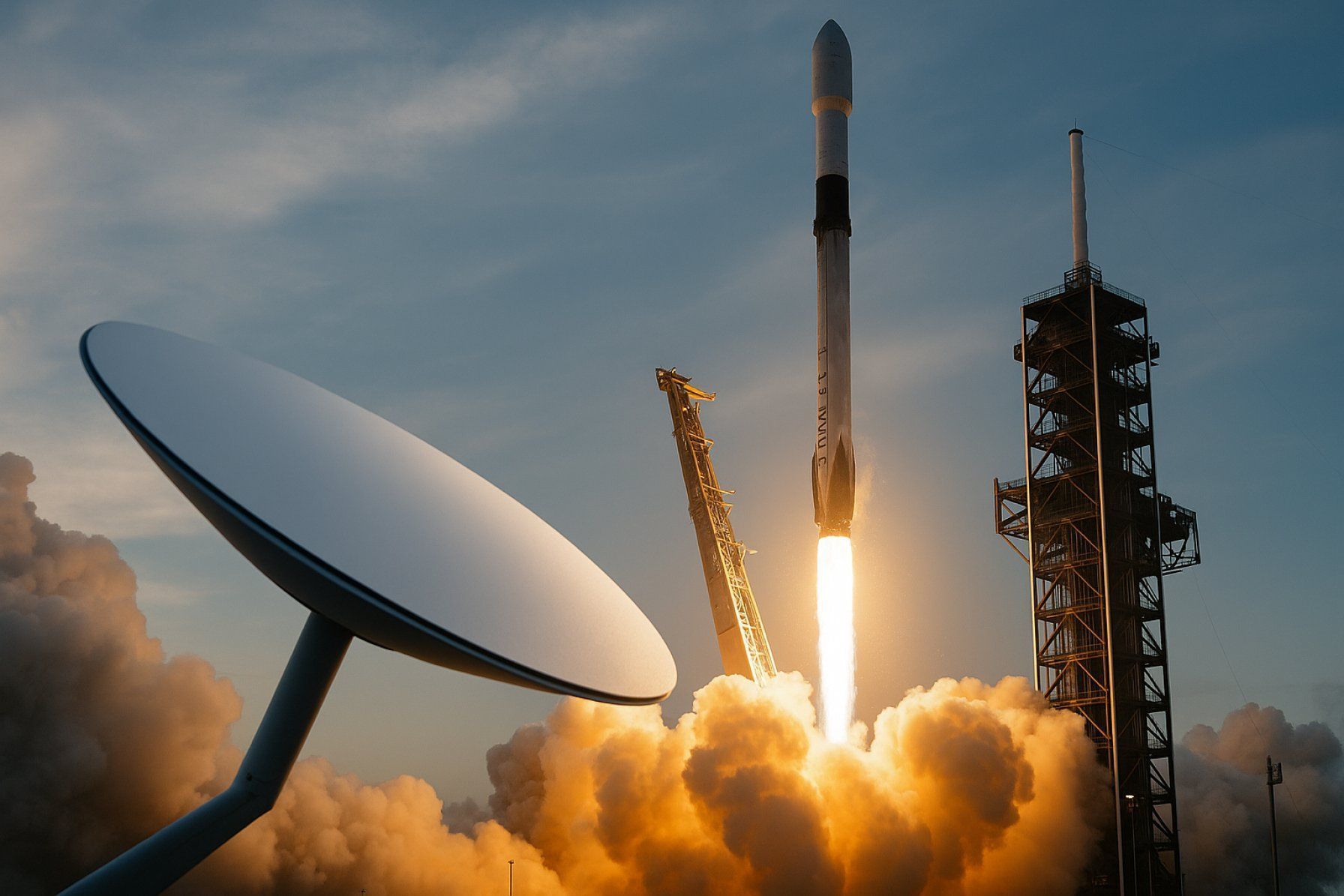
On June 17, 2025, a team led by Prof. Wu Jian (Peking University of Posts & Telecommunications) and Dr. Liu Chao (Chinese Academy of Sciences) achieved a 1 Gbps downlink from a geostationary satellite using a 2-watt optical laser. The GEO satellite was parked about 36,705 km above Earth and beamed data to a ground station in southwest China. The ground receiver used an 1.8-meter telescope at the Lijiang Observatory with advanced optics to capture the laser signal. The experiment delivered 1 Gbps downlink, five times faster than SpaceX Starlink’s typical 50–200 Mbps consumer speeds (bursts to 300–500 Mbps under
25 June 2025
Everything You Need to Know About Google Gemini CLI: Features, News, and Expert Insights

Google’s Gemini CLI Just Dropped—Here’s Why This Free, Open‑Source AI Agent Could Replace Your Favorite Coding Tool

Gemini CLI is a command‑line AI agent that passes natural-language prompts to Gemini 2.5 Pro and returns structured responses, code, or multimedia within the terminal. Gemini 2.5 Pro supports a 1,000,000-token context window, about 50–100× larger than mainstream LLMs, enabling repository-scale reasoning. The CLI integrates with Veo for video, Imagen for images, and Google Search via the Model Context Protocol (MCP) to handle multimodal tasks. During the preview, individuals can issue 60 requests per minute and 1,000 per day. Google released the entire Gemini CLI codebase under the Apache 2.0 license on GitHub, inviting pull requests and forks. Taylor Mullen,
25 June 2025
Everything You Need to Know About Google Gemini CLI: Features, News, and Expert Insights

Everything You Need to Know About Google Gemini CLI: Features, News, and Expert Insights

Gemini CLI was released by Google on June 25, 2025, as an open-source Apache-2.0 tool integrating Gemini 2.5 Pro into the terminal. Gemini 2.5 Pro in the CLI provides a 1,000,000-token context window and a free tier of up to 60 model requests per minute and 1,000 requests per day for personal Google accounts. The CLI runs natively on macOS, Linux, and Windows (no WSL) as an npm package requiring Node.js 18+, installable with npm install -g @google/gemini-cli. It includes built-in Google Search for real-time data and supports Model Context Protocol (MCP) to connect to external data sources and tools.
25 June 2025
EU Declares War on Space Junk: A Deep Dive into the New Space Act, the Starlink Dilemma and the Hidden Climate Costs of Orbital Debris

EU Declares War on Space Junk: A Deep Dive into the New Space Act, the Starlink Dilemma and the Hidden Climate Costs of Orbital Debris

The EU Space Act was presented on 25 June 2025 and would impose EU-wide rules on launch licensing, debris-mitigation, end-of-life disposal, cybersecurity and environmental impact, with fines up to 2% of global turnover. If approved, most provisions would apply from 2030, including special traffic-coordination duties for mega (100+) and giga (1,000+) constellations. The debris crisis features about 40,000 tracked objects orbiting Earth and more than 1.2 million pieces larger than 1 cm, with at least 3,000 new debris fragments created in 2024. Starlink has launched 7,578 satellites, of which 7,556 were operational as of 30 May 2025. SpaceX logged over
25 June 2025
Sky on Fire Tonight: Giant ‘Solar Canyon’ Aims 800‑km/s Wind at Earth—Northern Lights Could Ignite 15 U.S. States & Test Global Tech

Sky on Fire Tonight: Giant ‘Solar Canyon’ Aims 800‑km/s Wind at Earth—Northern Lights Could Ignite 15 U.S. States & Test Global Tech

NOAA’s Space Weather Prediction Center issued a G2 (moderate) geomagnetic‑storm watch for the night of 25 June 2025. A negative-polarity coronal hole crossing the Sun’s central meridian is releasing plasma at roughly 500–800 km/s toward Earth. The fast solar wind could drive auroras as far south as Colorado, New York and Oregon and briefly disturb power grids, satellites and GPS. Peer‑reviewed modeling in Nature Scientific Reports shows high-speed streams routinely trigger medium geomagnetic storms that can inject more energy into near‑Earth space than rarer CMEs over a solar cycle. A compressed co-rotating interaction region at the leading edge combined with
25 June 2025
Historic Liftoff! Poland’s “Star Scientist” Launches on SpaceX Dragon—All the Inside Details on the Ax-4 Mission, Crew and Experiments

SpaceX’s ‘Grace’ Roars to Orbit: Axiom Mission 4 Sends India, Poland & Hungary Back to Space — and Signals the Dawn of a Truly Global Commercial ISS Era

Liftoff occurred at 2:31 a.m. EDT (06:31 UTC) on 25 June 2025 from Launch Complex 39A at Kennedy Space Center, and the Falcon 9 booster landed at LZ-1 eight minutes later. Dragon C213, the fifth and final production Crew Dragon, was named Grace by Commander Peggy Whitson moments after orbital insertion. The two‑week Ax‑4 mission carried about 60 experiments for 31 nations, the largest research manifest of any Axiom flight. The multinational crew included Peggy Whitson (USA), Shubhanshu Shukla (India’s first ISS astronaut), Sławosz Uznański‑Wiśniewski (Poland’s first ISS visitor), and Tibor Kapu (Hungary’s first spacefarer in 45 years). Ax‑4 marked
25 June 2025
Historic Liftoff! Poland’s “Star Scientist” Launches on SpaceX Dragon—All the Inside Details on the Ax-4 Mission, Crew and Experiments

Historic Liftoff! Poland’s “Star Scientist” Launches on SpaceX Dragon—All the Inside Details on the Ax-4 Mission, Crew and Experiments

On June 25 at 08:31 CEST, SpaceX Crew Dragon “Grace” launched from Pad 39A with four astronauts on Axiom Mission 4 (Ax-4). Peggy Whitson (USA) commands Ax-4 and is on her fifth spaceflight, with a U.S. orbital record of 675 days. Shubhanshu Shukla (India) is Pilot for Ax-4, becoming the first Indian in space since 1984. Sławosz Uznański-Wiśniewski (Poland) is the first Polish national on the ISS and the second Pole in space. Tibor Kapu (Hungary) is Ax-4’s Mission Specialist, marking Hungary’s first visitor to the ISS. Poland’s 47-year space drought ends with Ax-4, following Mirosław Hermaszewski’s 1978 Soyuz 30
25 June 2025
Massive iCloud Meltdown: Why Apple’s Cloud Went Dark Today — and What It Means for Millions of Users

Massive iCloud Meltdown: Why Apple’s Cloud Went Dark Today — and What It Means for Millions of Users

On 24 June 2025, the iCloud outage began after lunchtime in the US, with Apple’s System Status dashboard flagging an outage at 2:36 p.m. ET for iCloud Web Apps and iWork for iCloud, and yellow warnings for Mail, Photos, and Storage Upgrades. Downdetector spiked around 1:00 p.m. ET, and by 4:11 p.m. ET reports reached about 900+ complaints. iCloud Web Apps, iWork for iCloud, Photos, iCloud Mail, and Storage Upgrades and backup APIs experienced outages or severe slowness. The status tiles remained red for several hours and flipped to green roughly four hours after the first alert as Apple rolled
24 June 2025
Earthquake Frenzy TODAY: Caribbean Shocker, Pacific Powerhouse & Surprise U.S. Tremor—See Where the Ground Is Shaking Right Now

Earthquake Frenzy TODAY: Caribbean Shocker, Pacific Powerhouse & Surprise U.S. Tremor—See Where the Ground Is Shaking Right Now

A M5.7–5.8 earthquake struck about 77 km NNE of Punta Cana, Dominican Republic, at 02:45 UTC on 24 June 2025, depth 68 km, felt in Puerto Rico with no tsunami. A M6.3–6.5 quake east of the Philippine Islands occurred at 01:58 UTC, depth 10 km at 7.97°N, 129.83°E, with tremors felt in Bangkok and Mandalay and no tsunami. A M2.7 earthquake near Burbank in Los Angeles at 19:22 UTC, depth 8 km, described as a wake-up quake with no damage. A deep-focus M4.4 quake struck the Atacama Desert, Chile, at 07:42 UTC, depth 179 km, typically producing limited surface shaking.
24 June 2025
Latest Satellite News & Insights 25.06.2025

Latest Satellite News & Insights 25.06.2025

EarthDaily Analytics launched its first Earth observation satellite, initiating a next-generation ten-satellite constellation to deliver daily AI-ready global imagery and analytics, with the full constellation expected to be operational next year. SpaceX launched 27 Starlink satellites from Cape Canaveral on a Falcon 9 booster (B1080) in its 20th flight, with the first stage successfully recovered, expanding global internet coverage to over 7,800 active relays. James Webb Space Telescope captured its first direct image of exoplanet TWA 7 b about 110 light-years away using a coronagraph on the MIRI instrument. ESA’s Biomass satellite released its first radar images using P-band synthetic
24 June 2025
You Won’t Believe Why the San Fernando Valley Just Shook: Inside the 2.7‑Magnitude Sherman Oaks Quake—and What It Really Tells Us About L.A.’s Seismic Future

You Won’t Believe Why the San Fernando Valley Just Shook: Inside the 2.7‑Magnitude Sherman Oaks Quake—and What It Really Tells Us About L.A.’s Seismic Future

A shallow Ml 2.7 earthquake struck at 12:22 p.m. PDT on June 24, 2025, about 2 km northeast of Sherman Oaks, with a focal depth of ~5 km. Shaking was light (MMI IV), and the USGS Did You Feel It? page logged about 12 responses within the first 13 minutes. No injuries or structural damage were reported by local agencies as of press time. ShakeAlert did not issue an early warning because the ground motion remained below activation thresholds. The event occurred about 3 km SSE of Van Nuys, according to SCEDC data. Dr. Lucy Jones described small quakes as
24 June 2025
Jeff Bezos vs. Elon Musk: How Amazon’s New Kuiper Satellites Could Disrupt a $100 Billion Space‑Internet Gold Rush

Space Race Frenzy: Exploding Starships, Quantum‑Proof Satellites & Europe’s Billion‑Dollar Constellation Shake‑Up — Everything That Hit Orbit TODAY (24 June 2025)

SpaceX’s Transporter-14 rideshare lofted 70 payloads, including memorial capsules, ICEYE and Capella radar sats, and York Space Systems’ Dragoon Tranche-1 12-satellite demo. The first Dragoon craft launched Monday on Transporter-14 is now on orbit, with SDA citing a four-month schedule cut to accelerate capabilities. Shijian-21 rendezvoused with Shijian-25 at about 22,236 miles, rehearsing refueling and capture maneuvers that analysts warn could neutralize adversary satellites in a conflict. T-Mobile’s T-Satellite service will provide full data links on 1 Oct 2025, piggybacking on 657 Starlink satellites, with basic messaging starting 23 July and 911 texting free for all U.S. users. SpaceX targets
Lyon’s Bold Digital Revolution: 7 Reasons the City’s Break‑Up With Microsoft Will Rock Government IT

Lyon’s Bold Digital Revolution: 7 Reasons the City’s Break‑Up With Microsoft Will Rock Government IT

On 23 June 2025, Lyon announced Territoire Numérique Ouvert (TNO) and a progressive migration from Microsoft Office to OnlyOffice, Linux, and PostgreSQL across municipal workstations. Territoire Numérique Ouvert is an open-source collaborative suite developed with SITIV and the Lyon Metropole. TNO is hosted in regional datacentres. TNO received a €2 million grant from the National Agency for Territorial Cohesion (ANCT). TNO already serves several thousand agents in nine local authorities. Civil servant training for the switch began in June 2025. The initiative aims to escape American software dependency. Zimbra integration by Axess reduces maintenance costs by at least 50%. Over
Sky‑Spectacle Alert: Rare Northern Lights Could Paint U.S. Skies Tonight—Here’s the Science, the Map and the Expert Warnings You Need

Sky‑Spectacle Alert: Rare Northern Lights Could Paint U.S. Skies Tonight—Here’s the Science, the Map and the Expert Warnings You Need

A coronal-hole high-speed stream traveling at about 750 km/s is slamming Earth’s magnetosphere and has prompted NOAA to issue a G2 (Moderate) geomagnetic-storm watch for 24–25 June 2025. The storm could push aurora visibility as far south as Illinois, Ohio, and New York on the night of 24–25 June 2025. The disturbance already produced vivid green and magenta curtains seen from Texas to Alberta earlier this month. NOAA SWPC reported K-index values of 4 late Monday, indicating active conditions likely to produce auroras in the northern tier of the United States. Updated view-line maps show the aurora oval dipping into
24 June 2025
Sky‑Spectacle Tonight: 15 U.S. States Could Witness a Rare Aurora Outburst—Everything You Must Know Before Sunset

Sky‑Spectacle Tonight: 15 U.S. States Could Witness a Rare Aurora Outburst—Everything You Must Know Before Sunset

A large negative-polarity coronal-hole high-speed stream (CH HSS) has been rotating into Earth’s line of sight since 23 June, prompting NOAA SWPC to issue a G2 geomagnetic-storm outlook for 25–26 June UTC. Solar wind gusts exceeding 600 km/s are expected, with the planetary K-index (Kp) peaking near 5–6. Solar Cycle 25 is nearing its predicted maximum in mid-2025, following multiple strong flares including an X-class event captured by NASA’s Solar Dynamics Observatory on 17 June. Forbes identifies a 15-state ‘Aurora Alert’ zone spanning Alaska, Washington, Oregon, Minnesota, North Dakota, Montana, Maine, Michigan, Wisconsin, Vermont, New Hampshire, New York, Idaho, South
24 June 2025
Sky‑Spectacle Alert: 15 U.S. States Could See the Northern Lights Tonight—Everything You Must Know Before You Look Up

Sky‑Spectacle Alert: 15 U.S. States Could See the Northern Lights Tonight—Everything You Must Know Before You Look Up

The 24–25 June 2025 event is forecast to reach G1–G2 geomagnetic storming with a peak Kp of 5.67. NOAA SWPC’s 3‑Day Forecast issued on 24 June projects storming for 25–26 June. Up to 14–15 states could see auroras, from Alaska and Washington to New York and South Dakota. A large equatorial coronal hole rotated into the Earth-facing solar disk on 22–23 June, driving a 500 km/s solar wind. This fast solar wind is expected to reach Earth about 2–3 days later, triggering G1–G2 storming. Aurora Viewline maps place the southern visibility limit through northern Oregon, Idaho, South Dakota, Wisconsin, Michigan,
24 June 2025
Trump’s High‑Wire Act: NATO Shockwaves, Middle‑East Firestorm, and a Congress on Edge—What the June 24, 2025 Frenzy Really Means for America and the World

Trump’s High‑Wire Act: NATO Shockwaves, Middle‑East Firestorm, and a Congress on Edge—What the June 24, 2025 Frenzy Really Means for America and the World

On June 24, 2025, President Donald Trump arrived in The Hague demanding all 32 NATO allies commit 5% of their GDP to defense. Spain and Slovakia sought carve-outs, exposing cracks despite a one-page summit communiqué praised by NATO Secretary-General Mark Rutte. From Air Force One, Trump phoned Israeli Prime Minister Benjamin Netanyahu and Iranian intermediaries via Qatar to secure a cease-fire pledge minutes before landing. Trump ordered U.S. B-2 strikes on Iranian nuclear sites. Within hours, Iran and Israel fired new missiles, prompting Trump to lash out at Israel for unloading right after agreeing. U.S. refueling tankers and the carrier
24 June 2025
Space Race 2.0: A Shoebox‑Sized Quantum Satellite Blasts Off—Can It Make Hackers Obsolete?

Space Race 2.0: A Shoebox‑Sized Quantum Satellite Blasts Off—Can It Make Hackers Obsolete?

QUICK³ is a 3U CubeSat weighing 4 kg, led by Germany’s Technical University of Munich, and it launched on 23 June 2025 aboard SpaceX’s Transporter‑14 from Vandenberg SFB. It carries the first true single-photon source flown, a laser-pumped hexagonal boron nitride chip on a 10 × 10 × 15 cm photonic chip. True single photons are expected to raise secret-key rates 10–100× over weak-laser systems. The pump laser is a 698 nm diode module, 45 × 80 × 20 mm, weighing 200 g. QUICK³ uses a 3U CubeSat bus with a 4 kg mass budget and rideshare compatibility, with launch
“Unhackable from Orbit!” – How a 4 kg CubeSat Just Kicked‑Off the Race for a Global Quantum‑Secure Internet

“Unhackable from Orbit!” – How a 4 kg CubeSat Just Kicked‑Off the Race for a Global Quantum‑Secure Internet

On 23 June 2025 at 07:18 UTC, the Falcon 9 lifted the QUICK³ nano-satellite into a 550 km sun-synchronous orbit from Vandenberg Space Force Base during SpaceX’s Transporter-14 rideshare, with payload separation confirmed nine minutes after launch. The QUICK³ spacecraft weighs 4 kg and is a 3-U CubeSat (10 × 10 × 30 cm) with a primary experiment window of 6 minutes per 97-minute orbit. QUICK³ aims to bypass fiber-based quantum key distribution limits by sending true single photons through near-vacuum upper atmosphere to enable intercontinental quantum-secure links. A hexagonal-boron-nitride colour centre single-photon source emits at 650–700 nm, paired with
Umbrella in Orbit: ESA’s BIOMASS Satellite Lifts Earth’s Green Veil, Revealing Hidden Carbon Stores and Jaw‑Dropping First Images

Umbrella in Orbit: ESA’s BIOMASS Satellite Lifts Earth’s Green Veil, Revealing Hidden Carbon Stores and Jaw‑Dropping First Images

BIOMASS uses a fully polarimetric P-band SAR with a 70 cm wavelength to pierce through canopies and measure woody trunks where most forest carbon is stored. The 12-meter deployable reflector, shaped like an umbrella and built by L3Harris, directs radar pulses back to the sensor. The 1.25-tonne spacecraft was launched on 29 April 2025 aboard a Vega-C rocket from Kourou into a 666 km sun-synchronous orbit (flight VV26). The gold-colored reflector unfurled in orbit on 7 May 2025, marking a key commissioning milestone. First images show colour-coded maps of the Amazon, Indonesia, and the bedrock of the Sahara. By combining
24 June 2025
1 339 340 341 342 343 352

Stock Market Today

Real estate stocks rise as rate-cut bets return; XLRE ends at $41.99 ahead of payrolls and CPI

Real estate stocks rise as rate-cut bets return; XLRE ends at $41.99 ahead of payrolls and CPI

7 February 2026
U.S. real estate stocks rose Friday, with XLRE up 1.8% to $41.99 and VNQ and IYR each gaining 1.6%. The Dow closed above 50,000 for the first time as the 10-year Treasury yield ended at 4.206%. Bank of America downgraded Public Storage and Extra Space Storage, citing weak housing turnover and high borrowing costs. The delayed January jobs report is set for Feb. 11, with CPI due Feb. 13.
Go toTop