Mateusz Kaczmarek

A technology and finance expert writing for TS2.tech. He analyzes developments in satellites, telecommunications, and artificial intelligence, with a focus on their impact on global markets. Author of industry reports and market commentary, often cited in tech and business media. Passionate about innovation and the digital economy.

Hungary’s Digital Lifeline: How Fiber, 5G, and Satellites Are Rewiring the Nation

Hungary’s Digital Lifeline: How Fiber, 5G, and Satellites Are Rewiring the Nation

As of late 2023, more than 97% of Hungarian households have access to wired fixed broadband networks, including FTTH and upgraded cable. Thanks to the Superfast Internet Programme (SZIP), by 2020 at least 30 Mbps service reached over 95% of households in underserved areas. By 2022, gigabit-speed networks pass about two-thirds of households, and Very High Capacity Network coverage rose from 72% in 2021 to 80% in 2022, well above the EU average of about 72%. Pure fiber (FTTP) coverage reached 70% of households by 2022, up from roughly 50% two years earlier. Mobile networks provide nearly universal 4G coverage
The GEO Reboot: How 2040 Will Look from 36,000 km Up

The GEO Reboot: How 2040 Will Look from 36,000 km Up

By 2040, analysts expect the global GEO replacement rate to be 10–15 new satellites per year, totaling about 200 GEO satellites from 2024 to 2040 and replacing most of today’s roughly 350-satellite fleet. A typical GEO satellite is designed for about 15 years, but all-electric propulsion and on-orbit servicing can push operational life to 20–30 years, as shown by MEV extensions of Intelsat-901 and 10-02 in 2020–2021. NASA is phasing out the dedicated TDRS relay fleet by the mid-2030s and shifting to commercial SATCOM services from providers such as SpaceX, SES, Viasat, and Inmarsat, with NASA stopping new TDRS users
Inside Morocco’s Internet Revolution: From Fiber Optics to Satellite Access

Inside Morocco’s Internet Revolution: From Fiber Optics to Satellite Access

As of early 2024, Morocco had 34.47 million internet users, representing about 90.7% of the population. In 2024, Morocco recorded 51.36 million cellular connections, equating to a mobile penetration of 135%. The three leading mobile operators are Maroc Telecom (IAM) with about 42.9% of mobile users, Orange Maroc with 33.2%, and Inwi with 23.9%. 4G service launched in 2015–2016, and by mid-2023 about 95% of identified rural white spots had mobile internet coverage, with the remaining few hundred localities slated to be connected by the end of 2023. 5G has been tested by all major operators, with a licensed spectrum
Inside Estonia’s Internet Revolution: How the Baltic Tech Star is Pioneering Connectivity (Even from Space)

Inside Estonia’s Internet Revolution: How the Baltic Tech Star is Pioneering Connectivity (Even from Space)

As of 2022, about 94.9% of Estonian households could access fixed broadband, and 78.9% had gigabit-speed FTTP, well above the EU average. The government targets full gigabit coverage by 2030, with about 77% of households connected to a Very High Capacity Network by 2023. 4G coverage exceeds 99% of the population, and by 2023 5G coverage reached 87% of households, with Telia 5G reaching about 75% of the population by October 2023 and Elisa around 75% by early 2024. By 2024, 93.7% of the population were internet users and 92.9% of households had internet access. Starlink entered Estonia in August
Satellites, Sensors, and the Next $4 Billion Boom: Inside the 2025–2031 IoT Space Race

Satellites, Sensors, and the Next $4 Billion Boom: Inside the 2025–2031 IoT Space Race

By 2030, satellite-connected IoT devices are projected to exceed 26 million and the market is expected to reach about $4 billion. The 3GPP Release-17 NTN standards were finalized in 2022, enabling a single IoT module to operate on both cellular and satellite networks. By 2027, 5G NR-NTN standards under 3GPP Releases 18 and 19 will standardize high-speed satellite IoT links. Low-Earth orbit constellations reduce latency to under 50 ms round-trip, versus geostationary satellites at around 600 ms. Launch costs have fallen due to reusable rockets and rideshare launches, enabling IoT nanosatellite constellations. In 2020 there were about 3.6 million satellite
Eritrea’s Digital Desert: Inside the World’s Most Isolated Internet – and the Satellite Lifeline on the Horizon

Eritrea’s Digital Desert: Inside the World’s Most Isolated Internet – and the Satellite Lifeline on the Horizon

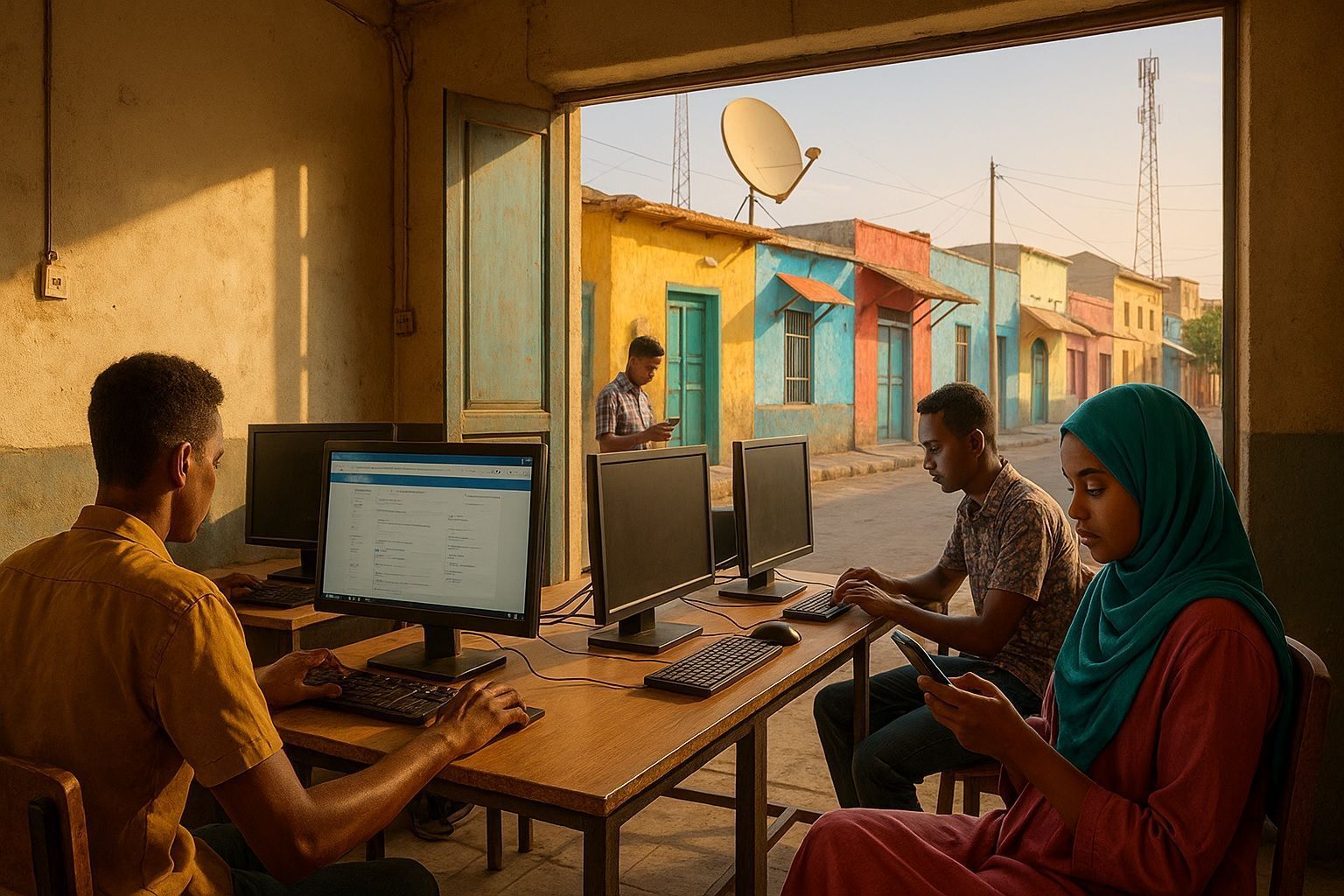
As of early 2024, about 26% of Eritrea’s 3.7 million people were internet users. Eritrea is the only coastal African nation with zero submarine fiber-optic cable landings. The telecom sector is entirely state-owned and monopolized by Eritrean Telecommunication Services Corporation (EriTel), with no private ISPs or competing mobile operators. Public mobile data is essentially unavailable; the mobile network runs on 2G GSM with 3G/4G largely disabled for ordinary users. Fixed broadband remains extremely limited, with fewer than 150 subscriptions in the mid-2010s. Internet cafés are the primary access point, with fewer than 10 in Asmara and roughly 100 nationwide. EriTel’s
12 June 2025
Flat-Panel Frenzy: Phased-Array Antennas Set to Boom Across Global Industries by 2029

Flat-Panel Frenzy: Phased-Array Antennas Set to Boom Across Global Industries by 2029

The global market for flat-panel and phased-array antennas was valued at about $5.05 billion in 2024 and is on track to surpass $13 billion by the early 2030s, with a roughly 11–12% CAGR. Flat-panel antennas for satellite communications and mobility are expected to grow from about $0.49 billion in 2024 to $1.37 billion by 2029, a 22.7% CAGR. The satellite antenna market growth is driven by LEO, MEO, and GEO constellations, with about 5,500 active satellites in 2022 and up to 58,000 additional satellites could be launched by 2030. Kymeta pioneered metamaterial-based flat-panel antennas and released the Osprey u8 HGL
The Digital Desert: Inside Equatorial Guinea’s Struggle for Internet Access

The Digital Desert: Inside Equatorial Guinea’s Struggle for Internet Access

Equatorial Guinea is described as a digital desert due to the internet’s high cost, slow speeds, and limited availability. Internet access began in 1997 via a France-backed connection, and by 2010 only about 2% of the population were internet users. GETESA, the state-dominated operator, held about 60% ownership with Orange S.A. around 40%, and controlled international gateways via GITGE. HiTs Telecom launched Green Com (Muni) around 2011, and GECOMSA was created in 2012 to expand competition. Equatorial Guinea connected to the ACE submarine cable in 2012, and domestic Ceiba-1 and Ceiba-2 cables linked the mainland Rio Muni with Bioko. Internet
12 June 2025
Ground Control Goes Cloud: The Digital Overhaul of Satellite Operations (2025–2030)

Ground Control Goes Cloud: The Digital Overhaul of Satellite Operations (2025–2030)

From 2025 to 2030, ground control shifts from hardware-centric architectures to cloud-enabled, software-defined infrastructure via Ground-Station-as-a-Service (GSaaS). The global satellite ground station market is projected to grow from about $56 billion in 2022 to $125 billion by 2030. AWS Ground Station and Microsoft Azure Orbital provide pay-per-use, cloud-connected antennas that deliver downlinks directly into cloud storage and analytics pipelines. Digital Intermediate Frequency (DIF) technology enables digitizing RF signals at the antenna and transporting RF over IP to cloud data centers. Digital twins are expanding into operations by 2025, with AWS Ground Station offering a digital twin environment and NASA JPL
The Digital Divide and Skyborne Signals: Internet Access in El Salvador

The Digital Divide and Skyborne Signals: Internet Access in El Salvador

As of early 2025, about 4.88 million Salvadorans are online, representing 76.9% of the population. The telecom sector privatized in 1997, leading to competition among Claro (~40%), Tigo (~25%), Digicel (~11%), Movistar (~6%), and Others (~5%) for fixed broadband. Mobile networks cover about 93% of the territory, and 92% of Salvadorans have at least 3G coverage. Mobile phone subscriptions reached 11.5 million in 2022, exceeding the 6.5 million population for roughly 160% penetration due to multiple SIMs. Fixed telephone lines and legacy DSL have stagnated at under 0.9 million, as mobile becomes the preferred access. Median fixed broadband download speeds
11 June 2025
Satellite Bus Showdown: Legacy Titans vs. NewSpace Mavericks (2024–2033)

Satellite Bus Showdown: Legacy Titans vs. NewSpace Mavericks (2024–2033)

The global satellite bus market is projected to rise from $14.1 billion in 2023 to $23.4 billion by 2033, a CAGR of about 5.4%. Lockheed Martin is developing the LM-2100 modular bus with upgradeable components, while Northrop Grumman, Boeing, Airbus, and Thales Alenia Space remain leaders in GEO and military programs. SpaceX has mass-produced Starlink satellites in-house, with over 6,500 launched to date and satellites comprising roughly 50% of active satellites, plus a Starshield military variant. Airbus and OneWeb formed a joint venture that manufactured hundreds of satellites on an assembly-line in Florida for mass production. Britain’s BAE Systems agreed
Inside Ecuador’s Digital Frontier: Internet Access, Inequality, and Satellite Solutions

Inside Ecuador’s Digital Frontier: Internet Access, Inequality, and Satellite Solutions

Fixed broadband penetration is around 15% of the population as of December 2022, equating to roughly 2.75–2.9 million fixed broadband accounts in a country of 18 million people. About 20,242 km of fiber-optic cable were laid in 2022 alone, representing nearly 10% of Ecuador’s total fiber infrastructure. The Mistral undersea cable was activated to increase international bandwidth, in partnership with América Móvil (Claro) and Telxius, with planned Galápagos subsea cable and Carnival Submarine Network to link Ecuador to the United States. By January 2023, Ecuador had 16.7 million active mobile connections (roughly 92% of the population) and about 10.8 million
High Seas Broadband Boom: Maritime VSAT & L-Band Services Market Set to Soar by 2032

High Seas Broadband Boom: Maritime VSAT & L-Band Services Market Set to Soar by 2032

The global maritime VSAT and L-band services market is forecast to reach about $12.4 billion by 2032, with a roughly 8.5% CAGR from 2024 to 2032. In 2024, VSAT-based connectivity accounted for about 77% of maritime satcom revenue, while L-band MSS accounted for about 23%. The maritime VSAT market is projected to grow from about $3.46 billion in 2024 to $9.30 billion by 2032, a 14.6% CAGR for 2025–2032. Post-pandemic, total maritime satcom revenues fell by over 11% in 2020, then surged 42% in 2021 as demand rebounded and VSAT-equipped vessels rose from 28,350 in 2020 to 39,700 in 2021.
11 June 2025
Timor-Leste’s Internet Evolution: Bridging the Digital Divide in 2025

Timor-Leste’s Internet Evolution: Bridging the Digital Divide in 2025

In June 2024, Timor-Leste landed the TLSSC submarine cable, about 607 km to Australia with 27 Tbps capacity, built by Alcatel Submarine Networks, connecting Dili to Australia’s NWCS via Darwin and Port Hedland. Starlink launched in Timor-Leste in December 2024, becoming the 116th country with Starlink coverage and achieving nationwide signal by December 13, 2024. As of Jan 2025, internet users numbered 486,000 (34.5% of the population), down from 742,000 (54.2%) in Jan 2024 due to updated methodologies. Timor-Leste’s population is about 1.41 million (roughly 33% urban) with a median age around 21–22 years and about 74% under 35. The
11 June 2025
In-Flight Wi-Fi Takes Off: The Sky-High Race for Satellite Connectivity 2024–2030

In-Flight Wi-Fi Takes Off: The Sky-High Race for Satellite Connectivity 2024–2030

Euroconsult projects the number of IFC-equipped aircraft worldwide will grow from about 9,900 in 2021 to over 21,000 by 2030. SpaceX Starlink, an LEO system with more than 4,000 satellites by 2024, has contracts to equip over 2,000 aircraft by early 2025 and can deliver up to 350 Mbps per aircraft with installation times of 8–10 hours. OneWeb completed a 618-satellite constellation in 2023, merged with Eutelsat to form a multi-orbit offering, and began aviation service in 2023–2024 with Panasonic Discover Airlines projects by 2025. Viasat and Inmarsat provide a global Ka-band GEO network after merger, with ViaSat-3 entering service
Dominican Republic’s Digital Revolution: Fiber, 5G and Starlink Are Connecting Every Corner of Paradise

Dominican Republic’s Digital Revolution: Fiber, 5G and Starlink Are Connecting Every Corner of Paradise

Historical Development Current State of Internet Infrastructure Dominican Republic internet penetration is high (~89% in 2024 Datareportal), driven mostly by mobile broadband. As of mid-2023 there were 8.94 million mobile‑broadband subscriptions (about 73% of the population) versus only ~1.09 million fixed‑broadband lines (≈9%) Trade. Fixed broadband is available via fiber, cable and DSL in urban/suburban areas, while 4G/LTE mobile covers ~98% of the population Worlddata (4G “or better” at 97.6%) and 5G networks now cover roughly 54.9% of the country Worlddata. Urban vs. Rural Access There is a stark digital divide between cities and the countryside. In 2022, about 50.8% of urban
10 June 2025
Sky’s the Limit: Earth-Observation Data & Analytics Market Set to Soar by 2031

Sky’s the Limit: Earth-Observation Data & Analytics Market Set to Soar by 2031

Market Overview and Definition Satellite Earth observation covers remote sensing data from space (and high-altitude) sensors plus the analytics that turn imagery into actionable insights. The sector is rapidly evolving: by 2023 there were over 6,500 satellites in orbit, enabling unprecedented global coverage mordorintelligence.com. Today’s EO data includes optical images, radar (SAR) returns, hyperspectral scans, LiDAR, etc., which are processed into maps, change-detection alerts, and predictive models. Key application segments span agriculture, energy, infrastructure monitoring, disaster response, and more mordorintelligence.com. For example, one analysis notes that agriculture (crop monitoring), energy (resource site selection), infrastructure, and disaster management are core EO
Dominica: Internet Infrastructure and Access Technologies

Dominica: Internet Infrastructure and Access Technologies

Dominica is a landing point on the 3,000-km Southern Caribbean Fiber (SCF) ring linking 15 Eastern Caribbean islands. On-island, Flow (formerly Cable & Wireless) provides fixed DSL and coaxial/cable service, while Digicel Play offers cable/FTTP over an upgraded HFC network. In 2018 Digicel won a 15-year contract to overhaul Dominica’s telecommunications, rebuilding towers and fiber to government offices and health centers. In 2019 the Southern Caribbean Fiber cable landed at Dominica’s Canefield, boosting international capacity. Starlink LEO service began serving Dominica in June 2025, offering high-speed, low-latency internet across the island. As of January 2024, about 61,020 Dominicans were online,
10 June 2025
Rural Broadband Revolution: Satellite Internet’s Sky-High Growth (2024–2030)

Rural Broadband Revolution: Satellite Internet’s Sky-High Growth (2024–2030)

The global satellite broadband market was roughly $5–9 billion in 2023 and is forecast to reach about $24–23 billion by 2030, with an annual CAGR of 14–30%. North America led in 2023 with about 32% of revenues, while Asia-Pacific (~15%), Europe (~14%), Latin America (~12.5%), and Middle East & Africa (~12%) are forecast to grow fastest. By 2030, North America, Europe and Asia-Pacific are each projected to be in the $6–7+ billion range, with Latin America and MEA contributing several hundred million USD. In 2023 the regional revenues were North America $2,966.1 M, Europe $2,435.0 M, Asia–Pacific $2,264.6 M, Latin
Inside Djibouti’s Digital Frontier: The Rise of Internet Access and Satellite Connectivity

Inside Djibouti’s Digital Frontier: The Rise of Internet Access and Satellite Connectivity

Djibouti hosts about 10–12 international undersea cables on the Red Sea coast, including SMW3, EIG, SEA-ME-WE-5/6, AAE-1, EASSy, WIOCC, Yemeni, and DARE1, linking to Europe, Asia and East/Southern Africa. Djibouti Telecom invested over $200 million in the last decade in landing stations and a protected submarine corridor, reinforcing Djibouti as a regional internet gateway. Terrestrial fiber links connect Djibouti to Ethiopia and Somalia, and AfriFiber serves thousands of homes in Djibouti City. The Djibouti Data Center (DDC) is the first and only carrier-neutral data center in East Africa, co-locating major cable landing points with Tier-3 colocation, peering, and the DjIX
1 134 135 136 137 138 140

Stock Market Today

Go toTop